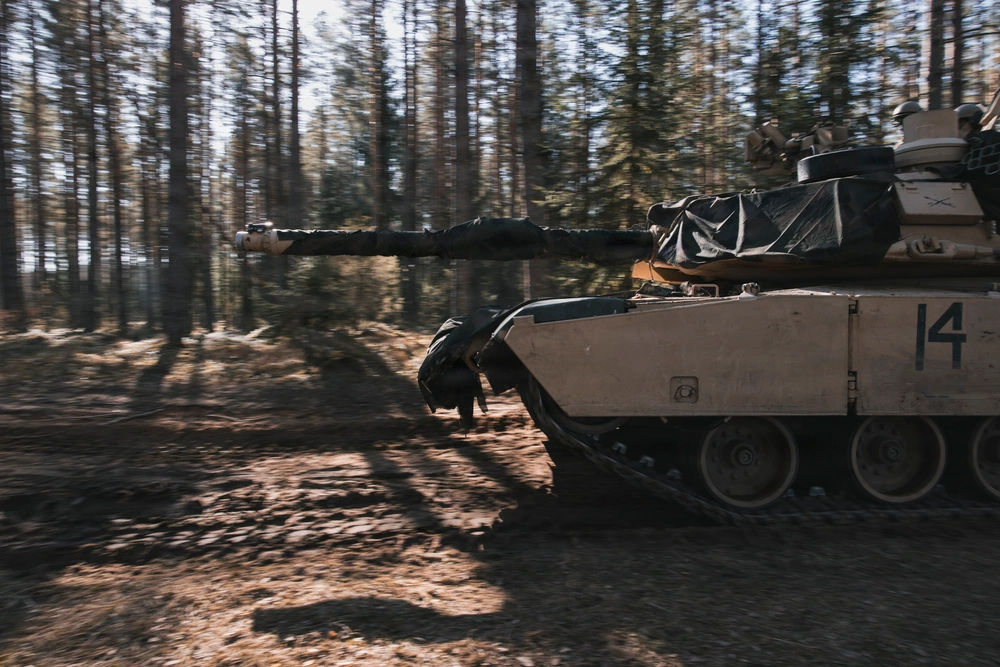
The United States will deploy a new rotational Army unit to Estonia in November, closing a months-long gap in the American ground presence on NATO’s northeastern flank. U.S. Ambassador to Estonia Roman Pipko confirmed the deployment on September 29, 2026, describing it as part of “the U.S. commitment to collective defense.” Estonia’s Ministry of Defence said the incoming unit will be equivalent in size and capability to the 6th Squadron, 9th Cavalry Regiment (6-9 CAV), the armored formation that rotated out in the spring.
The announcement ends uncertainty that began when the Pentagon paused new unit rotations into Europe this spring pending a continental force posture review. The Estonian ministry first disclosed the November arrival on September 23, one week after retired Gen. Martin Herem, commander of the Estonian Defence Forces (EDF) from 2018 to 2024, took office as defense minister. U.S. officials told Tallinn the decision is separate from the ongoing posture review. Pipko said the new rotation would help the two countries “enhance our joint readiness to deter and defend against any threats.”
How the Force Posture Review Thinned US Troops in Estonia
6-9 CAV, a 1st Cavalry Division squadron normally based in Texas, completed its Estonian rotation in the second quarter of 2026. Its replacement was scheduled to follow, but the rotation was suspended once the force structure review began, leaving only a reduced contingent, largely support personnel, at Camp Reedo in Võru County, southern Estonia. The bilateral defense cooperation arrangement envisages a U.S. contingent of 500 to 700 troops in the country, a level the residual footprint fell well below.
Herem’s predecessor, Hanno Pevkur, acknowledged in July that Tallinn did not know how many troops or which units would arrive. Pevkur resigned on September 2 over a €70 million artillery shell procurement for Ukraine that drew criticism from Estonia’s National Audit Office.
Estonia was not the only Baltic host affected. Lithuania, which hosts roughly 1,000 U.S. troops, faced its first rotation gap since 2020 when an armored battalion with Abrams tanks and Bradleys began departing in June. Lithuanian President Gitanas Nausėda announced on September 22 that a new U.S. rotation was also inbound. In May, the Pentagon reduced the number of U.S. brigade combat teams in Europe from four to three, returning to the pre-2022 baseline.
Congress has limited how far any drawdown can go. The Fiscal Year 2026 National Defense Authorization Act (NDAA) bars the Pentagon from using funds to reduce U.S. forces in Europe below 76,000 personnel, or to remove major equipment, without consulting allies and certifying the impact to lawmakers. The floor governs the theater total, not the distribution of forces among host nations, which leaves individual rotations exposed to the review’s outcome.
Matching 6-9 CAV: What the Incoming Unit Brings to Camp Reedo
6-9 CAV deployed as an armored formation equipped with M1A2 Abrams main battle tanks and M2-series Bradley fighting vehicles. Its Dakota Troop brought 14 Abrams to Tapa Army Base in the fall of 2025, replacing a High Mobility Artillery Rocket System (HIMARS) training unit that shifted to Lithuania and marking the first U.S. Abrams presence in Estonia in about a decade. The troop completed tank qualification at Tapa in December 2025, and the squadron ran a combined arms live-fire exercise there on February 18, 2026.
Publicly available specifications indicate the M1A2 mounts a 120mm M256 smoothbore gun and runs on a 1,500-horsepower AGT1500 gas turbine, while the Bradley pairs a 25mm M242 Bushmaster chain gun with TOW antitank missiles. That combination gives a U.S. squadron a mobile counterattack capability the EDF does not field in equivalent form: Estonia operates CV90 infantry fighting vehicles but no main battle tanks.
The squadron was based at Camp Reedo and trained alongside the EDF 2nd Infantry Brigade, which covers southern Estonia, while the UK-led NATO multinational battlegroup holds Tapa in the north. U.S. battalion-sized units have rotated through southern Estonia since Russia’s full-scale invasion of Ukraine in 2022, initially as Task Force Voit; 6-9 CAV was the sixth such unit.
Key details remain unconfirmed. Neither Washington nor Tallinn has named the incoming unit, its parent division, its exact troop strength or its equipment set. The ministry’s description of an equivalent force points to a squadron- or battalion-sized formation with comparable armored firepower, but that remains an inference until the unit is identified.
Analysis: Carving the Estonia rotation out of the posture review signals that Washington still treats a credible U.S. ground presence in the Baltic states as separate from its broader push to shift the defense burden onto European allies. The timing reinforces that reading. Pipko’s statement came the same day Tallinn attributed the August 15 arson at a Milrem Robotics site, which builds THeMIS unmanned ground vehicles for Ukraine, to Russian special services. Yet the spring pause exposed a structural weakness: rotational forces deter through continuity, and that continuity now depends on Pentagon review cycles rather than standing commitments. A returning squadron restores capability, not predictability.
The incoming unit’s identity and arrival date will show whether it matches 6-9 CAV’s armored profile. The Pentagon’s Europe posture review is due to present option sets to Defense Secretary Pete Hegseth by November 6 and conclude in December, according to reported terms of reference. Its findings will determine whether November’s rotation restores a durable baseline in Estonia or marks a single extension inside a shrinking European footprint.