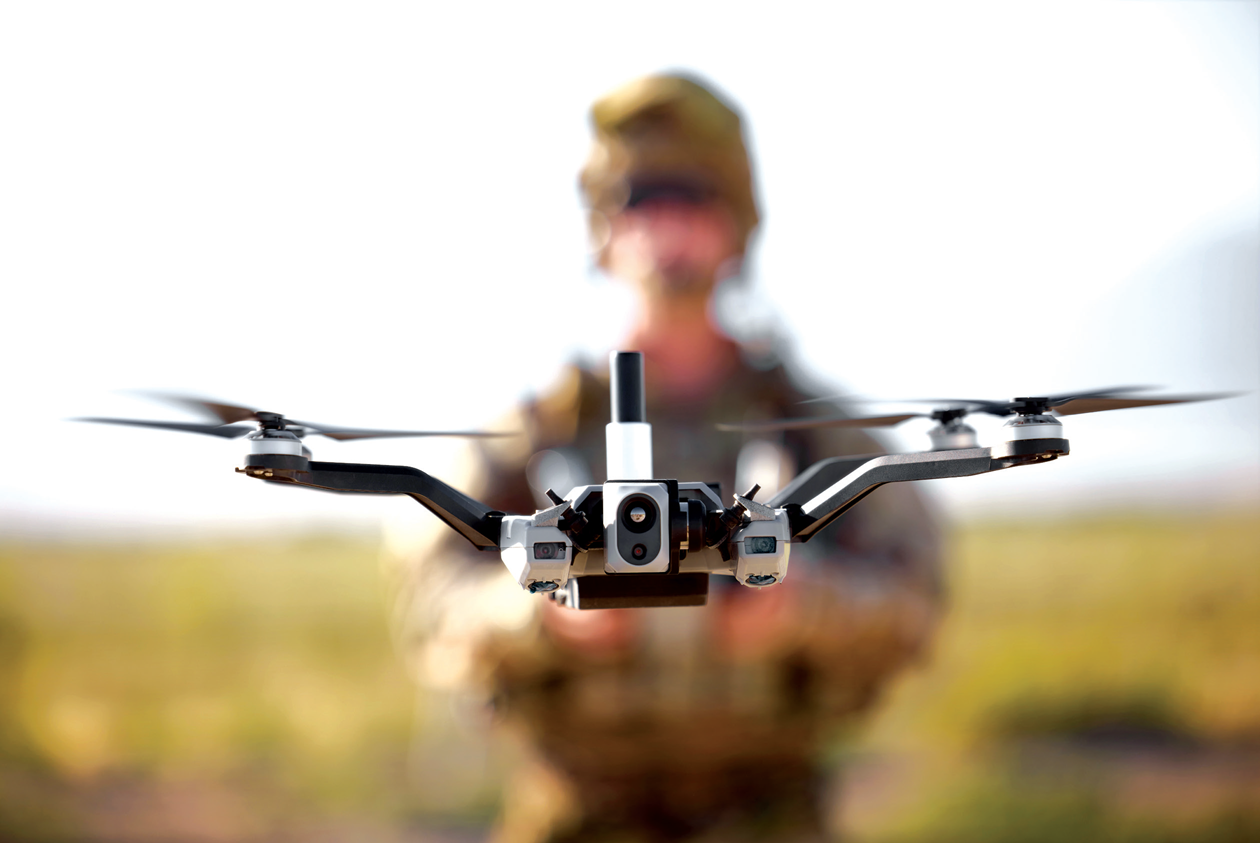
The Washington Army National Guard’s 3rd Battalion, 161st Infantry Regiment wired small unmanned aircraft systems (sUAS) into its mortar fire chain during a drill at Yakima Training Center, Washington, from September 17 to 19, 2026. Using Black Widow and Bumblebee drones, soldiers located targets, obtained grid coordinates, observed mortar rounds and supported battle damage assessment (BDA), while the battalion’s mortar platoon certified on both 81mm and 120mm systems, according to the Army.
The event doubled as a Mortar Training and Evaluation Program (MORTEP) and paired the infantry battalion with forward observers from the 2nd Battalion, 146th Field Artillery Regiment and soldiers from the 1st Squadron, 303rd Cavalry Regiment. The “Dark Rifles” battalion, part of the 81st Mobile Brigade Combat Team, is preparing for a National Training Center (NTC) rotation planned for summer 2027, and it put 22 soldiers through new equipment training on the Bumblebee during June 2026 annual training at Joint Base Lewis-McChord.
How Mortar Drone Integration Worked During the Yakima MORTEP
The Army described the drill’s central objective as connecting unmanned aircraft to the process of identifying targets and directing indirect fire. The four tasks crews rehearsed map onto the full call-for-fire cycle: the drone finds and locates the target before the first round, observes impacts during adjustment, and confirms effects after the mission ends.
Lt. Col. Josh Brown, the battalion commander, summarized the outcome in a statement: “Our training objective was to successfully incorporate UAS systems into the indirect fire sensor-to-shooter chain. We exceeded expectations.” Brown also credited the 2-146th Field Artillery fire support team as critical to linking the drones to the battalion’s indirect fire capability. That detail matters doctrinally. In Army practice, forward observers and fire support teams own target location and the call for fire; the drone feeds them rather than replacing them, which keeps target validation and clearance of fires inside a trained chain.
Capt. Mike Sebastionelli, commander of Delta Company, said the event showed that drones can improve target acquisition, round observation and BDA under field conditions, and that it answered questions about synchronizing the aircraft with mortar operations.
The BDA task closes a loop mortar sections have long struggled to close. A ground observer often judges effects across masked terrain. A drone over the impact area can confirm whether a target was destroyed, suppressed or simply displaced, and that answer decides whether the section fires again, shifts or ends the mission. Fewer wasted rounds also mean less time on the firing point and less exposure to enemy counter-battery radar. The Army has not released adjustment times, rounds expended per target or first-round accuracy data from the drill, so the size of any gain remains unquantified.
Black Widow and Bumblebee: Sensors, Range, and the Mortar Envelope
The two aircraft come from different lineages. Black Widow, built by Red Cat Holdings subsidiary Teal Drones, is the Army’s Short Range Reconnaissance (SRR) Tranche 2 platoon-level quadcopter, selected in November 2024 for a program of record that Red Cat has said could cover nearly 6,000 systems. Publicly available specifications put it at about 1.6 kilograms (3.6 pounds), with endurance of 35 minutes or more, a datalink range of roughly 8 kilometers and a FLIR Hadron 640R+ electro-optical and thermal payload. A Doodle Labs Helix mesh radio provides jam-resistant links, and the system feeds the Android Tactical Assault Kit (ATAK), the common map and targeting display used across the force.
That 8-kilometer figure matters because it overlaps the mortar envelope. Publicly available data put the M252-series 81mm mortar’s maximum range at roughly 5.6 to 5.9 kilometers depending on ammunition, and the M120-series 120mm mortar’s at 7.2 kilometers. One platoon-level aircraft launched near the firing point can, in principle, observe targets across the full reach of both weapons, terrain and electronic warfare conditions permitting.
Bumblebee is a less conventional spotter. Perennial Autonomy of Menlo Park, California, builds the Bumblebee V2 as a first-person-view (FPV) kinetic interceptor that destroys hostile small drones by collision, using AI-based automated target recognition, under a $5.2 million agreement awarded by Joint Interagency Task Force 401 (JIATF-401) on January 30, 2026. The Army release does not specify which Bumblebee variant the battalion flew, and endurance and sensor figures for the aircraft have not been published. Its use at Yakima, following June training in day and thermal reconnaissance, points to one airframe covering both counter-drone and observation roles inside a single battalion.
Analysis: Yakima matters less for the hardware than for where it is being trained. Drone spotting for mortars is proven practice in Ukraine; the Washington drill shows it reaching a reserve-component battalion’s certification events with a field artillery fire support team in the loop. A drone generating coordinates outside the fires architecture yields fast but unvalidated targeting, while a drone tied to trained observers turns the mortar platoon into an observed, precision-adjusted fires asset under the battalion commander’s direct control. The unresolved variable is survivability: every drone link is an emitter, and against a peer adversary battlefield transparency cuts both ways.
Brown said October and November drills will move platoons and companies into the field to practice operating together while integrating fire support officers, logistics resupply and casualty evacuation. Open questions remain: measured engagement timelines from Yakima, whether drones will fly under live electronic attack at NTC, and how quickly SRR deliveries reach other Guard mortar formations.