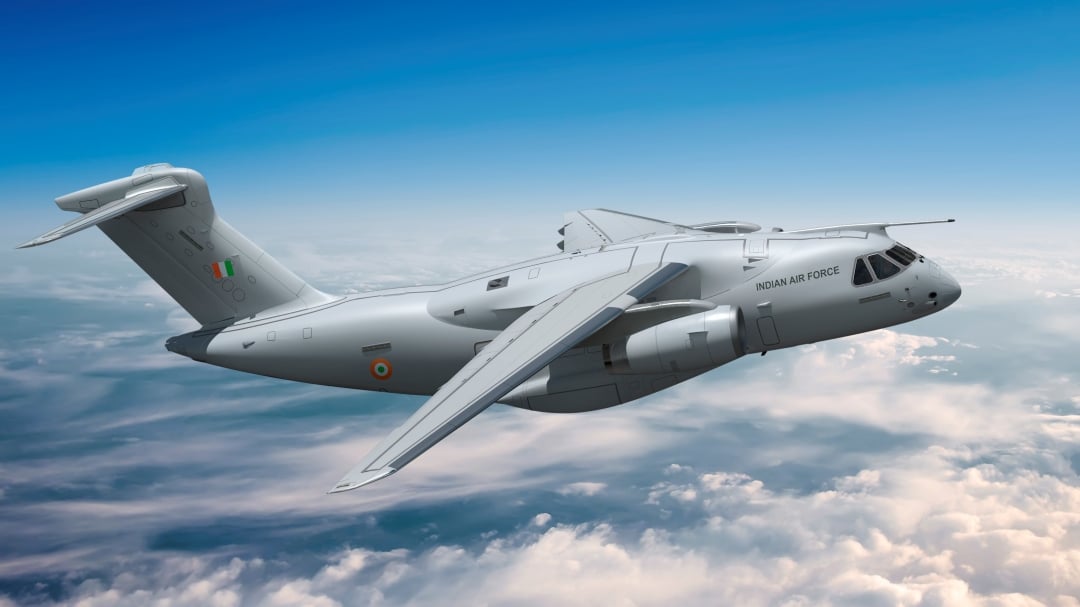
Embraer and India’s Mahindra Group have identified Nagpur, in Maharashtra state, as the site of a potential final assembly line (FAL) for the C-390 Millennium military transport, the companies announced in Mumbai on October 1, 2026. The plant would proceed only if New Delhi selects the Brazilian airlifter for the Indian Air Force (IAF) Medium Transport Aircraft (MTA) program and places an order.
The announcement follows the request for proposals (RFP) issued by India’s Ministry of Defence on August 12, 2026, for 60 aircraft in the 18 to 30 tonne payload class, a contest reported to be worth about INR 1 trillion, or roughly $10.5 billion. Under the reported terms, 12 aircraft would arrive in flyaway condition and 48 would be built in India, with indigenous content starting at 40% and rising in phases toward 60%. The fleet is meant primarily to replace the IAF’s Antonov An-32 tactical transports, in service since 1984.
How the Nagpur C-390 Assembly Line Would Take Shape
The companies are working with the Government of Maharashtra on the site, and Mahindra Group Executive Board member Vinod Sahay thanked the state for “expeditiously allotting the land in Nagpur.” Neither company has disclosed the plot size, investment value, planned production rate or the number of jobs the facility would create.
As described by the partners, the plant would cover aircraft assembly, systems integration, manufacturing engineering and local supply chain development, pairing Embraer’s aerospace engineering and airframe production expertise with Mahindra’s manufacturing base and Indian supplier network. If the program is awarded, Indian firms would be progressively integrated into C-390 manufacturing, aftermarket services, training and lifecycle support under the Make in India and Atmanirbhar Bharat self-reliance policies. Bosco da Costa Junior, President and CEO of Embraer Defense & Security, framed the site choice as a step toward a long-term Indian aerospace ecosystem, contingent on selection.
Nagpur caps a partnership built in stages: a memorandum of understanding (MoU) signed on February 9, 2024, a Strategic Cooperation Agreement in October 2025 covering industrialization, assembly and maintenance, repair and overhaul (MRO), and a February 2026 plan for a C-390 MRO capability in India. The RFP reportedly requires the winning team to establish both an FAL and an MRO base in country.
The city already hosts the headquarters of the IAF’s Maintenance Command and the Dassault Reliance Aerospace plant producing Falcon business jet components. Mahindra brings aerostructures and land systems manufacturing experience but has never assembled a military transport, a gap evaluators are likely to probe.
C-390 vs C-130J: Payload, Speed and High-Altitude Demands
The C-390 is powered by two IAE V2500-E5 turbofans rated at 31,330 lb of takeoff thrust each. Embraer specifications list a 26-tonne maximum payload, a maximum cruise speed of 470 knots true airspeed (KTAS), or Mach 0.80, and a 36,000 ft ceiling. Range is 1,080 nautical miles (nm) with 26 tonnes and 1,470 nm with 23 tonnes, or 4,570 nm in ferry configuration with internal tanks. The aircraft integrates Collins Aerospace Pro Line Fusion avionics with fly-by-wire controls and is designed for semi-prepared and unpaved strips, landing in about 1,000 m at full payload under sea-level standard conditions. The KC-390 configuration adds underwing hose-and-drogue refueling pods.
The rival C-130J-30 Super Hercules, offered by Lockheed Martin and Tata Advanced Systems Limited (TASL), uses four Rolls-Royce AE 2100D3 turboprops. US Air Force data give it a maximum allowable payload of 44,000 lb, roughly 20 tonnes, and a cruise speed of 356 KTAS at 22,000 ft, placing it at the lower edge of India’s requirement.
That margin carries operational weight. India’s Zorawar light tank, developed for high-altitude warfare along the Line of Actual Control, weighs about 25 tonnes according to publicly reported figures: within the C-390’s envelope, beyond the C-130J-30’s. The jet’s speed advantage of roughly 30% also shortens transits from rear depots to forward bases in Ladakh and the Northeast.
Altitude is the counterweight. The IAF landed a C-130J at Daulat Beg Oldi, an airstrip at roughly 16,600 ft, in August 2013. Publicly available Embraer specifications do not address C-390 performance at that elevation, making Himalayan field trials a likely decisive test.
Analysis: The MTA will likely be decided as much on industrial architecture as on aircraft performance. The C-390 fits the payload specification better, but Tata and Lockheed Martin bring an installed base that Mahindra and Embraer must build from scratch: 12 C-130J-30s in IAF service for some 15 years, a Hyderabad joint venture that has delivered more than 200 C-130J empennages, and TASL’s Airbus C295 final assembly line in Vadodara, inaugurated in October 2024. Securing land before bids are submitted is Mahindra’s attempt to close that credibility gap. For Embraer, which has sold the C-390 to roughly a dozen air forces, 60 Indian aircraft would dwarf the Brazilian Air Force’s reduced order of 19.
The RFP’s bid submission deadline has not been made public. Technical evaluation, field trials, commercial negotiations and Cabinet Committee on Security approval remain ahead, and it is unclear whether the Airbus A400M or a Hindustan Aeronautics Limited (HAL) offer with a Russian partner will enter. Until a contract is signed, Nagpur is a site plan, not a production line.