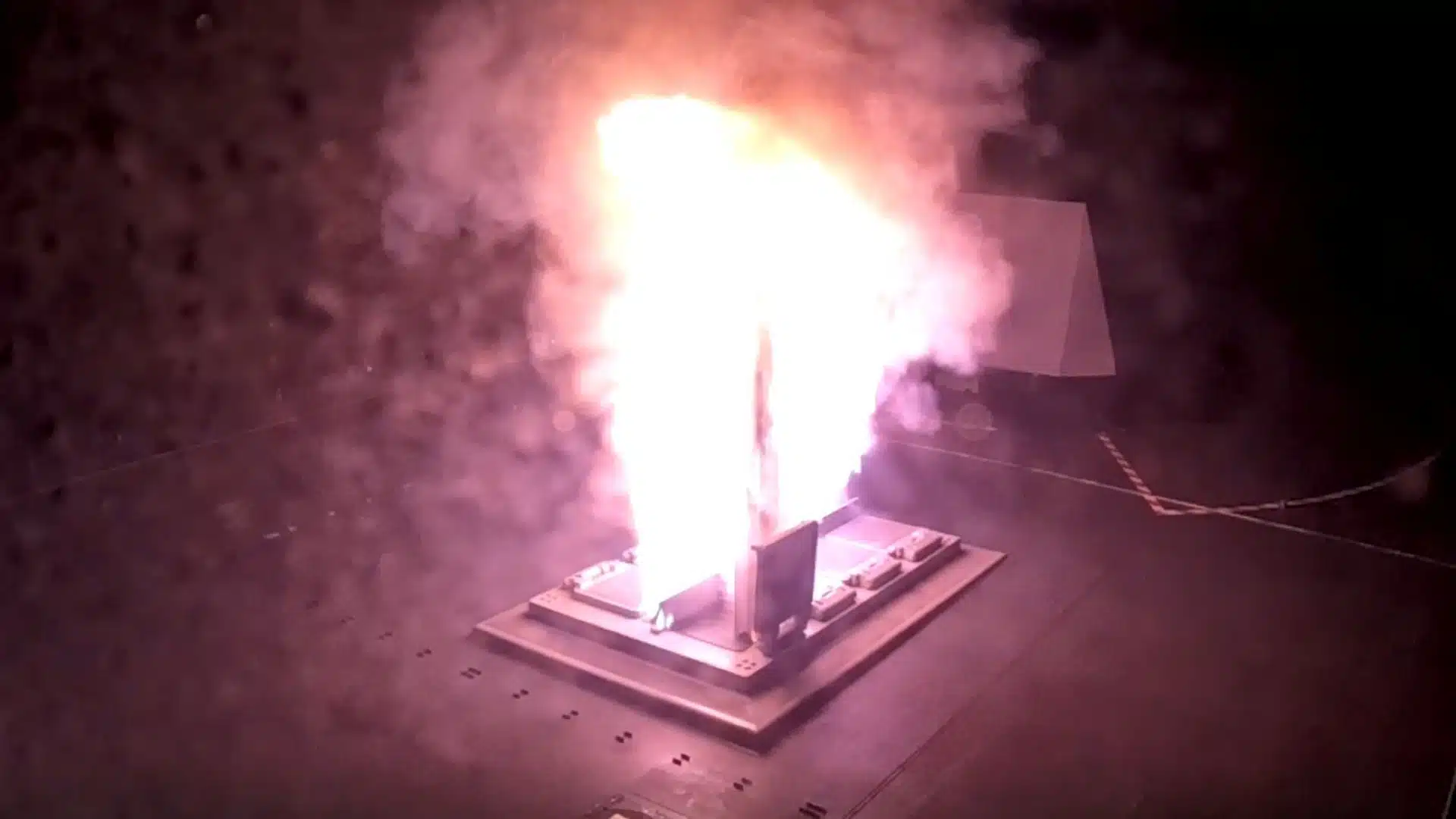
The Royal Norwegian Navy has fired the Evolved SeaSparrow Missile (ESSM) Block 2 from a Fridtjof Nansen-class frigate for the first time, with HNoMS Otto Sverdrup (F312) engaging target drones off Andøya in northern Norway in late September 2026. The Norwegian Defence Materiel Agency (FMA) said the campaign validated new Aegis combat system software and the missile’s active guidance functions, clearing the way for fleet integration.
The firing closes a long-running integration effort on the navy’s principal air-defense combatants. The four remaining Fridtjof Nansen-class frigates, commissioned between 2006 and 2011, carry the Aegis combat system and have relied on the semi-active ESSM Block 1 since entering service. A 2022 follow-up report by the Office of the Auditor General of Norway described the Block 2 upgrade as running through 2024; validation arrives roughly two years after that window, as Oslo prepares to replace the class with at least five Type 26 frigates selected on August 31, 2025.
ESSM Block 2 Test Campaign Validates New Aegis Software
The trials ran under Project P6192, managed by the FMA’s Maritime Capabilities division, on the range operated by Andøya Space Defence (ASD), roughly 300 kilometers north of the Arctic Circle. The campaign combined simulated launches with live firings against aerial target drones. According to the FMA, the primary objective was to test new Aegis software and confirm that ship-to-missile communication and the missile’s active guidance performed to requirement. The agency has not disclosed the number of rounds fired, the target types or the intercept geometries.
Project manager Commander Tor Harald Monsen directed the firings from Range Control at ASD and credited both the ship’s crew and the multinational test team. Support came from the US Navy, Aegis prime contractor Lockheed Martin, ASD, Norway’s National Maritime Operations Centre (NSS N6) and the Royal Norwegian Navy Logistics Command (SFK). Data from the missile and the combat system has been sent to the United States for detailed analysis, and the FMA describes preliminary results as consistent with the expected performance gain.
The software is the core of the story. US operational test reporting has documented that legacy Aegis baselines can fire ESSM Block 2 but initialize it as a Block 1 round and cannot exercise its full capability until the weapon system itself is upgraded. Norway’s focus on new Aegis software indicates the campaign was built to unlock those modes on the frigates’ AN/SPY-1F configuration, not simply to load a newer missile into existing cells.
How the Active Seeker Eases the Nansen Class Illuminator Bottleneck
Developed under the 12-nation NATO SEASPARROW consortium, of which Norway is a member, and produced by RTX’s Raytheon, ESSM Block 2 retains the Block 1 rocket motor and 10-inch (25.4-centimeter) diameter but adds a dual-mode X-band seeker operating in active or semi-active mode. Publicly available specifications indicate a length of 3.66 meters, a weight of about 280 kilograms, speed above Mach 4 and range beyond 50 kilometers, with a new blast-fragmentation warhead and improved maneuverability. Unchanged external dimensions mean four rounds still quad-pack into one Mark 41 Vertical Launching System (VLS) cell.
That matters on a hull with limited magazine depth. Publicly available specifications indicate each frigate carries an eight-cell Mk 41 module holding 32 ESSM, alongside the AN/SPY-1F multifunction radar and two Mk 82 fire-control directors. With Block 1, each missile needs illumination from one of those two directors in the terminal phase, capping simultaneous terminal engagements regardless of how many rounds remain. Midcourse updates from the SPY-1F still arrive by datalink, as with Block 1; the change sits in the terminal phase. Block 2’s active mode lets the missile home autonomously at end-game, freeing the illuminators for additional intercepts against a saturation raid. The semi-active mode remains available for stressing targets, including high-altitude threats.
Air Defense Bridge From Fridtjof Nansen Class to Type 26
The upgrade also aligns Norway with allied inventory planning. In April 2026, the US Navy awarded Raytheon a contract modification worth approximately $833 million for ESSM Block 2 assemblies covering all 12 consortium nations, including Norway, with work running to September 2030. The manufacturer has said it aims to raise annual Block 2 output to about 400 rounds in 2026. Denmark committed about 880 million Danish kroner in May 2025 to buy and accelerate Block 2 deliveries for its Iver Huitfeldt-class frigates.
For Norway, the payoff is time-bound. The Navantia-built hulls, derived from Spain’s Álvaro de Bazán design, will be approaching 25 years in service when the first replacement arrives. The class will carry the fleet’s medium-range air defense in the Norwegian Sea and the High North until Type 26 hulls arrive, with first delivery targeted around 2030. Oslo has not publicly detailed the Type 26 air-defense fit, including how its ESSM inventory will sit alongside the Common Anti-air Modular Missile (CAMM) carried by Royal Navy Type 26 ships.
Analysis: The significance of the Andøya firing lies less in the missile than in the combat system software that now lets the Nansen class use it fully. On a frigate with two illuminators and 32 ready rounds, the binding constraint against a multi-axis raid has been terminal guidance channels, not missile count. Active homing converts the existing magazine into more simultaneous engagements, a real capacity gain for ships that routinely integrate into allied carrier strike groups. Depth remains the limit: 32 ESSM per hull is thin against sustained salvo fire, and Block 2 does not change that arithmetic.
The FMA’s Maritime Capabilities division and the Royal Norwegian Navy will now complete installation, fleet integration and operational certification. The agency has not published a timeline for initial operational capability, the size of Norway’s Block 2 order or the sequence for updating the remaining three frigates, and the US analysis of the Andøya data is still pending.