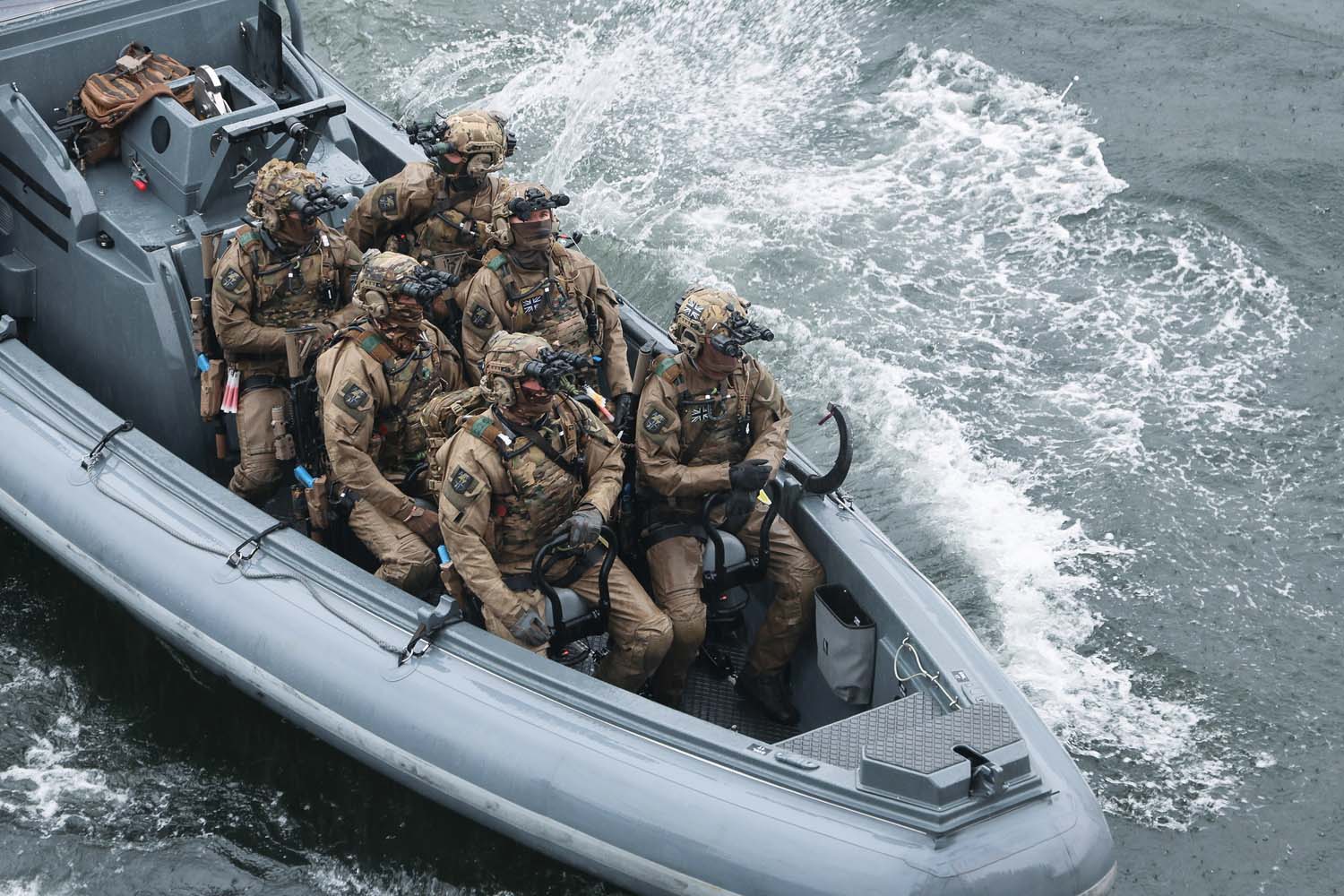
Royal Marines of the UK Commando Force have deployed to the Faroe Islands for the first time since World War II, running boarding, cliff assault and small boat drills alongside Danish forces and Faroese maritime agencies during the Joint Expeditionary Force (JEF) Exercise Lion Protector 26, the Royal Navy announced on October 2, 2026.
The archipelago, a self-governing country within the Kingdom of Denmark, sits at the center of the Greenland-Iceland-United Kingdom (GIUK) Gap, the chokepoint between Northern Fleet bases on the Kola Peninsula and the open Atlantic. NATO launched its Arctic Sentry enhanced vigilance activity on February 11, 2026, under Joint Force Command (JFC) Norfolk. Lion Protector, which runs from August 3 to October 12, 2026, opens a three-year JEF series that continues with Lion Sentinel in 2027 and Lion Shield in 2028.
SOMTG in Action: Inside the Royal Marines Faroe Islands Drills
The UK Commando Force committed its Allied Reaction Force (ARF) Special Operations Maritime Task Group (SOMTG) to the Faroese phase. The roughly 150-strong formation, as publicly reported, combines boarding teams, boat operators, pilots and engineers from across the Royal Navy and Commando Force. NATO validated it during Exercise Hyperion Storm in January 2026, with 42 Commando forming its maritime core, and the UK assumed leadership of the ARF Special Operations Component on July 1, 2026, for a 12-month standby. The Royal Navy calls Lion Protector the task group’s “first major workout.” Its mission: recapture vessels and oil platforms and mount covert coastal raids ahead of allied amphibious landings, at extremely short notice.
The marines worked through maritime interdiction operations (MIO) with Danish and Faroese counterparts, rehearsing vessel approaches, boarding ladder techniques, and the search and seizure of target ships. The teams then shifted to coastal raiding across the 18-island volcanic archipelago, where layered basalt, sheer sea cliffs and glacier-cut terrain leave few viable landing points. They established clifftop observation posts to monitor maritime traffic routes before conducting cliff ascents.
Each serial maps onto a live problem in northern waters. Boarding and seizure skills apply directly to suspected shadow fleet tankers, which European navies have boarded or detained since late 2024. Clifftop observation posts offer persistent, low-signature surveillance of sea lanes where radar and maritime patrol aircraft coverage remains thin.
“The return of the Royal Marines to the Faroe Islands should send an unequivocal message: the UK, alongside Denmark and our other allies in the Joint Expeditionary Force, stand ready to protect the waters, islands and vital routes that keep our nations secure,” said General Sir Gwyn Jenkins, First Sea Lord and Commandant General Royal Marines.
GIUK Gap Surveillance and Denmark’s North Atlantic Defense Buildup
The Faroes’ strategic value is not new to London. After Germany invaded Denmark on April 9, 1940, Britain launched Operation Valentine: destroyers HMS Havant and HMS Hesperus reached Tórshavn on April 12, and the cruiser HMS Suffolk landed Royal Marines the following day, a force the Royal Navy puts at 250. British troops held the islands until 1945, denying Germany a foothold astride the North Atlantic convoy routes.
During the Cold War, the GIUK Gap became NATO’s primary antisubmarine barrier, and a radar station atop Sornfelli mountain, near Tórshavn, watched the airspace between Scotland and Iceland. The site has hosted no military air surveillance radar since the late 2000s, leaving a coverage gap between northern Britain, the Faroes, Iceland and southern Greenland.
Under a June 9, 2022, agreement with the Faroese government, Denmark earmarked roughly DKK 400 million for a new unmanned radar at Sornfelli with a stated range of up to 400 kilometers, and in December 2025 the parties to the Danish defense agreement selected Lockheed Martin to supply it. Two Arctic and North Atlantic agreements followed in 2025. The first, concluded January 27, committed DKK 14.6 billion to three new Arctic naval vessels, long-range drones and satellite capacity. The second added DKK 27.4 billion for two more Arctic vessels, maritime patrol aircraft capacity, a new Joint Arctic Command headquarters and a North Atlantic undersea cable.
That spending buys sensors, hulls and persistence. It does not provide a force able to board a hostile vessel or retake a coastal installation within hours, which is what the British contribution brought to the Faroese phase.
Analysis: London is loading two northern commitments onto a single force. The SOMTG serves simultaneously as NATO’s maritime special operations element on ARF standby and as the sharpest UK instrument inside the JEF, a 10-nation framework that can move on sub-threshold contingencies, such as a seized tanker or sabotaged undersea infrastructure, without requiring consensus among all 32 NATO allies. The constraint is depth. One task group of roughly 150 personnel covers a theater stretching from the Baltic to the Denmark Strait, and with the Albion-class landing platform docks retired, the Commando Force depends on three Bay-class auxiliaries until the planned Multi-Role Support Ships arrive.
Lion Protector concludes on October 12, 2026; its later stages include critical infrastructure protection in Iceland and Exercise Lion Apex, which deploys the JEF Operational Headquarters (OHQ) to the High North. The Atlantic Future Forum and International Sea Power Conference follow aboard HMS Prince of Wales later this autumn. The UK’s ARF special operations lead runs through mid-2027. Neither London nor Copenhagen has said whether Royal Marines will return to the Faroes on a recurring basis, and Denmark has not published an in-service date for the Sornfelli radar.