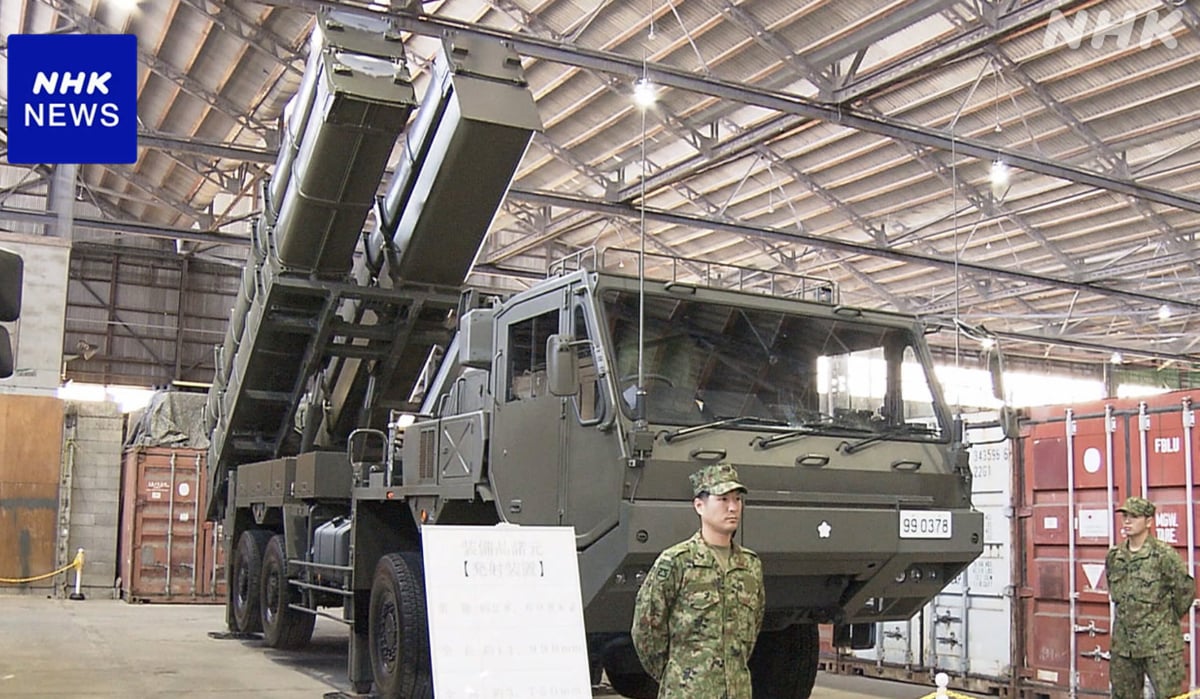
The Japan Ground Self-Defense Force (JGSDF) showed the ground equipment of its Type 25 Surface-to-Ship Guided Missile (25SSM) to the general public for the first time on October 3, 2026, at Camp Kengun in Kumamoto. A company commander from the 5th Surface-to-Ship Missile Regiment walked about 80 residents through four vehicles, including a launcher and an ammunition carrier, during the morning session.
Built by Mitsubishi Heavy Industries (MHI) as the upgraded Type 12 surface-to-ship missile, the Type 25 entered service at Camp Kengun on March 31 as the first domestically produced stand-off missile assigned to a Self-Defense Force unit. Tokyo counts it among the means to exercise the counterstrike capability adopted in its December 2022 National Security Strategy. The display came 16 days before the system’s first deployment in a large-scale exercise, Keen Sword 27.
Type 25 Missile Display Follows Months of Local Friction in Kumamoto
The event was originally set for August 22. The Kyushu Defense Bureau and JGSDF Western Army headquarters postponed it after the July 28 earthquake in Kumamoto Prefecture and reset the date on September 3. Attendance was limited to Kumamoto city residents and prefectural residents who work or study in the city, with advance registration, photo identification checks, and bag inspections.
The controlled format follows months of local friction. Launchers arrived at Camp Kengun before dawn on March 9 without advance explanation to prefectural or city authorities, drawing expressions of regret from Governor Takashi Kimura and Mayor Kazufumi Onishi. A March 17 showing was restricted to the governor, the mayor, assembly members, and local community council heads, after which Kimura pressed for a public session.
Western Army headquarters framed the October 3 event as an equipment display, not a question-and-answer briefing, although attendees did question soldiers on site. Defense Minister Shinjiro Koizumi said in March that the ministry had no plans for the interactive resident briefings civic groups have demanded. Camp Kengun, which also hosts Western Army headquarters, sits in a residential district of eastern Kumamoto, and opponents warn the garrison and its neighborhood could become a target.
Range, Low-Observable Shaping, and Satellite Retargeting: Type 25 Versus Type 12
The Type 25 keeps the Type 12’s truck-mounted, canister-launched concept but little of its missile. Publicly available specifications indicate the Type 12, fielded in the mid-2010s, measures about 5 m, weighs roughly 700 kg, and combines a TJM2 turbojet and solid rocket booster with inertial and GPS midcourse guidance and active radar terminal homing for a range near 200 km. Its launcher carries six canisters.
The Type 25 introduces a larger, low-observable airframe shaped to reduce radar cross-section and complicate interception. Japanese reporting places its range at about 1,000 km, roughly five times that of its predecessor; the ministry has not published an official figure. The missile reportedly incorporates an Up-To-Date Command (UTDC) function that relays updates from ground equipment via satellite, allowing the flight path to be adjusted if a target ship maneuvers. Dimensions, weight, propulsion, and warhead remain undisclosed, as does the number of canisters per launcher.
The range increase changes the system’s role. A Type 12 battery on Kyushu covers adjacent straits; a Type 25 battery at Camp Kengun, roughly 900 km from Shanghai in a straight line, covers most of the East China Sea and reaches parts of the Chinese coast and the Korean Peninsula. At that distance, organic radar cannot cue engagements, so off-board targeting and the satellite link matter as much as the airframe.
Development firings proceeded in stages: three ground-launched and two ship-launched shots at the Niijima test site between October 4 and November 1, 2024, then a second ground-launched campaign in the United States starting in October 2025.
Keen Sword 27 and the Type 25 Deployment Roadmap Through FY2027
The Defense Ministry has said the Type 25 will deploy to the Onohara Training Area, which spans Nagasaki and Saga prefectures, during Keen Sword 27, scheduled for October 19 to 29. The Joint Staff lists about 45,000 Japan Self-Defense Forces (JSDF) personnel, 6,100 vehicles, 40 vessels, and 260 aircraft, with Australian, Canadian, French, German, Dutch, New Zealand, and Philippine forces joining U.S. units. Its 15 major training events include bilateral joint offensive anti-ship operations. The ministry has not announced a live firing.
That deployment sits within a schedule the ministry accelerated in August 2025. Ground-launched systems go to the 5th Surface-to-Ship Missile Regiment in fiscal 2025 and fiscal 2026, then to the Artillery Training Unit at Camp Fuji in Shizuoka Prefecture in fiscal 2027. The ship-launched variant is to begin operating aboard the modified destroyer JS Teruzuki and the air-launched variant on upgraded F-2 fighters at Hyakuri Air Base, both in fiscal 2027 rather than fiscal 2028 or later as first planned. An F-2B test aircraft was photographed carrying what appear to be air-launched Type 25 test articles at Gifu Air Base on July 30.
The second stand-off system activated on March 31, the Type 25 Hyper Velocity Gliding Projectile (HVGP), went to Camp Fuji.
Analysis: The Kengun display shows that Japan’s counterstrike posture faces a domestic test alongside its operational one. Stand-off deterrence depends on launchers an adversary cannot easily locate, and a 1,000 km missile garrisoned in a city district gives residents and planners the same incentive: dispersal. Moving launchers to Onohara during Keen Sword exercises exactly that. The harder variable is the kill chain. Without persistent maritime surveillance, resilient satellite communications for UTDC, and bilateral targeting data, a Type 25 battery cannot use its full reach, which makes the anti-ship training at Keen Sword more consequential than the hardware shown in Kumamoto.
The next milestones are Keen Sword 27, additional Type 25 deliveries to Camp Kengun before fiscal 2026 closes on March 31, 2027, and ship, air, and Camp Fuji fielding in fiscal 2027. Inventory size, launcher loadout, and any full-range live-fire plan remain undisclosed, and the ministry has not committed to the interactive briefings Kumamoto groups continue to request.