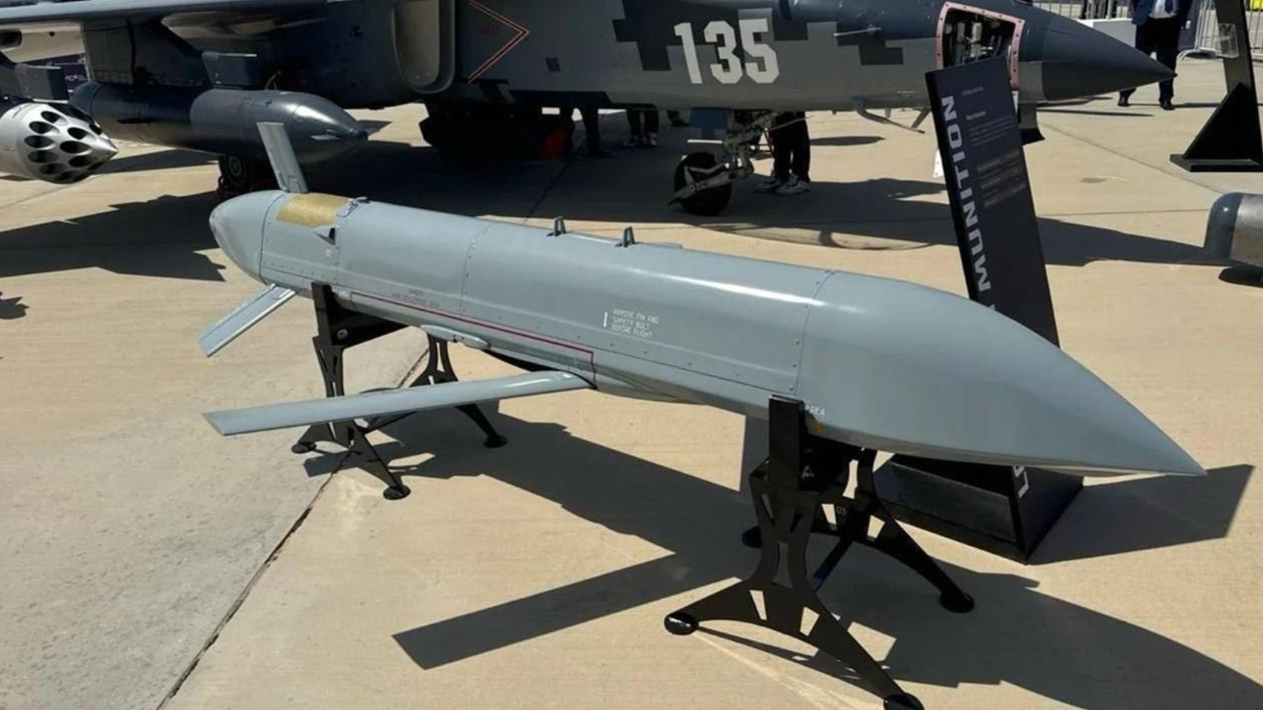
Russia is using the Dan-T, a jet-powered loitering munition with a 130-kilogram warhead and a declared 450-kilometer range, in strikes against Ukraine, weeks after state arms exporter Rosoboronexport unveiled it at the El Alamein International Airshow in Egypt on September 8, 2026. Launched from Su-34, Su-57, and Mi-28 aircraft or from a ground launcher, the weapon is slated for production of up to 2,000 units by the end of 2026, according to Ukrainian sources.
The weapon arrives as Moscow shifts its long-range strike mix from propeller-driven Geran-2 drones toward jet-powered designs. Ukraine’s inexpensive interceptor drones perform well against the Geran-2, which publicly available specifications put at roughly 185 km/h, but struggle against targets flying at 500 km/h or more. Russia responded with the Geran-3, the Geran-5 first used in January 2026, and the S8000 Banderol air-launched cruise missile, in service since mid-2025. According to Ukrainian sources, turbojet-powered drones have made up 50 to 60 percent of the drones in Russian attack packages since late August, with a goal of 80 percent by November.
Dan-T Loitering Munition Specifications: Airframe, Propulsion, and Guidance
Rosoboronexport data list a maximum takeoff weight of 268 kilograms, a 130-kilogram warhead, a maximum speed of 500 km/h, and a range of 450 kilometers. Imagery suggests a length above 3 meters and a wingspan near 2 meters, though neither has been officially released. The layout is a miniature cruise missile: slender cylindrical fuselage, swept wings, and a conventional tail, a clear break from the cropped-delta Geran family.
Propulsion reportedly comes from the MD-120, a Russian turbojet rated at about 120 kgf and built in series since the 1990s for the Dan target family. That identification is unconfirmed: the modernized Dan-M introduced in 2020 adopted the 125 kgf MGTD-125E. Upgraded electronics are being fitted to harden the weapon against Ukrainian electronic warfare.
Guidance pairs an inertial navigation system with global navigation satellite system updates. After release, the munition flies a fire-and-forget, terrain-following profile at low altitude, then pops up near the target and dives vertically onto it. The low cruise compresses detection windows for ground-based radars, while the steep dive suits the target set Ukrainian assessments describe: armored vehicles, fortified field positions, and light infrastructure. Ukrainian reporting indicates work on a Kometa-16 satellite navigation antenna array, a successor to the jam-resistant Kometa modules on Geran drones, and an electro-optical terminal seeker that would enable precision strikes on relocatable targets.
The Dan-T trades range for payload. Ukrainian intelligence estimates the Geran-5 weighs about 850 kilograms, reaches 600 km/h, and flies roughly 950 to 1,000 kilometers, but carries only a 90-kilogram warhead. The Dan-T delivers a heavier charge from an airframe less than a third that weight, while air launch offsets much of its range deficit.
Dan-M Target Roots and the Unresolved S8000 Banderol Connection
The Dan-T reportedly derives from the Dan-M aerial target, a modernized version of the Dan target drone that the Kazan-based Sokol Design Bureau, now the Simonov Design Bureau, developed in the early 1990s to replicate incoming aircraft and cruise missiles for air-defense training. Publicly available specifications for the target version indicate a 350-kilogram takeoff weight, an altitude band of 50 to 9,000 meters, and speeds of 300 to 750 km/h. Conversion removed the recovery parachute and the Luneburg lens, a passive reflector that enlarges radar cross-section, freeing volume for the warhead and guidance package. The target’s published weight nonetheless exceeds the Dan-T’s declared 268-kilogram maximum by roughly 80 kilograms, despite the added warhead, a discrepancy that has not been publicly explained. Russian forces first fired weaponized Dan-M drones from occupied Crimea in May 2025.
Rostec, the state conglomerate whose subsidiary Rosoboronexport runs the export campaign, stated at El Alamein that the weapon has completed hundreds of successful combat launches and can be integrated on foreign aircraft. That pitch has fed a competing hypothesis: that the Dan-T is an export derivative of the S8000 Banderol built by drone maker Kronstadt, which it closely resembles. Ukrainian defense intelligence assessed in May 2025 that the Banderol carries up to 150 kilograms over 500 kilometers at about 500 km/h, launched mainly from Kronstadt’s Orion medium-altitude, long-endurance (MALE) drone and adapted for the Mi-28N.
Russia has not clarified the relationship, but one distinction matters industrially. Ukrainian intelligence identified more than 20 foreign components in Banderol wreckage, including a Chinese Swiwin SW800Pro-A95 turbojet. A domestically powered Dan-T would remove that dependency, consistent with Ukrainian military intelligence statements that Moscow wants a fully Russian component base for the program. Ukrainian reporting adds that the Russian Aerospace Forces command is weighing exclusive Dan-T procurement and a Banderol phase-out, citing a unit cost roughly 35 percent lower.
Combat Use Over Ukraine and Russia’s 2027 Production Targets
Ukrainian sources flagged the Dan-T in August 2026, a month before its public debut. Because the two weapons cannot be reliably distinguished in flight, the Ukrainian Air Force reports them as a single “Banderol/Dan-T” category, obscuring how many Dan-Ts have been expended. Reported use has climbed since September. On September 17, the Ukrainian Air Force counted ten Banderol/Dan-T munitions in a combined attack with missiles and more than 150 drones, followed by three more on September 18. Overnight on September 21 to 22, it reported downing eight alongside 177 Geran-type drones and one cruise missile.
Launch options broaden the threat axis. Beyond the Su-34, Su-57, and Mi-28, a Ukrainian analyst has listed the Su-25SM3 and Su-30SM as carriers, and imagery circulated in August shows a wheeled ground launcher carrying two transport-launch containers. Range figures diverge by mode: Ukrainian assessments put air-launched range at up to 500 kilometers and ground-launched range at roughly 250 kilometers, against the 450 kilometers declared by the exporter.
Scale is the decisive variable. Ukrainian sources report Russian plans for up to 2,000 Dan-Ts by the end of 2026, with 2027 targets cited at between 10,000 and 14,000 units. Neither figure has been confirmed, and both would demand a steep ramp in turbojet output. The Dan-T’s advantages are structural: a mature airframe, a supply chain built for expendable targets, and no reported reliance on imported engines. By comparison, the Geran-3 runs on the Chinese Telefly JT80 and the Geran-5 on a Telefly TF-TJ2000A, leaving both dependent on continued access to Chinese suppliers.
Analysis: The Dan-T is less a performance leap than an industrial one. It neither outranges the Geran-5 nor outruns conventional cruise missiles; it offers a heavier warhead, jet speed, and a propulsion chain that does not run through China. That targets the weakest layer of Ukraine’s air defense. Interceptor drones tuned for slow Shahed derivatives cannot reliably catch a 500 km/h munition, pushing engagements onto surface-to-air missiles Ukraine already lacks heading into winter. Even the lower 2027 estimate would create an interceptor-volume problem that curbs on Chinese engine exports cannot ease. For NATO, the implication is broader: an export-ready cruise munition built on target-drone tooling is now offered to any operator of compatible aircraft.
Daily Ukrainian Air Force reports will show whether Banderol/Dan-T counts approach the 2,000-unit 2026 target. Integration of the Kometa-16 array and electro-optical seeker would mark the shift to terminal precision under jamming, and a Russian Aerospace Forces decision to retire the Banderol would confirm cost-driven consolidation. Rostec’s choice of an Egyptian airshow signals intent to market the weapon in the Middle East and Africa; a first foreign order would show whether it proliferates. Russia has not officially disclosed the unit cost, the engine designation, or the Banderol link.