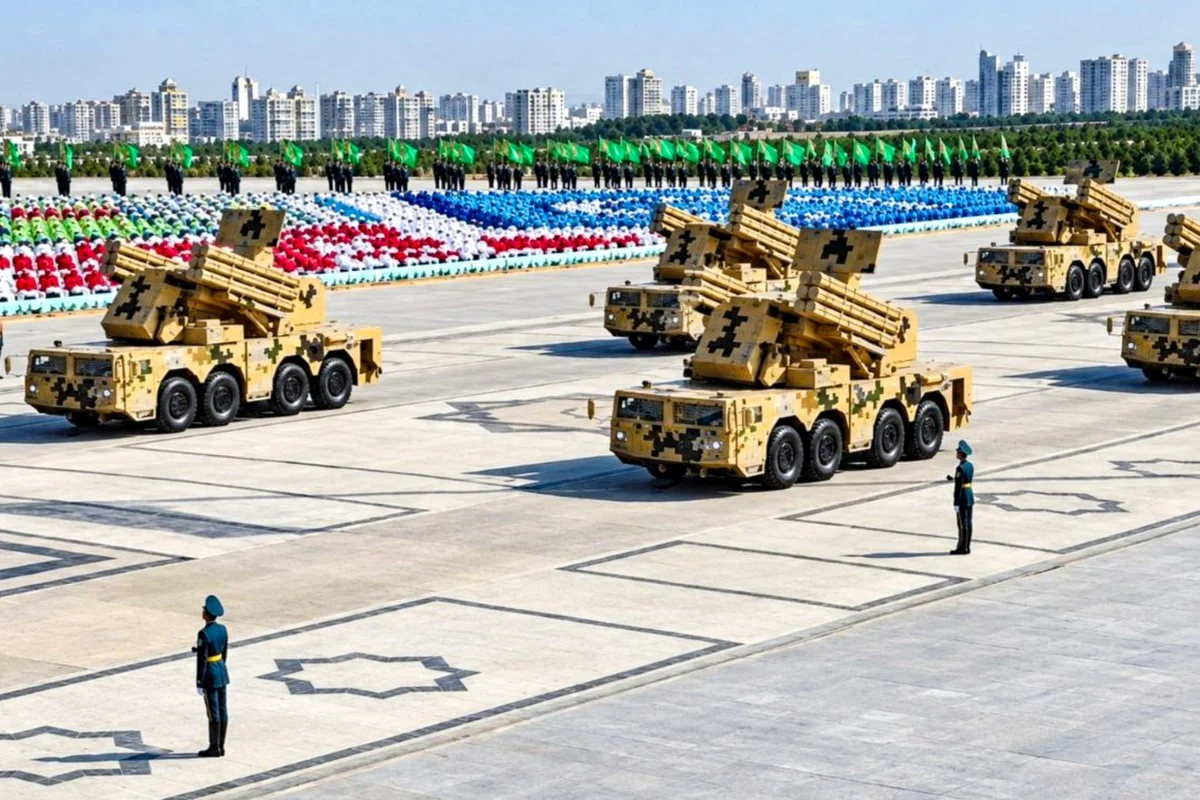
Turkmenistan has inducted China’s FK-2000 short-range gun-missile air defense system, displaying at least eight vehicles during the September 27, 2026, military parade in Ashgabat marking 35 years of independence. Official Turkmen state coverage described the FK-2000 as recently entered into service with the National Army, making it the fourth Chinese-origin surface-to-air missile (SAM) system in the country’s inventory.
The induction extends a procurement shift that began a decade ago. Ashgabat first paraded the Chinese FM-90, KS-1A and FD-2000 in 2016, alongside Soviet-era S-200V, S-125 Pechora-2M and Osa batteries. Russia’s position as a supplier has eroded since. According to the Stockholm International Peace Research Institute (SIPRI), Russia’s share of global arms exports fell from 21 percent in the 2016 to 2020 period to 6.8 percent in 2021 to 2025, a decline SIPRI dates to before the invasion of Ukraine. Turkmenistan, which holds United Nations-recognized permanent neutrality and belongs to no military bloc, now sources air defense from China, drones from Israel and Türkiye, and aircraft from Italy and Brazil.
FK-2000 Specifications and Its Role in Turkmenistan Air Defense
Developed by China Aerospace Science and Industry Corporation (CASIC) and first shown at Airshow China in Zhuhai in 2021, the FK-2000 integrates detection, tracking and engagement on a single vehicle. In Turkmen service it rides on the KDP-2000 universal transport platform, an 8×8 wheeled chassis, with an unmanned turret carrying 12 ready-to-fire missiles and two six-barrel 30 mm Gatling-type cannons. CASIC material cites a capacity of 12 to 16 missiles depending on configuration.
Published specifications give the missile an engagement envelope of 1.2 to 25 km against aircraft and 1.2 to 10 km against cruise missiles and precision-guided munitions. The guns cover the inner layer: the manufacturer claims a combined rate of fire of up to 8,000 rounds per minute across an effective band of 200 to 1,500 m. Sensors comprise a search radar, a fire-control radar and an electro-optical/infrared (EO/IR) sight, a mix that allows passive tracking under emissions control. CASIC states the system can engage four targets simultaneously with up to eight missiles under guidance, deploy in five minutes and react in four seconds from detection to engagement. None of these figures has been independently verified, and the missile designation and seeker type remain undisclosed.
The architecture places the FK-2000 in the same class as Russia’s Pantsir-S1, which publicly available specifications credit with 12 57E6 missiles reaching about 20 km and two twin-barrel 2A38M 30 mm cannons. The Chinese system’s six-barrel guns favor volume of fire, consistent with CASIC’s marketing against multirotor drones and precision munitions, the threat class that has driven short-range air defense (SHORAD) demand worldwide. Because the vehicle needs no separate radar, command or power units, Turkmenistan can move it with mechanized formations or use it as point defense for fixed sites such as gas processing and pipeline infrastructure.
From S-200 to FD-2000: How Ashgabat Built a Chinese-Layered Network
The FK-2000 completes a Chinese architecture spanning three range bands. Publicly available specifications credit the FD-2000, the export variant of the HQ-9, with about 125 km against aircraft; the KS-1A, the export HQ-12, with around 50 km; and the FM-90, derived from the HQ-7, with roughly 15 km. The FK-2000 overlaps the FM-90 in missile reach while adding the gun layer the Chinese-built network previously lacked. Soviet-era assets have not vanished: the parade still featured ZSU-23-4 Shilka self-propelled guns and truck-mounted ZU-23 cannons, while the status of the S-200V batteries shown in 2016 is unclear. With a combat aircraft fleet centered on attack types such as the Su-25 and A-29, Ashgabat leans on ground-based systems for most of its counter-air mission.
Official coverage also listed the sensors behind the shooters, including a radar complex designated YLS-18A and the DWL-002 electronic environment monitoring system, a Chinese passive surveillance system that locates emitters without radiating. Unmanned systems formed the parade’s other headline. Turkmen authorities identified the Israel Aerospace Industries Point Blank precision-strike munition, the ThunderB vertical take-off and landing (VTOL) unmanned aerial vehicle (UAV) for the navy, and DJI Matrice 30T quadcopters as recent additions, alongside Chinese Sky Saker FX-80 and CW-15D UAVs, Sky Striker loitering munitions, Bayraktar TB2 combat drones and Katana unmanned surface vessels.
Analysis: The FK-2000 induction confirms that China, not Russia, now supplies every tier of Turkmenistan’s ground-based air defense, from long-range FD-2000 batteries down to gun-based point defense. Turkmenistan borders Iran and Afghanistan and fronts the Caspian Sea, and its procurement shows that a neutral Central Asian state can field a complete layered air defense stack without new Russian equipment, a reference case for neighbors as Moscow’s export capacity contracts. Russia keeps a footprint, visible in the T-90S tanks, BMP-3 vehicles, Smerch rocket launchers and Mi-17V-5 helicopters on parade, but the new air defense money went to Beijing. The open question is integration: Chinese sensors and shooters now operate beside Soviet-era guns and Israeli and Turkish drones, and open sources show no common command-and-control layer tying them together.
The number of FK-2000 systems purchased, the contract value and the delivery schedule remain undisclosed by both Ashgabat and CASIC. The next indicators to watch are whether Turkmenistan turns to Chinese combat aircraft to replace its MiG-29 fleet, which did not feature in this year’s official flypast, and whether CASIC converts this public showcase into further export orders across Central Asia and the Middle East.