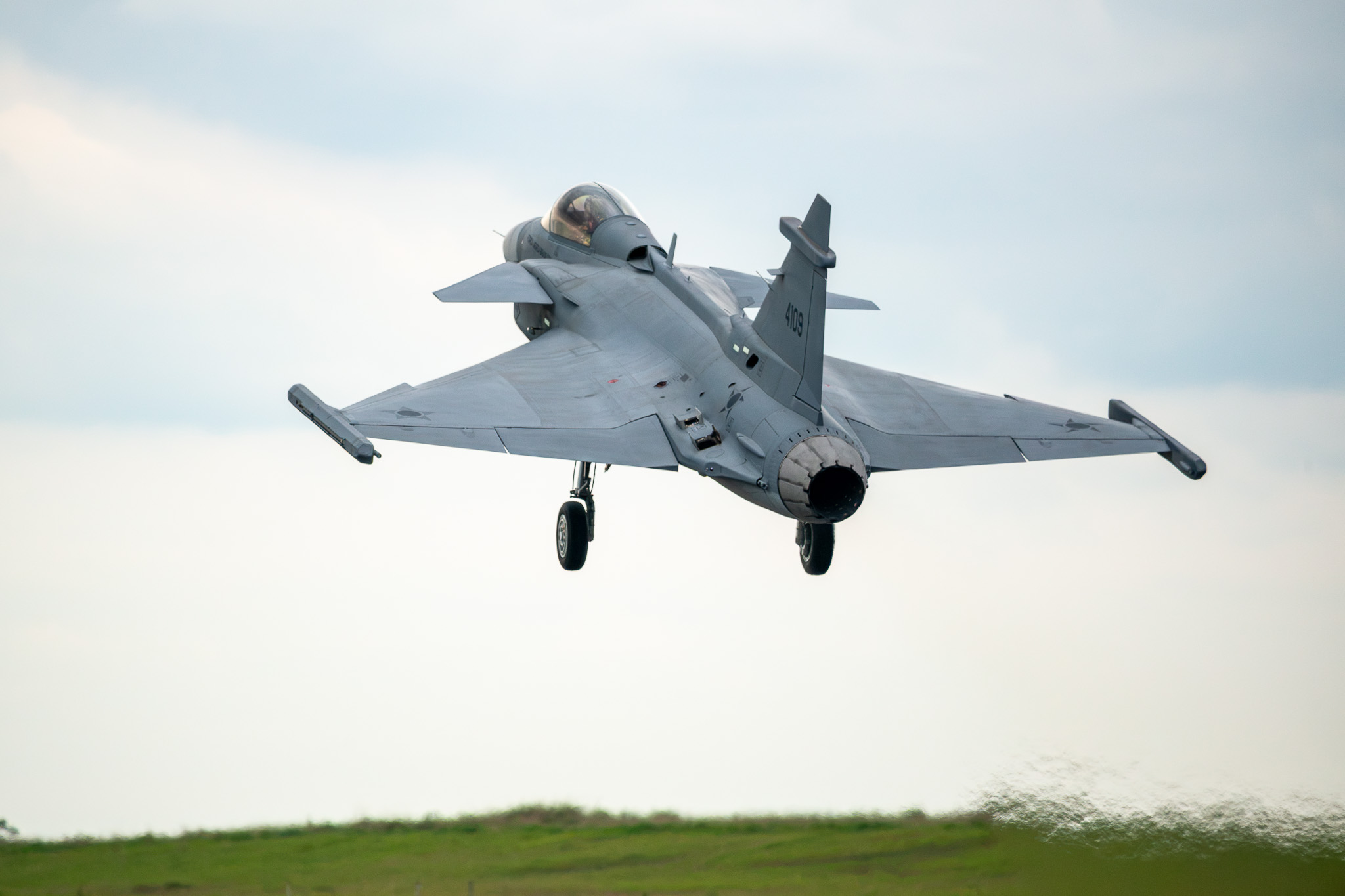
The first Gripen E fighter produced in Brazil completed its maiden flight on October 6, 2026, departing Embraer’s Gavião Peixoto aerodrome in São Paulo State at 10:21 local time with Saab chief test pilot Jakob Högberg at the controls. Saab classified the sortie as the aircraft’s first production acceptance test, opening the final phase of manufacturing before handover to the Brazilian Air Force (Força Aérea Brasileira, FAB). It is the first Gripen built outside Sweden to fly.
The flight follows the aircraft’s rollout on March 25, 2026, and comes 12 years after Brazil signed the F-X2 contract in October 2014 for 36 Gripen fighters: 28 single-seat Gripen E and eight two-seat Gripen F, designated F-39E and F-39F in Brazilian service. Valued at roughly $5.4 billion at signature, the program has run behind its original delivery schedule, with the remaining aircraft now due by 2032. This airframe is the first of 15 Gripen E that Embraer will produce under the current contract.
Brazilian Gripen E Production Moves From Assembly to Acceptance
Embraer flight engineers planned and executed the sortie with Saab in support, a further step in the F-X2 technology transfer package. The flight verified basic system functions and gathered initial performance data. Marcus Wandt, head of Saab’s Aeronautics business area, said it shows Brazilian Gripen production “has reached a new level of maturity.” Embraer Defense & Security CEO Bosco da Costa Junior called it validation of a strategy combining FAB requirements, Saab technology and Embraer’s industrial base.
The aircraft carries FAB registration 4109, according to the Brazilian Air Force. After acceptance flights, it will be certified and transferred to Anápolis Air Force Base in Goiás State to join the First Air Defense Group (1st GDA), which currently operates 10 Gripen E. Neither company has disclosed the length of the acceptance campaign or a delivery date.
Final assembly began at Gavião Peixoto in 2023, alongside the Gripen Design and Development Network, opened in 2016, and the Gripen Flight Test Center. Aerostructures arrive from Saab’s plant in São Bernardo do Campo, while AEL Sistemas, Akaer and Atech contribute avionics, structural engineering and simulation. Saab says more than 350 Brazilian engineers, technicians and pilots have trained under the program.
F414G Engine, ES-05 Raven Radar and Brazil’s Wide Area Display
The F-39E is a redesigned Gripen rather than an incremental upgrade of the C/D. Publicly available specifications indicate a length of 15.2 meters, a wingspan of 8.6 meters and a maximum takeoff weight of 16,500 kilograms, against about 14,000 kilograms for the Gripen C. Internal fuel rises roughly 40 percent to 3,400 kilograms, and relocated main landing gear creates 10 hardpoints instead of eight. A single General Electric F414G turbofan rated at 22,000 pounds of thrust (98 kN) in afterburner, about 20 percent more than the earlier RM12, gives a top speed of Mach 2 and is intended to enable supercruise. Across the 22 million square kilometers the FAB counts as its area of responsibility, those margins translate into combat air patrol endurance.
The Leonardo ES-05 Raven active electronically scanned array radar sits on a repositioner that extends its field of regard to about 100 degrees either side of the nose, letting a pilot turn away after a missile launch while maintaining track. It works alongside the Skyward-G infrared search and track sensor and an integrated electronic warfare suite. The FAB fired its first MBDA Meteor ramjet missiles from F-39Es in November 2025 near Natal, with two missiles hitting Mirach 100/5 target drones. Brazilian-specific systems include the Link BR2 encrypted datalink and AEL Sistemas’ 19-by-8-inch touchscreen Wide Area Display, which Sweden also adopted for its own Gripen E.
How Follow-On Orders and Colombia’s Deal Could Load Embraer’s Line
Fifteen aircraft is a thin run for a fighter line, and two developments could extend it. On June 4, 2026, Brazilian Defense Minister José Múcio Monteiro Filho and Swedish Minister for Defence Pål Jonson said they are negotiating an amendment to the existing agreement covering a possible 20 more Gripen E/F, which Jonson said would be built in Brazil. No contract or value has been announced. Even that batch would bring the fleet to 56, short of the 66 aircraft the FAB has told lawmakers it considers adequate, and the service also plans to replace its Embraer A-1 (AMX) attack jets with Gripen.
Colombia signed on November 14, 2025, for 17 Gripen E/F, 15 single-seat and two two-seat, valued at €3.1 billion ($3.6 billion), with deliveries from 2026 to 2032. Saab CEO Micael Johansson has said the contract will draw on both the Swedish and Brazilian lines, without specifying the split.
The two-seat F-39F follows a separate path. Brazil is its launch customer and co-developer, but production sits in Linköping. The first Gripen F rolled out there on June 2, 2026, and flew on August 28, 2026, with Högberg and FAB test pilot Lt. Col. Abdon de Rezende Vasconcelos aboard.
Analysis: The flight turns Brazil’s technology transfer from a contractual promise into a demonstrated production capability, but it does not yet make Gavião Peixoto an economical fighter line. Fifteen F-39Es over roughly six years cannot alone sustain tooling, suppliers and a trained workforce; the line’s long-term case rests on the 20-aircraft follow-on and on export work, starting with Colombia and potentially Peru, which Saab has openly targeted from its Brazilian hub. For the FAB, the issue is throughput: with 10 Gripens in service and the F-5M and A-1 fleets aging, every acceptance delay widens the gap between the fighter force Brazil fields and the one its planners say it needs.
The next milestones are completion of acceptance flights, FAB certification and the ferry to Anápolis, none yet dated. Beyond that, three decisions will set the line’s trajectory: signature of the 20-aircraft amendment, the number of Colombian aircraft assigned to Embraer, and the Gripen F test schedule that governs when the FAB receives its first two-seat aircraft. Gavião Peixoto’s planned production rate, which neither company has disclosed, remains the key unknown.