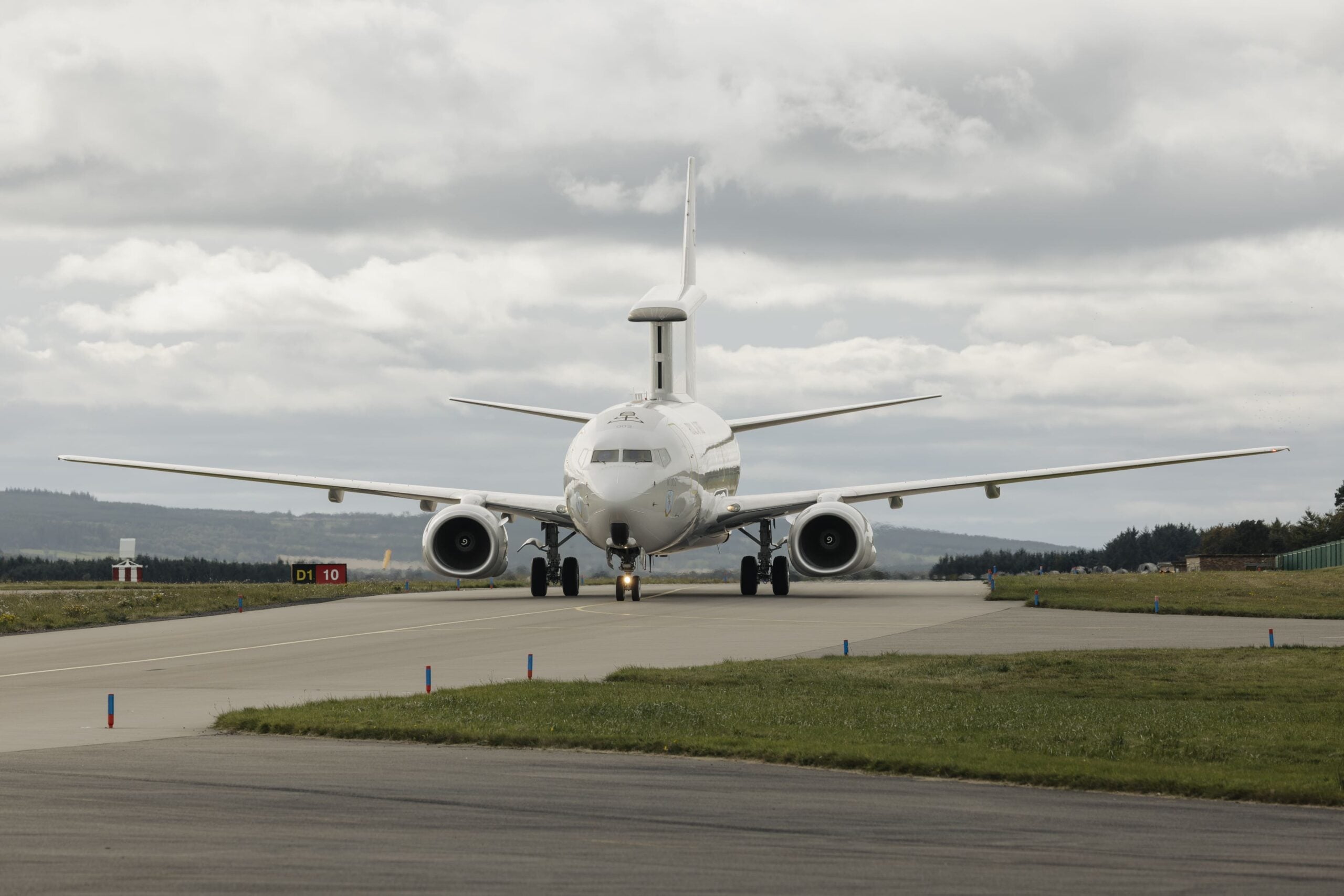
The Royal Air Force’s second Boeing E-7 Wedgetail Airborne Early Warning Mk1 (AEW1), serial WT002, has joined the first aircraft at RAF Lossiemouth in Scotland after completing its trials at MOD Boscombe Down, the service said on October 8, 2026. With two airframes now at their future main operating base, the RAF can run ground and flight evaluation in parallel as the program moves “towards its next stage.”
The move adds tempo to a program that has repeatedly slipped. The UK has had no dedicated airborne early warning and control fleet since the E-3D Sentry left service in September 2021, leaning on the NATO Airborne Early Warning and Control Force and allied assets to cover the gap. Neither the RAF nor Boeing has published a handover date; delivery and service entry both hinge on the trials now underway in Scotland.
RAF E-7 Wedgetail Trials Shift From Boscombe Down to Lossiemouth
WT002 made its first functional check flight from Birmingham Airport on July 15, 2026, after conversion by STS Aviation Services, the only facility currently set up for E-7 conversions. It appeared in its final paint scheme in late August before initial trials at Boscombe Down, the Ministry of Defence (MoD) test center in Wiltshire.
WT001 preceded it north on May 21, 2026, flown from Birmingham by a mixed Boeing UK and RAF crew after systems activation and radar calibration work at Boscombe Down. The third and final RAF airframe remains on the STS line, with no first flight date announced. The same line has begun converting the first Boeing 737-700 for the US Air Force.
Lossiemouth already hosts the RAF’s nine P-8A Poseidon MRA1 maritime patrol aircraft. Both types use the Boeing 737 Next Generation airframe, which the RAF and Boeing expect to yield savings in maintenance, spares, and training. No. 8 Squadron, the former E-3D unit, will fly the Wedgetail in service. On July 15, the National Armaments Director Group also awarded Boeing Defence UK a £127.5 million ($171.4 million) sustainment contract for the future fleet.
Inside the Wedgetail AEW1: MESA Radar and Mission Systems
The Wedgetail is built on the Boeing 737-700 increased gross weight airframe, powered by two CFM International CFM56-7 turbofans rated at 27,300 lb of thrust each. Publicly available specifications for the Australian E-7A list a maximum takeoff weight of 77,565 kg and a length of 33.6 m.
The core sensor is Northrop Grumman’s Multi-role Electronically Scanned Array (MESA), an L-band radar housed in a fixed dorsal “top hat” structure roughly 10.7 m long. Where the E-3D rotated a radome carrying its AN/APY-2 radar, the MESA steers its beam electronically for 360-degree coverage and can concentrate energy on a priority sector to extend detection range or raise the track update rate. The Royal Australian Air Force cites a range beyond 400 km and coverage of more than 4 million square kilometers per standard mission, with simultaneous tracking of air and maritime targets.
The cabin carries up to 10 mission crew consoles for air battle managers and electronics analysts. Open-source figures put patrol endurance at about nine hours at 555 km from base. The Australian configuration adds directed infrared countermeasures, chaff, and flares, alongside Link 16 and satellite communications. The UK has not detailed how far its AEW1 standard departs from that baseline.
Longer sorties require air-to-air refueling, a structural constraint for the RAF. The E-7 takes fuel through a boom receptacle, while the RAF’s Voyager tankers are fitted only for probe-and-drogue refueling. Defence Minister Luke Pollard confirmed in early September 2026 that the RAF will develop a boom capability; until it arrives, extended Wedgetail missions will rely on allied tankers.
Program Delays and a Narrowing Allied Market for the E-7
The UK ordered five Wedgetails in March 2019 for roughly £1.5 billion, then cut the buy to three in 2021. The program’s estimated cost now stands at £1.89 billion ($2.57 billion). Fielding was first promised for the early 2020s before the MoD approved a revised 2026 initial operating capability target. Ministers blamed earlier slippage on contractor performance, parts and skills shortages, and extra certification assurance after the 737 MAX investigations.
On March 17, 2026, National Armaments Director Rupert Pearce told the House of Commons Defence Committee that the MoD had wrongly assumed the UK aircraft would closely mirror the Australian design. The years since Australia’s buy left components obsolete, and certifying replacements added further delay.
Australia, Türkiye, and the Republic of Korea operate six, four, and four aircraft respectively. The Pentagon moved to cancel the US Air Force program in June 2025, citing per-aircraft cost growth from $588 million to $724 million and survivability concerns, before Congress funded it in the fiscal 2026 appropriations act and barred its termination. NATO partners abandoned a planned six-aircraft E-7 purchase in November 2025, and on July 7, 2026, the alliance announced it would pursue up to 10 Saab GlobalEye aircraft to replace its E-3A fleet.
Analysis: With NATO committed to GlobalEye and the US fleet still at the prototype stage, the RAF will be the only Western European E-7 operator for the foreseeable future. That keeps the UK tied into the US and Australian Wedgetail communities, but leaves a three-aircraft fleet carrying obsolescence and sustainment costs at small scale. Three airframes leave little margin for continuous orbits once maintenance and training are factored in, and the boom refueling gap compounds the problem. A second aircraft at Lossiemouth accelerates the trials; it does not change the fleet’s arithmetic.
The next milestones are the formal handover of WT001 from Boeing to the RAF, a declaration of initial operating capability, and the first flight of the third airframe. The MoD has not confirmed whether the 2026 target still holds, and Pearce’s March testimony pointed to a possible slip beyond it. Nor has the RAF disclosed how far the MESA mission system has been exercised in flight on UK aircraft. Those answers will determine when No. 8 Squadron puts a British Wedgetail on operational tasking.