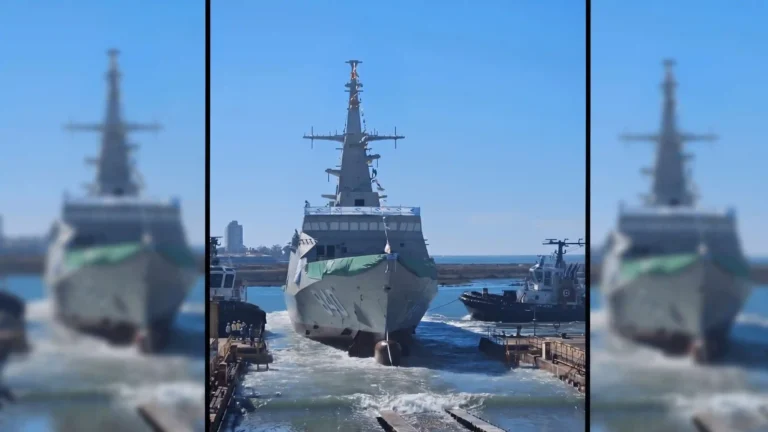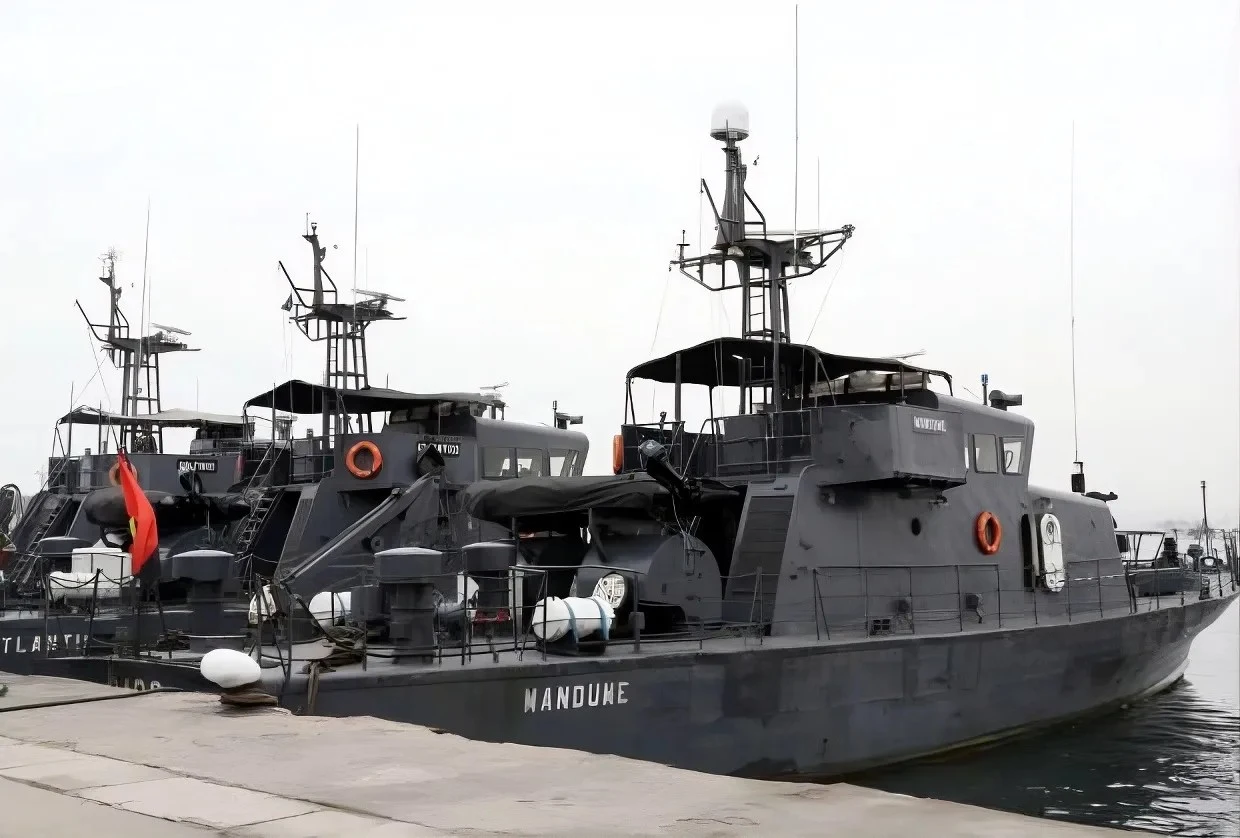
Spanish state-owned shipbuilder Navantia has signed a contract with Angola to repair and modernize two Mandume-class patrol vessels of the Angolan Navy, the company announced on October 15, 2026. Work on the Golfinho and the Atlântico will take place at Navantia’s San Fernando shipyard in Cádiz, the same yard that built both hulls more than three decades ago.
The agreement was signed with Simportex, the Angolan state-owned company responsible for procurement for the Ministry of Defence, by Álvaro Lobo, Navantia’s commercial director for Africa, and General Luis Manuel da Fonseca Sotto Maior Pizarro, president of Simportex. The deal brings back to Spain two of the four patrol boats that Empresa Nacional Bazán, Navantia’s predecessor, completed for Angola in 1993 under a 1990 order for fisheries protection. It also narrows a broader package Luanda had been weighing since at least February 2023, when reports indicated Angola was considering up to six new-build patrol vessels alongside the modernization of two existing hulls, a deal Navantia sources then described as dependent on financing.
Angolan Navy Patrol Vessels: Mandume-Class Design and Specifications
Publicly available specifications indicate the Mandume class displaces 104 tonnes standard and 112 tonnes at full load, with a length overall of 29.1 meters, a beam of 5.93 meters, and a draught of 2 meters. The hull is steel with an aluminum superstructure, a pairing that saves topside weight but typically demands close corrosion management after 30 years in warm Atlantic waters. The four-boat class comprises Mandume (P100), Polar (P102), Atlântico (P104), and Golfinho (P106).
Open-source data credits the class with two Paxman 16SET-CWM diesel engines driving two shafts for a combined 3,560 hp, a top speed of 25 knots, and an endurance of 800 nautical miles at 15 knots. Armament as built consists of a single 20 mm GAM-B01 cannon and two 12.7 mm heavy machine guns, supported by two Decca navigation radars. The crew numbers 11.
Those figures describe a constabulary craft rather than a combatant. An 800-nautical-mile endurance equates to just over two days of continuous transit at cruise speed, and a manually aimed 20 mm gun without electro-optical fire control limits effectiveness against fast, low-signature targets. Navantia has not detailed the modernization package, so it remains unclear whether the work is confined to hull and machinery overhaul or extends to sensors, communications, and weapons.
Contract Scope: Repair, Officer Training, and Two Years of Support
Beyond yard work, the contract includes training in Spain for a group of Angolan Navy officers, two years of life-cycle support, and knowledge transfer intended to let the service maintain both vessels in Angola. That sustainment package addresses a long-standing weakness: by the early 2000s, few Angolan Navy units were reported serviceable, and the fleet rebuilt since then draws on several suppliers, including French shipbuilder CMN, which has delivered HSI 32 high-speed patrol craft, Ocean Eagle 43 patrol vessels, and LCT-2000 landing craft.
For Navantia, the order sits within its Repairs and Services business area, which the company presents as part of a commercial effort in Africa to support navies in modernizing ships already in service. A refit of two 29-meter boats is modest by Navantia’s standards, but it renews the company’s link with a navy whose four Mandume-class boats all came from the Bazán yard.
Analysis: The contract reflects a pragmatic choice by Luanda to extend existing hulls rather than finance new construction, at least for now. For a navy responsible for roughly 1,600 kilometers of coastline and the offshore oil infrastructure that underpins Angola’s economy, two refurbished 112-tonne patrol boats add limited reach; their value lies in near-shore presence, fisheries enforcement, and generating a trained maintenance cadre. The knowledge-transfer clause may ultimately matter more than the refit itself if it builds domestic sustainment capacity the Angolan Navy can apply across a mixed-origin fleet.
Navantia has not published a start date, redelivery date, or contract value. The key open questions are the technical scope of the upgrade, whether Mandume and Polar will follow their sister ships into the yard, and whether the larger new-build program discussed in 2023, which Spanish reporting linked to San Fernando, advances now that a first tranche of work is under contract.