The U.S. Army Combat Capabilities Development Command Chemical Biological Center (DEVCOM CBC) has transitioned its Millimeter Wave Screening Obscuration Module (SOM), a portable system that disperses a cloud of coated fibers to degrade enemy radar tracking, to the Portfolio Management Executive for Chemical, Biological, Radiological and Nuclear Defense (PME CBRND). The handover follows live field demonstrations in August 2026, the Army announced on October 19, 2026.
The move targets a gap that has widened as adversaries field millimeter-wave sensors. Cold War-era smoke generators such as the M56 Coyote and M58 Wolf were built to defeat the human eye, optical rangefinders and early infrared sensors. Those screens offer little protection against millimeter-wave radar, which equips many modern fire-control systems and missile seekers. A unit concealed in conventional smoke can remain clearly visible on an enemy radar display.
How the Radar Obscuration Module Defeats Millimeter Wave Sensors
DEVCOM CBC scientists rebuilt the obscurant concept around wavelength rather than visibility. “Once you reach millimeter waves, you enter the radar spectrum,” said Dr. Jill Harland, a research scientist at the center, describing frequencies that pass through conventional smoke undetected. The millimeter-wave band spans roughly 30 to 300 GHz, corresponding to wavelengths of 1 to 10 mm, far larger than the particles that block visible and infrared sensors.
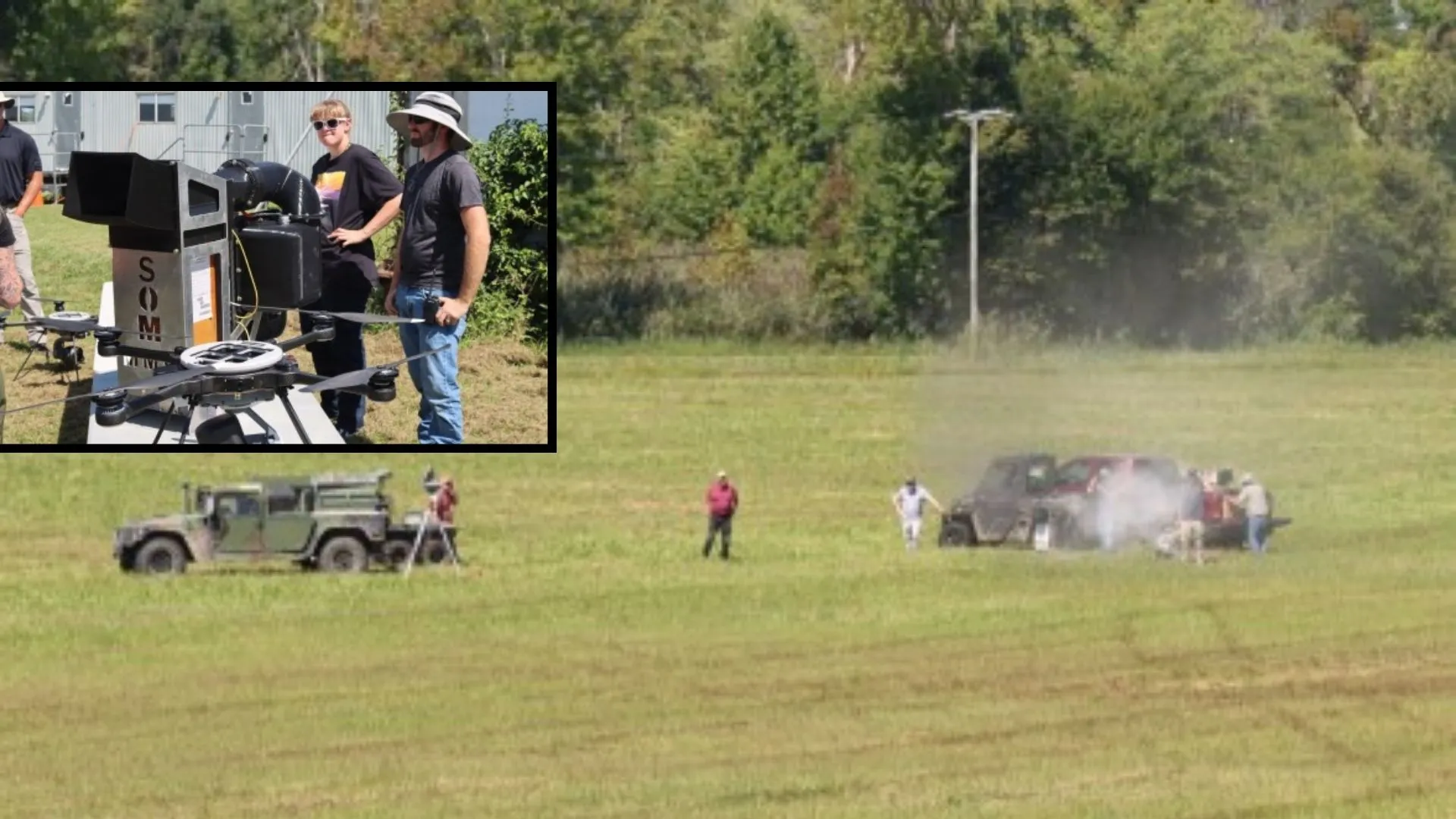
The module disperses approximately 30 pounds (13.6 kg) of coated fiber material from a portable dissemination device; Army imagery identifies the payload as carbon fibers. Once airborne, the fibers scatter incoming radar energy, applying the physical principle behind aircraft chaff to the shorter wavelengths of ground-combat radars. The Army has not disclosed fiber length, coating composition, targeted frequency bands, cloud dimensions, build-up time or persistence.
During the August trials, the team placed several targets in an open-air test area, tracked them on radar and dispersed the cloud around them to measure deployment speed and real-time suppression of active tracking. “As the cloud formed, the signature dropped and we got our obscuration that way,” said Michael Smith, a mechanical engineer at DEVCOM CBC. No quantified signature-reduction figures have been released.
For maneuver formations, the operational value lies in denying range and track data to fire-control radars and radar-guided munitions during the most exposed phases of an operation, such as breaching, wet gap crossing or withdrawal under contact. “Our objective is to buy Soldiers critical time on the battlefield,” Smith said.
From the M75 SOM to a Multispectral Screening Requirement
The radar module comes from DEVCOM CBC’s Smoke and Target Defeat Branch, led by Dr. Danielle Kuhn, the same team behind the M75 Screening Obscuration Module. The M75, a suitcase-sized generator operable by a single soldier, has been tested at Dugway Proving Ground, Utah, since 2018 as the Coyote’s successor. In November 2025, the center mounted an M75 on an unmanned ground vehicle to screen soldiers during a simulated wet gap crossing at Aberdeen Proving Ground, Maryland, and said the team was working on a new generation of the module.
The millimeter-wave effort also fits a broader push toward full-spectrum concealment. In December 2025, Army Contracting Command-Aberdeen Proving Ground issued a sources-sought notice for a Screening Obscuration Module Multispectral, a system one infantryman can carry and emplace to screen troops and vehicles from ultraviolet, visible and infrared sensors through millimeter-wave radar, under a two-to-four-year effort. Its stated targets include a screen 204 meters (670 feet) long and 12 meters (40 feet) high within 95 seconds, held for 12 minutes without resupply. Those are the figures L3Harris lists for the current M75 in the visible and near-infrared bands, so the requirement amounts to extending M75-class performance across the full spectrum.
Analysis: The Millimeter Wave SOM shows the Army now treats radar signature management as a ground-force survivability problem, not only an aviation or naval one. As sensor-to-shooter chains combine electro-optical, thermal and radar cueing, a single-spectrum screen leaves formations exposed. The real test is integration: a standalone radar obscurant adds weight and logistics burden, while one device defeating every band would reshape how maneuver units plan concealment.
PME CBRND will now conduct further testing before the system reaches units. The Army has not released a fielding timeline, procurement quantity, cost estimate or host platform, nor confirmed whether the millimeter-wave payload will be folded into the multispectral SOM effort or fielded separately. Those decisions, and any published signature-reduction data, will set the pace at which radar-defeating smoke enters Army formations.