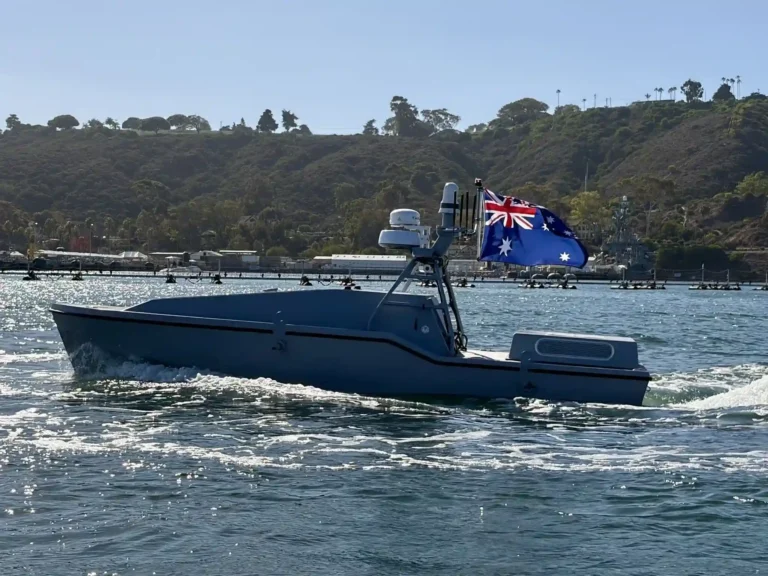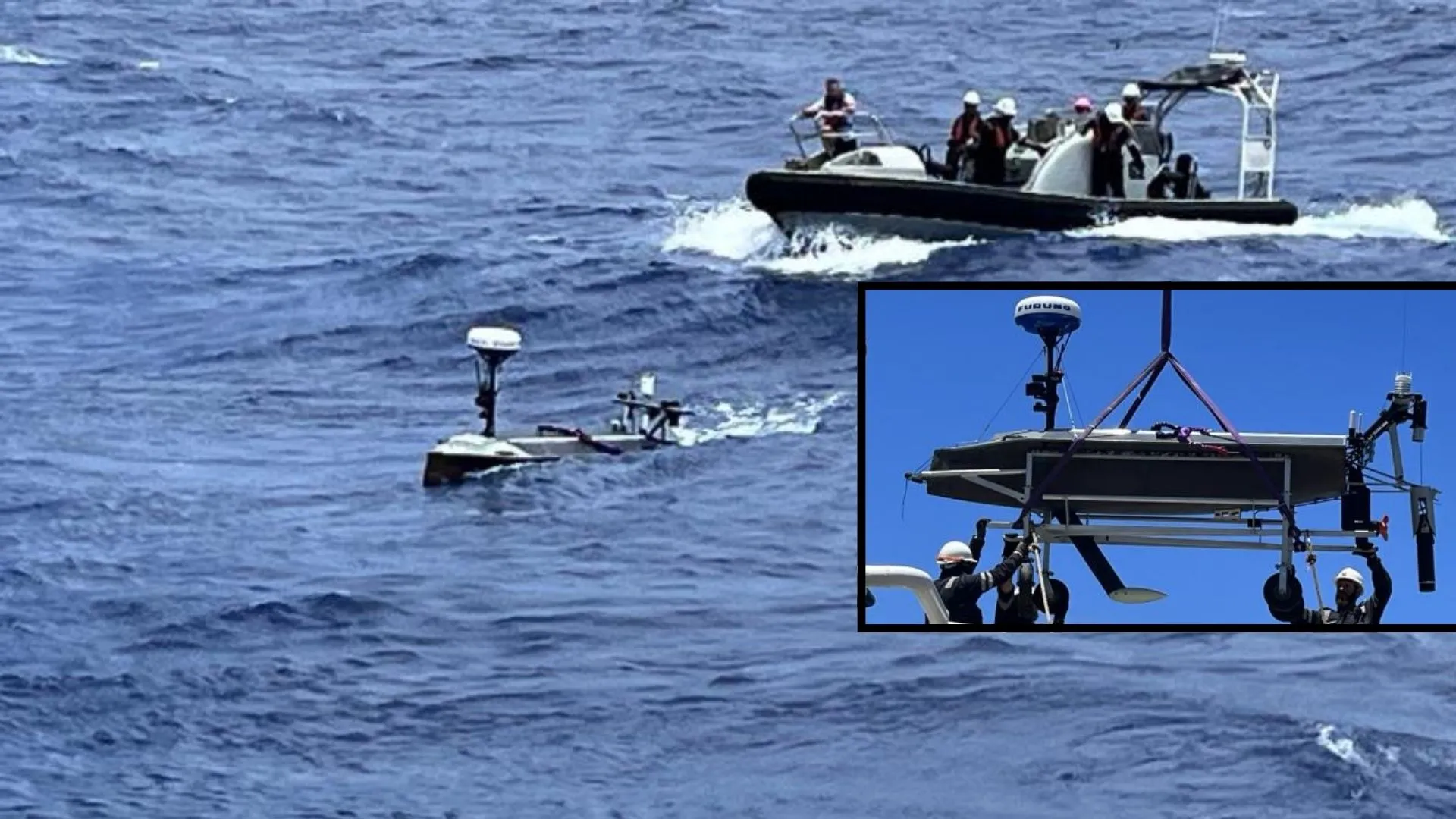
The Royal Australian Navy’s seaworthiness regulator has issued its first Naval Permit to Operate, clearing a Seasats Lightfish uncrewed surface vessel (USV) operated by Australian contractor Elysium EPL to take part in Exercise Rim of the Pacific (RIMPAC) 2026, the Department of Defence disclosed on October 29, 2026. It marks the first use of a regulatory route that brings experimental vessels into the Defence maritime jurisdiction without full operator certification.
The permit lands as Canberra pushes to field uncrewed maritime systems faster under Pillar II of the AUKUS partnership with the United Kingdom and the United States, whose defense ministers named uncrewed undersea vehicle payloads as the first Pillar II signature project on May 30, 2026. The Navy’s AUKUS Pillar II Subsea/Seabed Warfare project team worked with ANSA on the Lightfish case, which tests whether Australia’s regulatory machinery can keep pace with that experimentation tempo.
How the Naval Permit to Operate Works Under ANSR 307
The Australian Naval Seaworthiness Authority (ANSA) issued the permit under Australian Naval Seaworthiness Regulation (ANSR) 307, which allows a vessel to operate under defined conditions, limitations, and risk controls for temporary or limited activities. ANSA assessed the safety evidence with the Australian Naval Classification Authority (ANCA), the AUKUS project team, and Elysium EPL. Defence has not published the permit’s conditions, duration, or hull count.
The instrument sits inside the Defence Seaworthiness Program, in which the Chief of Navy serves as Defence Seaworthiness Authority, supported by the Australian Naval Flag Administrator, ANCA, and ANSA. The standard route into service is an Australian Naval Vessel Operator Certificate (ANVOC), issued to an accountable officer once the vessel has attained naval classification and the vessels and organization comply with the naval seaworthiness regulations. That process suits frigates, not a 3.5-meter commercial drone evaluated over a few weeks of exercise play.
The permit closes that gap for vessels outside the jurisdiction of the civilian Australian Maritime Safety Authority (AMSA). Elysium EPL had already secured AMSA certification for civil Lightfish operations; the naval permit extends the platform into the Defence jurisdiction. Elysium EPL Fleet Operations Manager Prue Davey said the approval “enabled Lightfish operations during Exercise Rim of the Pacific 2026 and showed how autonomous maritime systems can be practically introduced into Defence service.”
Seasats Lightfish Specifications: Endurance, Payload, and Autonomy
The Lightfish is built by San Diego-based Seasats. Manufacturer data for the base model lists a length of 3.5 meters (11.4 feet), a beam of about 1 meter, a draft of 0.79 meters, and a weight of 138 kilograms (305 pounds). It fits in a pickup truck and can be deployed by hand.
Propulsion is solar-electric, with 415 watts of solar panels, a 4-kilowatt-hour lithium-ion battery, and an optional supplemental methanol fuel cell. Seasats’ datasheet lists a cruise speed of 2 knots, a sprint speed of 5 knots, endurance of up to six months, and a range of more than 8,000 nautical miles. The hull is fully self-righting and rated to Beaufort force 6 and above, with AIS- and LiDAR-based collision avoidance, GPS-denied navigation, and LTE and Iridium satellite communications. The internal payload bay offers 4,700 cubic inches (about 77 liters) and up to 30 kilograms (66 pounds), with 5 to 28 volts of configurable power, 20 to 30 watts steady state, and bursts above 300 watts.
Seasats offers Base, Security, Environmental, and Hydrographic configurations. The Security variant carries marine radar, HD and thermal cameras, Automatic Identification System (AIS) transceivers, and LiDAR, with support for broadband VHF monitoring; the Hydrographic variant mounts a hull-mounted multibeam echosounder. Those numbers define the mission: a 5-knot hull with a 20- to 30-watt steady-state payload budget is a persistent sensor and relay node, not an interceptor, valued for cheap, long loiter, which seabed infrastructure monitoring requires. Its record fits that profile, including a roughly 2,500-mile, 10-week autonomous transit from San Diego to Pearl Harbor in 2024 and deployments with US Navy Task Force 66 during BALTOPS 2025.
Lightfish at RIMPAC 2026 and the AUKUS Seabed Warfare Effort
RIMPAC 2026 ran from June 24 to July 31 in and around the Hawaiian Islands. In July, Royal Australian Navy, Defence Science and Technology Group (DSTG), and US Navy personnel ran an AUKUS Pillar II undersea activity from the 107-meter Australian Defence Vessel Guidance. Australian systems included a Kongsberg HUGIN Superior autonomous underwater vehicle, a Schilling work-class remotely operated vehicle, the Lightfish, and the L3Harris-developed Rock Lobster deployable acoustic communications relay.
Defence said the Lightfish and Rock Lobster deployments demonstrated interoperability between Australian and US underwater acoustic communications technologies. It has not specified the Lightfish’s payload or role; a surface gateway between acoustic and satellite links fits the hull but remains unconfirmed.
Elysium EPL has been Seasats’ reseller in Australia and New Zealand since November 2025, providing sales, integration, and support. In the United States, Seasats holds an $89 million Small Business Innovation Research (SBIR) Phase III indefinite-delivery/indefinite-quantity (IDIQ) contract from Naval Information Warfare Center Atlantic to support Marine Corps USV efforts, plus a $24 million Department of Defense award, announced in January 2026 under the Accelerate the Procurement and Fielding of Innovative Technologies (APFIT) program, to scale production. Australia is evaluating a platform already used by US forces, with its sovereign contribution concentrated in integration, support, and the regulatory evidence package.
Analysis: The permit matters more than the platform. A commercial USV can be bought in weeks, but authorizing it inside a navy’s safety framework often takes far longer, a gap that brakes uncrewed adoption. ANSR 307 offers a bounded, auditable path built on conditions rather than full classification, and this first issue gives other vendors a working template. It does not solve the harder transition: a permit is temporary by design, and any platform the Navy wants in enduring service still faces the ANVOC and classification route. For a Pillar II effort criticized for moving slower than the submarine program, a functioning regulatory on-ramp is a prerequisite for fielding distributed autonomous systems at scale.
Key unknowns remain: the permit’s conditions and expiry, the number of Lightfish it covers, and whether the Royal Australian Navy intends to acquire the type rather than evaluate it. The next indicators will be further permits for other uncrewed platforms and how Pillar II undersea deliverables move from exercise trials into funded programs.