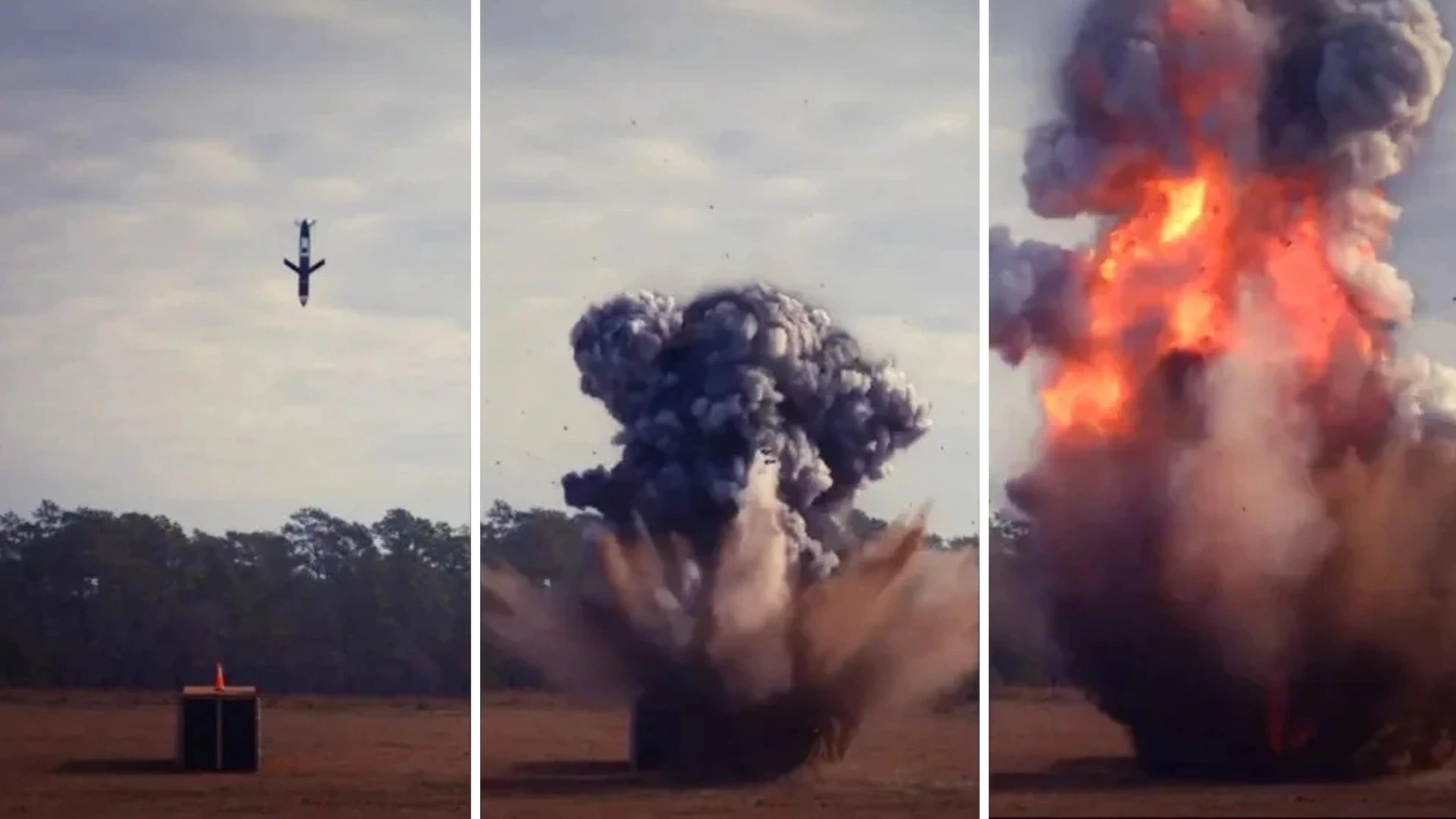
The U.S. Air Force has asked industry whether it can deliver more than 1,000 Extended Range Attack Munition (ERAM) cruise missiles within 15 months of contract award, according to a Request for Information (RFI) posted November 2, 2026, by the Air Force Life Cycle Management Center (AFLCMC) Armament Directorate at Eglin Air Force Base, Florida. Responses are due November 19.
ERAM is the service’s low-cost, air-launched standoff cruise missile, which the Air Force describes as “designed to provide affordable mass to the fight.” The program moved from 2024 contract awards to Zone 5 Technologies and CoAspire to a live-warhead test at Eglin on January 21, 2026. The notice lands as the Pentagon scales up the Family of Affordable Mass Missiles (FAMM) program of record, which includes missiles derived from both ERAM designs, and rebuilds munitions stocks drawn down by the war with Iran.
ERAM Cruise Missile RFI Sets 250 NM Range and 10 Meter CEP
The RFI calls for a 500-pound-class weapon capable of blast, fragmentation, and limited penetration effects, with variable fuze options. Minimum range is 250 nautical miles, about 463 kilometers, and minimum speed is Mach 0.6. The navigation system must function in a GPS-degraded environment, and terminal accuracy must hold a 50 percent circular error probable (CEP) of 10 meters in both benign conditions and high electromagnetic interference (EMI) environments.
Each threshold has an operational logic. The 500-pound class matches the Mk 82 bomb weight that fourth-generation fighters such as the F-16 already carry, which compresses integration. Publicly available specifications indicate that 250 nautical miles keeps the launch aircraft outside the roughly 400-kilometer advertised reach of the S-400’s 40N6 interceptor when that system defends the target. The Mach 0.6 floor points to a subsonic small-turbojet design that relies on routing, volume, and cost rather than speed for survivability.
The accuracy line is the most demanding. It reflects conditions over Ukraine, where Russian jamming and spoofing of satellite navigation are routine. The August 28, 2025, Foreign Military Sale (FMS) notification for Ukraine paired each of up to 3,350 ERAMs with an embedded GPS/inertial unit fitted with a Selective Availability Anti-Spoofing Module (SAASM). The RFI goes further, requiring 10-meter accuracy with GPS degraded, which implies alternative navigation such as vision-based or terrain-referenced updates.
Production terms are equally tight. Deliveries must start no later than three months after award and finish within 15 months, an average above 80 rounds per month. Respondents must also be able to obtain an active Top Secret/Sensitive Compartmented Information (TS/SCI) Facility Clearance Level.
Rusty Dagger, RAACM, and the Two-Step OTA Competition
The notice is Step 1 of a two-step competitive process under Other Transaction Authority (OTA), 10 U.S.C. § 4022. Only firms selected by the Agreements Officer will be invited to submit Commercial Solutions Proposals (CSPs) in Step 2. Respondents must qualify as a nontraditional defense contractor, a small business under NAICS code 336414 and its 1,300-employee standard, a traditional prime with significant nontraditional participation, or a firm covering at least one-third of project cost with non-federal funds. They must also state whether they are foreign-owned or foreign-controlled.
Two designs currently define the field. Zone 5’s AGM-188A Rusty Dagger completed F-16 integration trials at Eglin in March 2026. Zone 5 Chief Strategy Officer Tom Kanewske told The War Zone (TWZ) that integration took 72 hours and that the missile has been cleared on four fighter types. CoAspire offers the Rapidly Adaptable Affordable Cruise Missile (RAACM), which open-source reporting describes as a 500-pound weapon with a combined penetrating and blast-fragmentation warhead. Both also compete in FAMM, where Anduril is a third vendor and fiscal 2027 budget documents plan $12.6 billion for nearly 28,000 rounds over five years.
Ukraine is ERAM’s first announced foreign customer, through a 2025 FMS case valued at an estimated $825 million and funded in part by Denmark, the Netherlands, and Norway. In June 2026, Russian military bloggers claimed, and Ukrainian media reported, that Ukraine had used the AGM-188A against the Voronezh Semiconductor Device Plant, which makes components for Russian missiles. The Russian claim rests on debris that reportedly included an eight-element controlled reception pattern antenna (CRPA), a jam-resistant GPS antenna whose markings were traced to Zone 5. Neither government had confirmed combat use at the time, and the new RFI names no end user.
Analysis: The RFI pairs OTA eligibility rules built for nontraditional and small firms with an active TS/SCI facility clearance, narrowing the realistic field to companies already running cleared facilities. That bar, and the absence of any Ukraine reference, suggests this tranche serves classified U.S. requirements as much as partner aid. Ownership is a second variable: Kongsberg, about 50 percent owned by the Norwegian state, closed its purchase of a 90 percent stake in Zone 5 on June 10, 2026. Foreign ownership does not bar cleared work, but it typically requires a mitigation agreement. Step 2 gives the Air Force a route to a third ERAM source and a test of whether affordable mass can hold 80-plus rounds a month.
Capability statements, limited to 10 pages, are due by 2:00 p.m. Central Time on November 19, 2026. The Agreements Officer will then select who receives the Step 2 request. Award remains pending approval and funding, and the notice discloses no unit-cost target, quantity beyond the first 1,000 rounds, launch platforms, or delivery destination. It also states that no additional information will be provided and no presentation appointments will be made in reference to the RFI.