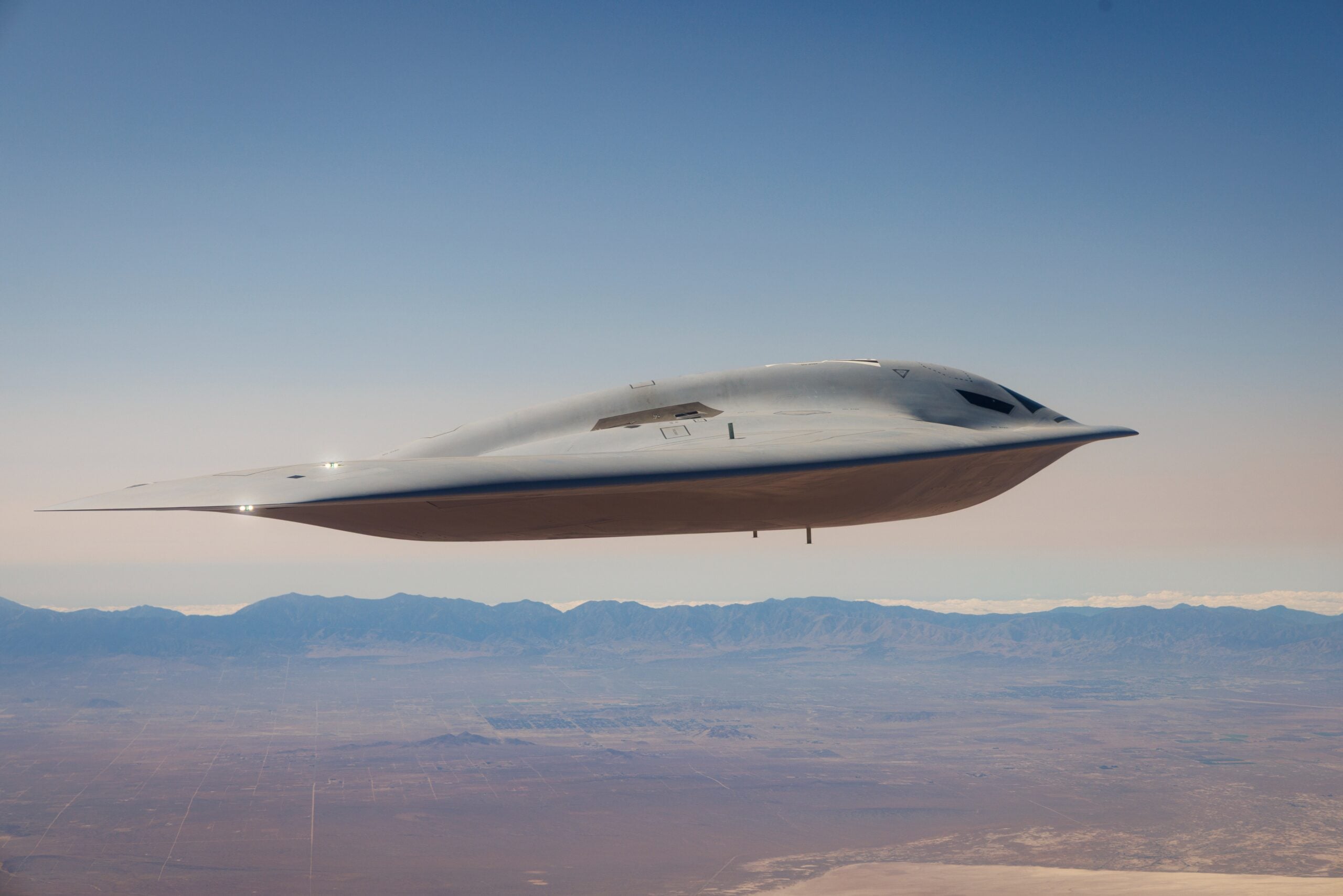
The Department of the Air Force and Northrop Grumman broke ground on September 29, 2026, on a new B-21 Raider final assembly line at Air Force Plant 42 in Palmdale, California. The project launches more than one million square feet of new facilities designed to raise annual B-21 production capacity by 25%, according to the Air Force, which announced the milestone on October 8, 2026.
The groundbreaking turns a funding decision into physical capacity. On February 23, 2026, the service and Northrop Grumman agreed to apply $4.5 billion authorized and appropriated under fiscal year 2025 reconciliation legislation, commonly referred to as the “One Big Beautiful Bill,” to accelerate production of the approved acquisition profile of 100 aircraft. The B-21 is slated to replace the B-1B Lancer and B-2 Spirit, and the acceleration is intended to compress delivery timelines as those legacy fleets age.
Inside the B-21 Production Expansion at Air Force Plant 42
Plant 42 is a government-owned, contractor-operated complex in California’s Antelope Valley, where Northrop Grumman built the B-2 in the 1980s and 1990s. The B-21 was unveiled there on December 2, 2022, and made its first flight from the site on November 10, 2023. Northrop continues low-rate initial production (LRIP) at its Palmdale facilities under a contract awarded in January 2024.
The Air Force has not disclosed the new line’s workforce requirement or a completion date. Neither the service nor Northrop has published the revised production rate, which remains classified. Previously published estimates placed the baseline full-rate target at roughly seven aircraft per year; a 25% uplift on that figure would imply about eight to nine aircraft annually, though officials have confirmed neither number.
Gen. Dale White, director of Critical Major Weapon Systems and direct reporting portfolio manager to the Deputy Secretary of War, tied the project to fielding speed. “The B-21 Raider is foundational to the Air Force’s future long-range strike capability, and this investment strengthens the industrial capacity required to field that capability faster,” White said.
Col. Nicholas Jordan, B-21 Systems program director at the Rapid Capabilities Office, said the Palmdale investment “will provide the infrastructure, workforce and manufacturing capacity needed to deliver the Raider to the Air Force at an increased rate.”
Stealth, Open Architecture and Cost: The Raider’s Design Baseline
The Air Force describes the B-21 as a long-range, penetrating strike aircraft designed to operate in highly contested environments, integrating advanced stealth, resilient networking and a data-driven command-and-control architecture. The bomber is dual-capable, carrying nuclear and conventional weapons, and uses an open-systems architecture intended to ease technology insertion across its service life.
Most performance parameters remain classified. Publicly available information indicates a flying-wing design smaller than the B-2, with propulsion supplied by Pratt & Whitney; engine model, thrust, unrefueled range and payload have not been released. The average procurement unit cost requirement is $550 million in base-year 2010 dollars, which the Air Force equated to $692 million in 2022 dollars, based on a buy of at least 100 aircraft.
The test fleet is designed to feed the operational fleet. Early B-21s are production-representative test aircraft that the Air Force plans to convert to operational configuration after testing rather than retire as prototypes. A second flight test aircraft arrived at Edwards Air Force Base, California, on September 11, 2025, allowing the 412th Test Wing’s B-21 Combined Test Force to move beyond flight performance into mission systems and weapons integration testing. That model means added Palmdale capacity translates more directly into operational inventory.
Northrop’s $2 Billion LRIP Loss and the Cost of Moving Faster
The acceleration lands on a program that has been costly for its prime contractor. Northrop Grumman recognized a $1.56 billion loss across the five LRIP options in the fourth quarter of 2023 and an additional $477 million in the first quarter of 2025, the latter tied to a manufacturing process change intended to enable a higher production rate. The company reports cumulative LRIP losses of approximately $2.0 billion, with a remaining loss accrual of $1.0 billion as of June 30, 2026.
The February agreement did not materially change that recognized loss. Northrop booked a $157 million net unfavorable estimate-at-completion adjustment on the first four LRIP lots, reflecting the agreement and higher estimated production costs, offset by a lower loss contingency on the remainder of the program. Northrop has stated it has invested more than $5 billion in digital engineering and manufacturing infrastructure for the B-21.
The first 21 aircraft fall under fixed-price LRIP options. In June 2024, Northrop disclosed that not-to-exceed pricing for the following 19 aircraft sits above the average unit price of the LRIP lots. A higher annual rate spreads fixed overhead across more airframes per year, which can ease the unit economics of the remaining lots while the $4.5 billion in reconciliation funding underwrites the expansion.
Analysis: The B-21 is shifting from a program measured by test milestones to one measured by industrial throughput. The 100-aircraft profile has not changed; the delivery curve has. The Air Force has long described 100 aircraft as a minimum, and a final assembly footprint sized for a higher rate gives planners a practical path to a larger buy without rebuilding capacity from scratch. Front-loading deliveries also shortens the period in which bomber force structure thins as the B-1B and B-2 retire. The risk is concurrency: production is accelerating while mission systems and weapons integration testing continue, so any late-discovered deficiency would touch more airframes.
The Air Force has not set a public completion date for the Plant 42 facilities or disclosed the revised annual rate. The next visible milestone is the arrival of operational B-21s at Ellsworth Air Force Base, South Dakota, in 2027, with Whiteman Air Force Base, Missouri, and Dyess Air Force Base, Texas, designated as the other two main operating bases. Key unknowns include the Palmdale workforce ramp, the pace of weapons integration testing at Edwards, and whether future budgets fund an inventory beyond 100 aircraft.