The US military has drawn up strike plans that include the potential use of the GBU-43/B Massive Ordnance Air Blast (MOAB), the 21,600-pound weapon nicknamed the “mother of all bombs,” against Iranian energy infrastructure and nuclear sites, CNN reported on October 15, 2026, citing multiple US officials. The options would be available if President Donald Trump orders combat operations to resume, either before or after the November 3 midterm elections.
The disclosure comes more than seven months into a war that began with US and Israeli strikes on February 28, 2026. A June memorandum of understanding has collapsed, attacks on shipping in the Strait of Hormuz have intensified, and on October 8 Trump pledged no new military action until after the midterms. CNN reports he has nonetheless ordered additional strike packages weighted toward energy targets, timed to precede a US retrograde from the US Central Command (CENTCOM) area of responsibility.
GBU-43/B Design: How the Mother of All Bombs Works
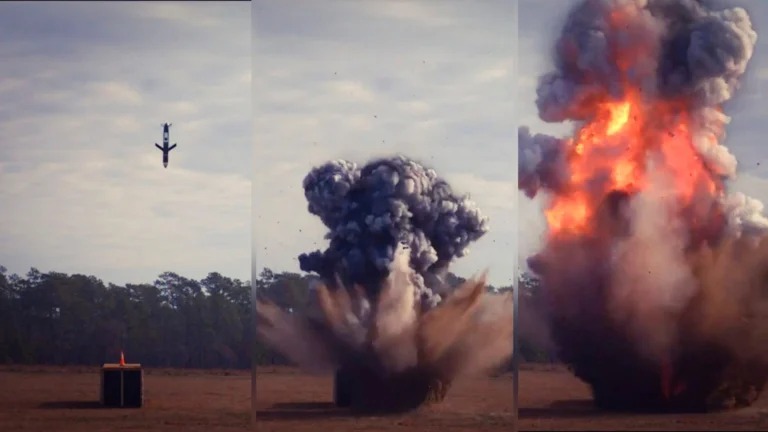
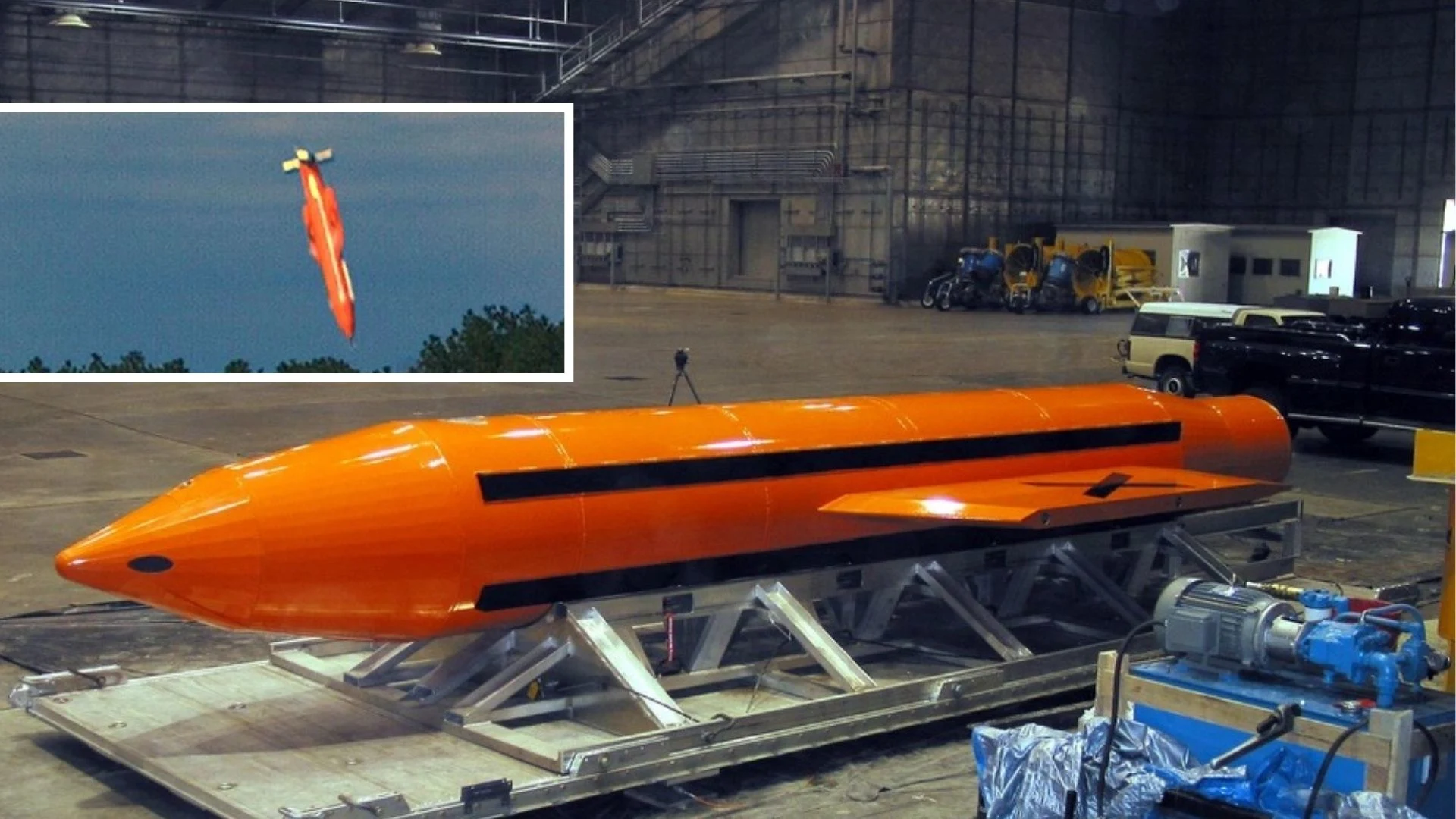
The Air Force Research Laboratory (AFRL) Munitions Directorate at Eglin Air Force Base, Florida, developed the MOAB in 2002 and 2003 as a satellite-guided successor to the unguided 15,000-pound BLU-82 Daisy Cutter. Publicly available specifications indicate a length of 30 feet (9.17 meters), a diameter of 40.5 inches (103 centimeters) and a weight of 21,600 pounds (9,800 kilograms). The BLU-120/B warhead accounts for roughly 18,700 pounds (8,480 kilograms) of H-6, an aluminized RDX and TNT blend about 1.35 times as powerful as TNT. Open-source estimates put the yield near 11 tons of TNT equivalent; CNN’s sources said the blast can destroy an area equal to nine city blocks.
The KMU-593/B tail kit pairs GPS with an inertial navigation system, steering the weapon through four grid fins while two low-aspect-ratio wings extend its glide. Too large for any bomber bay, the bomb rides on a cradle inside an MC-130 Combat Talon or a standard C-130 and is extracted through the cargo ramp like a supply pallet; the cradle then separates and the fins deploy. The fuze detonates the charge just above the ground, driving an overpressure wave outward in every direction.
A C-130-class aircraft flies a slow, non-stealthy profile to the release point, demanding near-total control of the airspace, and the MOAB lacks a hardened penetrating case; one source told CNN it is “definitely not designed as a deep penetration warhead.” About 15 units are believed to have been built at the McAlester Army Ammunition Plant in Oklahoma, and the current inventory is not public.
MOAB vs GBU-57 MOP: The Pickaxe Mountain Depth Problem
A second source told CNN that plans for striking Iranian nuclear sites, including Pickaxe Mountain, explicitly call for the MOAB. Known in Persian as Kuh-e Kolang Gaz La, the site lies just south of the Natanz enrichment complex. Analysts at the James Martin Center for Nonproliferation Studies estimated in 2023 that Iran was excavating chambers 80 to 100 meters (260 to 328 feet) under the mountain, and the Institute for Science and International Security assesses the complex may extend more than 100 meters below bedrock. CNN’s sources said layers of granite are believed to shield it.
The weapon purpose-built for this class of target is the 30,000-pound GBU-57A/B Massive Ordnance Penetrator (MOP), carried only by the B-2 Spirit. On June 22, 2025, during Operation Midnight Hammer, seven B-2s released 14 MOPs against Fordow and Natanz. Open-source estimates credit the MOP with penetrating roughly 60 meters (200 feet) of earth before detonating, short of Pickaxe Mountain’s estimated depth, and the site was left untouched in that raid.
The MOAB inverts that design logic. It carries more than three times the MOP’s estimated 2,400-kilogram (5,300-pound) explosive fill, but releases the energy at the surface. Sources told CNN its effects would likely be devastating at ground level only, with a blast radius large enough to raise civilian casualty concerns near populated areas.
Achin 2017 Precedent and the MOAB’s Psychological Warfare Role
The MOAB has been used in combat once. On April 13, 2017, during Trump’s first term, an MC-130 dropped a GBU-43/B on an Islamic State Khorasan Province (ISIS-K) tunnel complex in the Achin district of Afghanistan’s Nangarhar province. Afghan officials initially reported 36 militants killed, a figure later raised to 94, with no civilian casualties reported.
AFRL moved the program from contract award to theater delivery in about 10 months: the first live drop came on March 11, 2003, at Eglin, and a MOAB reached the Iraq theater on April 11, 2003, though it was never used there. Officials then described it as a psychological operations weapon meant to push Iraqi troops to surrender; its target set later widened to caves and tunnels under softer cover.
That logic has resurfaced. A third source described the MOAB to CNN as an information operations weapon suited to area clearance, arguing that without munitions able to reach the deepest targets, its psychological effect becomes the point. A fourth source said planners had built show-of-force options that could offer Trump an off-ramp even if they miss the war’s stated goals. The White House declined to discuss military plans, saying all options remain open to keep Iran from a nuclear weapon.
Analysis: The MOAB option reads as a signaling instrument rather than a counterproliferation tool. Against Pickaxe Mountain, a surface-burst weapon can at most collapse tunnel portals and damage access roads, ventilation and power infrastructure; it cannot reach halls estimated to sit 80 meters or more beneath rock. The deeper issue is a capability gap: Pickaxe Mountain’s estimated depth is believed to exceed even the MOP’s reach, leaving Washington without a publicly known conventional answer to Iran’s most protected site.
Trump’s pledge holds until at least November 3, though several advisers told CNN privately they were unsure it was definitive. A rotation of US forces in the CENTCOM region is expected within weeks, and some departing personnel may not be replaced. Open questions include the size and location of the MOAB inventory and whether stalled talks can resume before a strike order comes.