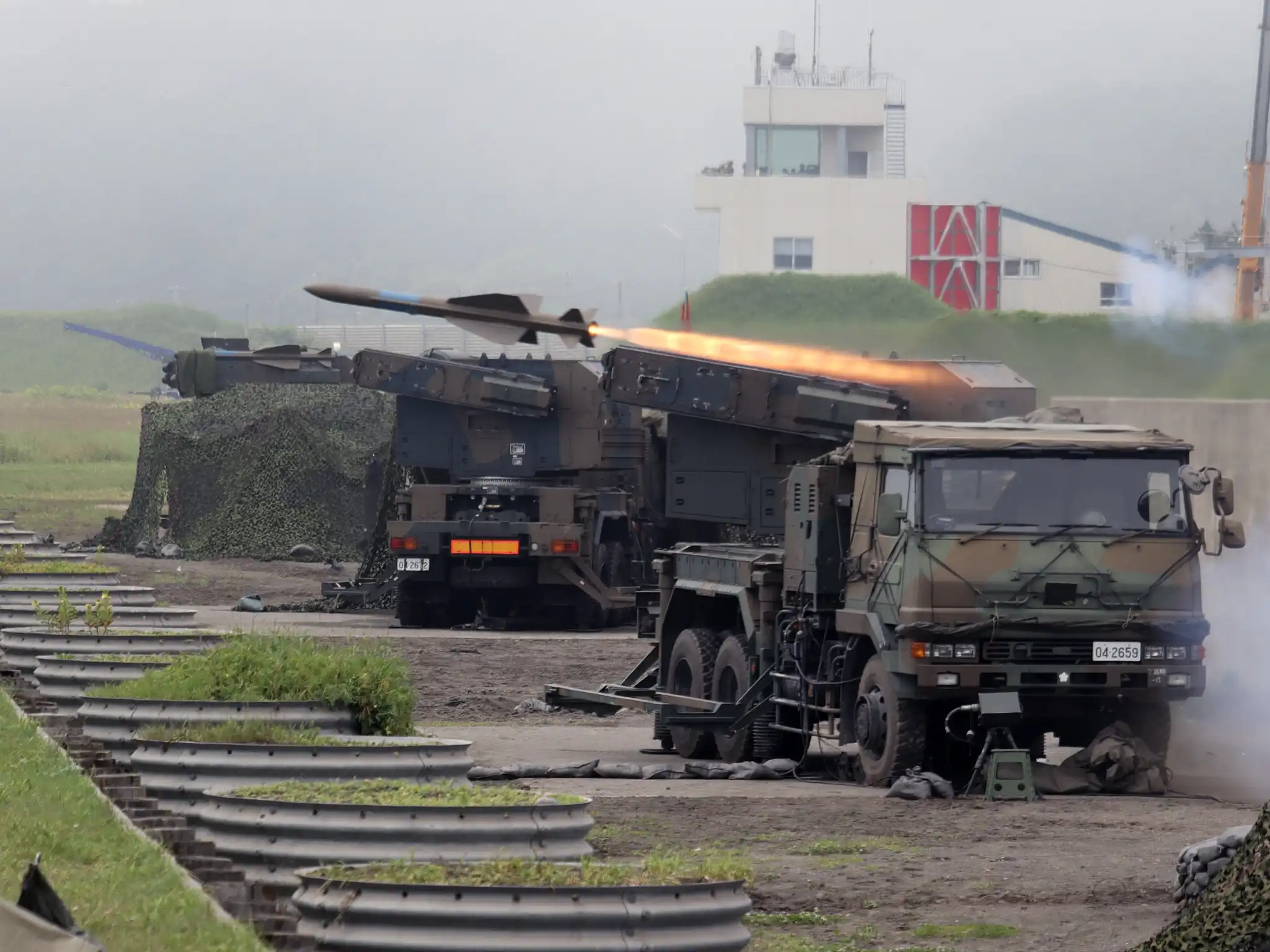
Japan Ground Self-Defense Force (JGSDF) air defense units have fired Type 03 medium-range surface-to-air missiles at McGregor Range, New Mexico, in combined live-fire training with Japan Air Self-Defense Force (JASDF) Patriot batteries, as part of an annual anti-aircraft live-fire cycle that began in July 2026 at ranges in northern Japan.
The New Mexico firings fill a gap Japan cannot close at home. Domestic ranges lack the airspace and safety distances needed to engage aerial targets with a missile whose envelope extends to roughly 50 km, so the JGSDF ships complete fire units across the Pacific each year. The JASDF has held annual service practice launches in the United States since 1964, and the 2026 campaign coincides with Keen Sword 27, which runs across Japan from October 19 to October 29, 2026, with about 45,000 Self-Defense Forces personnel.
Japan Air Defense Live-Fire Cycle From Shizunai to McGregor Range
According to the JGSDF, units have conducted live anti-aircraft fire since July 2026 at the Shizunai range in Hokkaido and the Rokkasho range in Aomori Prefecture. Those shoots covered the short-range tier: the Type 81 short-range surface-to-air missile (Tan-SAM), the Type 93 close-range surface-to-air missile (Kin-SAM), and the Type 87 self-propelled anti-aircraft gun (87AW), a twin 35 mm system built on a Type 74 tank chassis.
The medium-range tier had to move offshore. The Northeastern Army’s 5th Anti-Aircraft Artillery Group fired the Type 03 at McGregor Range from September 16 to 19, 2026, in coordination with JASDF Patriot units. The JGSDF’s fiscal 2026 Chu-SAM unit live-fire training runs at McGregor from September 1 to November 3, 2026, with each anti-aircraft artillery group except HAWK units, the 15th Anti-Aircraft Artillery Regiment, and the Anti-Aircraft Artillery Training Unit taking part.
The JASDF side ran under the fiscal 2026 Integrated Air and Missile Defense Shooting Practice (I-ASP), scheduled from September 13 to October 7, 2026, at McGregor Range and White Sands Missile Range. Roughly 190 JASDF personnel deployed with a full Patriot equipment set. The program covered bilateral live fire with the US Army, combined live fire with JGSDF units, maneuver and deployment drills, missile reload training, and counter-small unmanned aircraft systems (C-sUAS) training. The Type 03 itself first fired at McGregor in November 2006.
Type 03 Chu-SAM Specifications and the Kai Upgrade Path
Developed by the Technical Research and Development Institute, now the Acquisition, Technology and Logistics Agency (ATLA), the Type 03 Chu-SAM entered JGSDF service in 2003 as the successor to the towed MIM-23 HAWK. Mitsubishi Electric is the prime contractor, with Mitsubishi Heavy Industries producing the missile and Toshiba the radar. A fire unit is fully self-propelled: launchers, a search and fire-control radar, a fire control vehicle, radio relay and power vehicles, and loader-transporters.
Publicly available specifications indicate a missile length of about 4.9 m, a diameter of 320 mm, a launch weight near 570 kg, and a warhead of roughly 73 kg, with a maximum range of about 50 km. Each launcher carries six canisterized rounds. Guidance combines command and programmed midcourse phases with active radar terminal homing, cued by an active electronically scanned array (AESA) radar. Open-source reporting credits the system with tracking up to 100 targets and engaging 12 simultaneously. Self-propulsion lets batteries displace quickly after firing, a survivability gain over the towed HAWK.
Japan’s fiscal 2026 defense budget includes 5.1 billion yen, for an undisclosed quantity, for a capability-improved version of the Type 03 Kai intended to counter ballistic missiles and hypersonic glide vehicles. Defense Ministry evaluation documents set out two research and development phases: a software-based modification phase due in 2026 and new development due in 2028. Whether any upgraded rounds or software were exercised at McGregor this year has not been disclosed.
Analysis: The McGregor cycle matters for the integration it rehearses. Pairing JGSDF Type 03 batteries with JASDF Patriot units against live targets is the closest Japan comes to live-fire validation of a layered integrated air and missile defense architecture, with Patriot covering lower-tier ballistic missile defense and the Type 03 handling aircraft and cruise missiles at medium range. That layering matters most in the southwestern islands, where Defense Minister Shinjiro Koizumi confirmed in November 2025 that plans to station Type 03 units on Yonaguni are on schedule. Dependence on US ranges also ties readiness to alliance access: annual unit live fire for Japan’s medium-range air defense force runs through Fort Bliss, although the Type 03 has also fired in Australia during Talisman Sabre 2025.
The JGSDF’s US training window runs through November 3, 2026, and the service has said it will keep building anti-aircraft proficiency through firing at home and abroad. Milestones to watch include the pace of the Type 03 Kai upgrade ahead of its 2028 R&D completion, the timeline for the Yonaguni deployment, and whether future iterations add ballistic or hypersonic surrogate targets for the Type 03. Results from the 2026 firings have not been published.