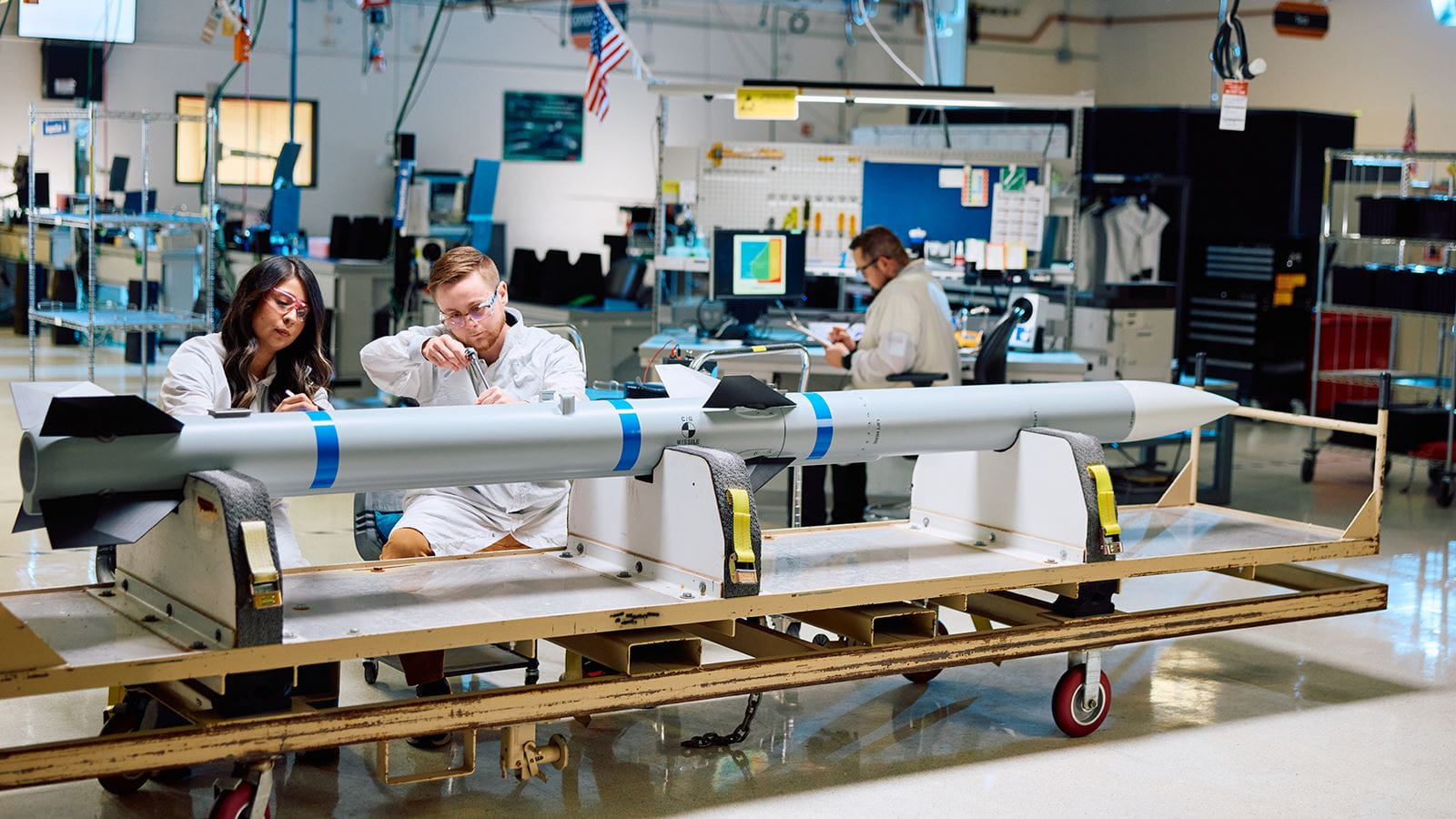
The Department of War has awarded Raytheon, an RTX business, a multiyear Advanced Medium-Range Air-to-Air Missile (AMRAAM) contract worth up to $20.7 billion, covering a five-year term plus two option years, according to the September 28, 2026 contract announcement. The Air Force Life Cycle Management Center made the award on September 25, 2026, and work will be performed in Tucson, Arizona, through June 30, 2033.
The award follows a February 4, 2026 framework agreement that supports annual AMRAAM production of at least 1,900 missiles, a rate roughly three to four times the 450 to 650 rounds a year that Raytheon executives said in 2024 the company typically built. It also follows a July 2025 undefinitized contract action (UCA) of up to $3.5 billion for Production Lots 39 and 40, then the largest in program history. The award falls under the Department of War’s Arsenal of Freedom munitions initiative, as the Pentagon works to replenish stocks drawn down by operations in the Middle East and support to Ukraine.
AMRAAM Contract Terms: $20.7 Billion Ceiling and 16 Foreign Customers
The new action is also a UCA, combining fixed-price incentive and firm-fixed-price terms, so final pricing and quantities remain to be negotiated. The announcement lists a not-to-exceed value of $20,699,334,581 for AMRAAM all-up rounds, guidance sections, direct charges and Foreign Military Sales (FMS) offsets under contract FA8556-26-C-B001. Neither the Department of War nor RTX has disclosed missile quantities, lot numbers, variant mix or delivery schedules.
Obligations at award were a small share of the ceiling: $154,266,225 in FMS funds and $85,715 in fiscal 2026 Air Force weapons procurement funds, about 0.75 percent of the maximum. Congress has granted multiyear procurement authority for AMRAAM, according to the department, but industry executives note that lawmakers have not yet appropriated the money for the full commitment, which limits how far suppliers can invest ahead of firm orders. The structure mirrors Lockheed Martin’s seven-year PAC-3 Missile Segment Enhancement multiyear contract, which reached $58.62 billion with a July 29, 2026 undefinitized modification.
The announcement names 16 FMS customers: Australia, Belgium, Canada, the Czech Republic, Denmark, Finland, Germany, Italy, Japan, Kuwait, the Netherlands, Norway, Poland, Sweden, Taiwan and the United Kingdom. The ceiling is nearly six times the 2025 figure for Lots 39 and 40. RTX says it nearly doubled AMRAAM production in 2025 compared with 2024, works with hundreds of small and midsize suppliers and is exploring international co-production. Raytheon President Phil Jasper said the company continues to invest in its workforce, technology, supply chain and facilities “to rapidly scale production capacity and meet surging demand” from the Air Force, Navy and international partners.
AMRAAM Guidance, Range, and Electronic Protection Against PL-15 and Meteor
AMRAAM is an active radar-guided, beyond-visual-range missile managed as a joint Air Force and Navy program. Navy program data list the AIM-120D at 12 feet (3.66 meters) long, 7 inches (178 millimeters) in diameter and 358 pounds (about 162 kilograms), with a solid-fuel rocket motor and a 19-inch wingspan; speed and range are classified. Open-source estimates put top speed above Mach 4 and AIM-120D range between 130 and 180 kilometers.
Guidance pairs an inertial mid-course phase, updated by datalink from the launch aircraft, with a terminal active radar seeker and a home-on-jam mode against electronic attack, so the shooter can disengage after launch. Publicly available specifications indicate the AIM-120D adds a two-way datalink and GPS-aided navigation. RTX calls the current standard fifth generation, with processors that allow software updates to counter emerging threats. The Form, Fit, Function Refresh behind the AIM-120D-3 and AIM-120C-8 upgraded guidance-section circuit cards and re-hosted legacy software.
RTX reports 14 host platforms, 44 operating countries and more than 7,000 live fires in test and combat. AMRAAM is also the primary interceptor for the National Advanced Surface-to-Air Missile System (NASAMS), where the AMRAAM-ER variant reportedly pairs the seeker with the Evolved Sea Sparrow Missile rocket motor to extend ground-launched reach.
Rivals are moving the range benchmark. Open-source estimates put China’s PL-15 at 200 to 300 kilometers, and some analysts assess it outranges the AIM-120D. MBDA says the Meteor’s throttleable ducted rocket sustains thrust to intercept and yields the largest no-escape zone of any air-to-air missile. AMRAAM’s counterweights are integration across fourth and fifth generation fighters and production scale.
Analysis: The ceiling signals demand and industrial intent more than committed spending. With under 1 percent obligated and appropriations pending, the contract’s value depends on Congress and on Raytheon lifting output from a prior 450 to 650 missiles a year toward 1,900. The Department of War is also funding the longer-range successor: on September 17, 2026, it signed a framework agreement with Lockheed Martin to expand AIM-260 Joint Advanced Tactical Missile production, without publishing a rate or value. The pairing suggests a two-tier inventory, with AMRAAM supplying magazine depth for the United States and 16 FMS partners while the AIM-260 addresses longer-range threats.
Three decisions will shape the program: definitization of the UCA, which will fix pricing and quantities; congressional appropriations beyond the initial obligations; and exercise of the two option years. Open questions include the AIM-120D-3 versus AIM-120C-8 mix, annual delivery profiles and which partner might host international co-production. Work in Tucson is scheduled to run through June 30, 2033.