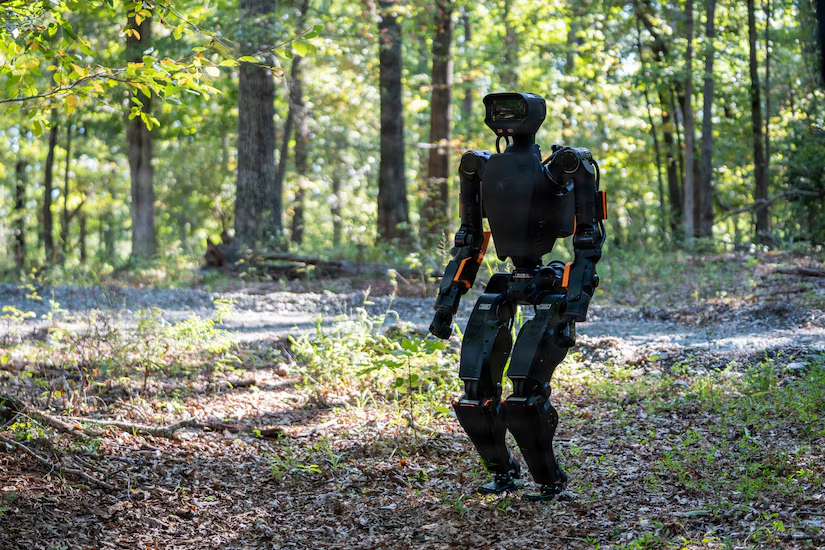
The U.S. Army named five winners of its xTechHumanoid competition on September 11, 2026, selecting one complete humanoid robot, the ballistic-protected Alex built by the Florida Institute for Human and Machine Cognition (IHMC), and four subsystem technologies covering power, tactile sensing and robot command. The picks followed live demonstrations by nine finalists at Marine Corps Base Quantico, Virginia, on September 9 and 10.
Army FUZE ran the competition with the Humanoid Community of Collaboration (HCoC), a Joint Force body established in December 2023 to advance the development and operational integration of humanoid systems. Opened in August 2025, xTechHumanoid drew 103 white papers and was built to set a technical baseline for a capability the Army sees as a way to pull soldiers out of dangerous, physically demanding tasks. “Humanoid robots are part of a broader autonomy push to increase the depth and breadth of robotic platforms and components industry can provide for a range of missions,” said Army Chief Technology Officer Dr. Alex Miller.
IHMC Alex: The Only Full Humanoid Platform in the xTechHumanoid Competition
The Army describes Alex as featuring impact-resilient actuators, ballistic protection and hybrid autonomy that combines artificial intelligence with human control for complex and dangerous missions. IHMC, a nonprofit research institute in Pensacola, Florida, unveiled the robot on November 20, 2025, as the successor to its Nadia humanoid, under a multi-year, multimillion-dollar Office of Naval Research (ONR) effort.
Publicly available specifications indicate Alex is a fully electric biped with 29 degrees of freedom, driven by custom, highly backdriveable quasi-direct-drive actuators. That architecture explains the Army’s emphasis on impact resilience: backdriveable joints yield under external load instead of transmitting shock into gear trains, a requirement for a machine expected to fall, collide and absorb debris outside a lab. IHMC estimated the robot’s weight at about 85 kilograms with its battery, roughly 15 kilograms lighter than Nadia, which paired electric arms with hydraulic legs and torso. Eliminating hydraulics removes pumps, fluid lines and leak points that complicate untethered field use.
IHMC research published in 2026 shows Alex fitted with PSYONIC Ability Hands, five-fingered end effectors with six degrees of freedom each, and perceiving its surroundings through two stereo color cameras in the head. ONR’s stated research goals include controllers for outdoor urban operations, building exploration behaviors and a behavior-cloning pipeline, a task set aligned with structure reconnaissance and hazardous-site entry.
Key parameters remain undisclosed. The Army has not released Alex’s protection level, armor material, coverage, protected weight, endurance, speed or payload. Those figures will determine whether ballistic protection is a survivability gain or a mass penalty that erodes the battery runtime every other function depends on.
Power, Touch and Command: The Four Humanoid Subsystem Winners
Two of the four subsystem winners target energy. ACES Group, LLC, won with an integrated power system built on scalable energy storage, sized from larger operational infrastructure down to individual robot batteries. Hydroplane Ltd. was selected for lightweight, compact mobile power generation designed for long-duration operation in contested logistics environments. The Lancaster, California, company’s prior Defense Department work centers on hydrogen fuel cell powerplants, including a 2024 xTechSearch 8 win and a Navy Small Business Innovation Research (SBIR) award for a Marine Corps fuel cell ground power unit. The Army did not specify the energy source behind Hydroplane’s humanoid entry.
RAS Labs, Inc. won with fingertip tactile sensors that let robots detect force, object form, slip and other physical interactions. The Boston firm builds them on Synthetic Muscle, a patented class of electroactive polymers, and company-published research reports detection thresholds as low as 0.005 newtons across a range above 50 newtons. Touch closes a gap vision cannot: cameras lose value at the point of contact, precisely when a robot handles fragile, hazardous or irregular objects.
Velocity Explorations won with software that extends its command-and-control technology to translate trusted information and command intent into discrete actions for humanoid systems. That layer targets operator burden, since a robot needing constant teleoperation consumes the soldier it was meant to free. “The xTech competition is really an interesting and unique one because it allows you to pressure test your technology in a field exercise paradigm,” said Alec Leesberg, the company’s president and co-founder.
Analysis: The winner list says more than the platform at its center. Four of five awards went to subsystems, and two of those four went to power, signaling that the Army sees energy, not locomotion, as the binding constraint on military humanoids. HCoC has already listed power and energy limits among its next lines of effort. Commercial electric humanoids generally advertise runtimes measured in hours, short of a patrol or logistics cycle, and ballistic protection deepens that deficit. The award mix also favors component specialists, pointing toward a modular approach in which the Joint Force integrates power, sensing and command layers rather than buying a sealed commercial platform.
The Army has not announced a program of record, fielding timeline or follow-on contract. At launch, xTechHumanoid advertised up to $490,000 in cash prizes and $1.25 million in potential follow-on awards, with up to two baseline humanoid and three subsystem winners; the final slate of one platform and four subsystems departs from that structure, and individual prize amounts were not disclosed. The next markers are HCoC’s power and energy work, any follow-on awards to the five winners and whether Alex returns to experimentation with its protection specifications published.