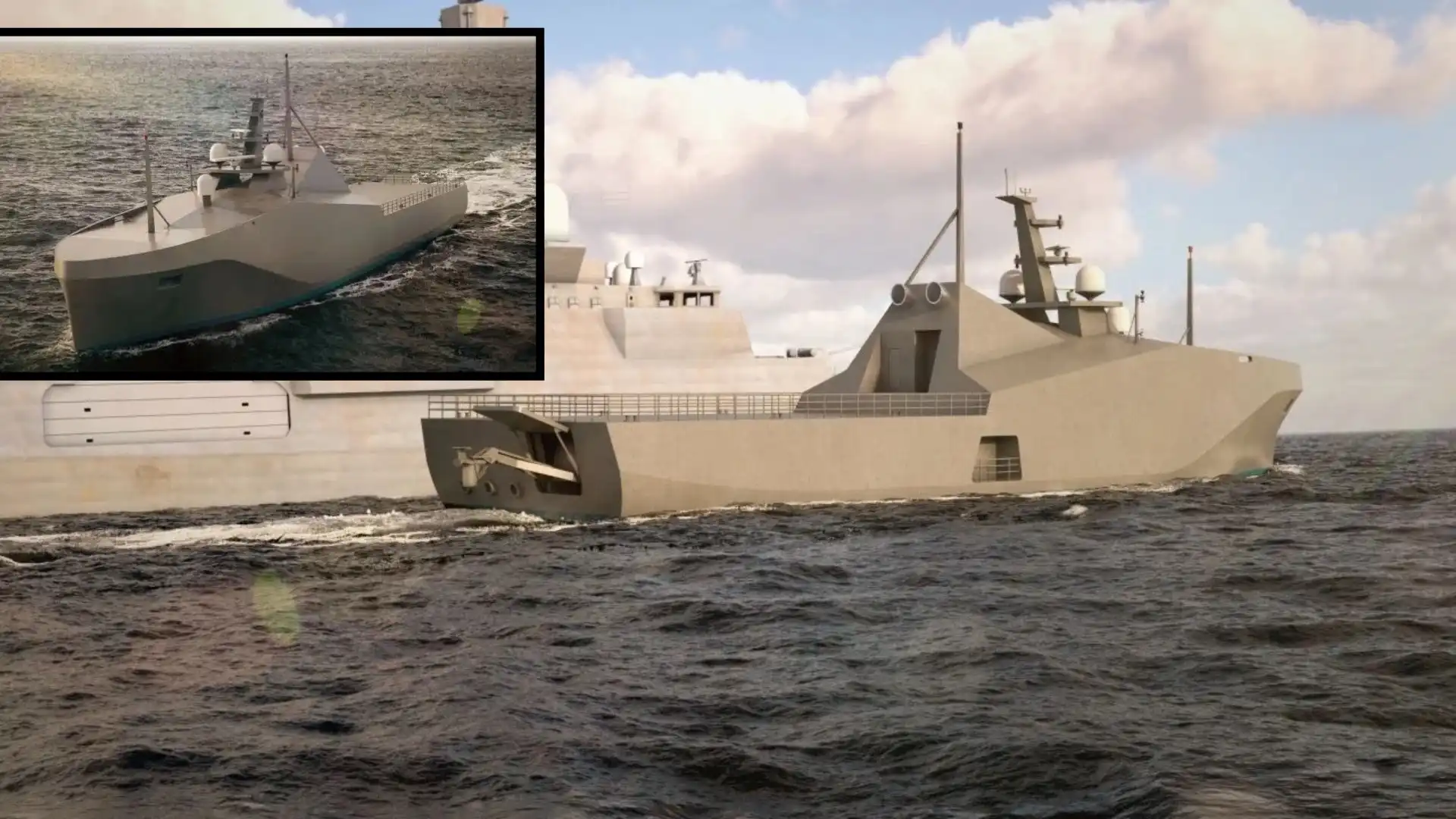
Norwegian maritime technology company Kongsberg Maritime unveiled the Arctic Hunter USV on November 9, 2026, a 56-meter uncrewed surface vessel proposed for the Royal Navy’s Type 92 anti-submarine warfare (ASW) requirement. Balaena Maritime would build the ships at Birkenhead, England, and Thales UK would supply sonar and secure communications. The UK Ministry of Defence (MoD) has not selected a design.
The launch follows the Defence Investment Plan of June 30, 2026, which placed Type 92 within the Royal Navy’s Hybrid Navy and added £1.5 billion over four years for Atlantic Bastion, the effort to track hostile submarines with networked crewed and uncrewed assets. London and Oslo signed the Lunna House Agreement on December 4, 2025, after UK data showed a 30 percent rise in Russian vessels threatening British waters over two years.
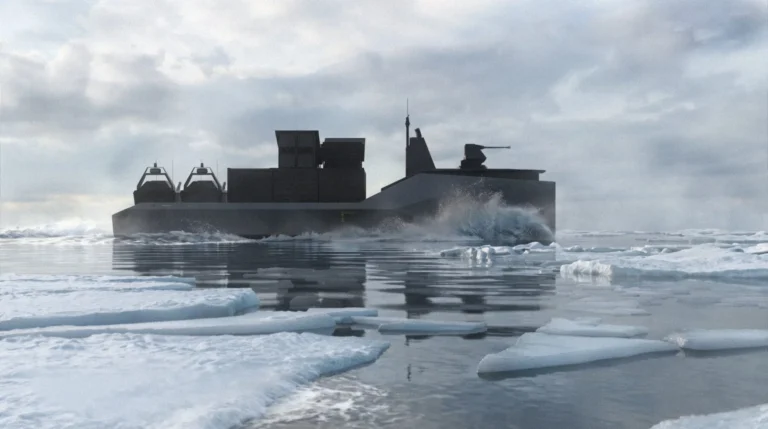
Arctic Hunter USV Design: 56-Meter Hull, 60-Day Missions
Kongsberg derived Arctic Hunter from one of its existing Arctic commercial designs, choosing a hull for its known North Atlantic seakeeping, endurance and payload volume. Kongsberg’s Norwegian-language announcement cites missions of up to 60 days, and published details give a length of 56 meters. Neither figure appears in the English-language launch release. Displacement, beam, draft, propulsion, transit speed and maximum operating sea state remain undisclosed.
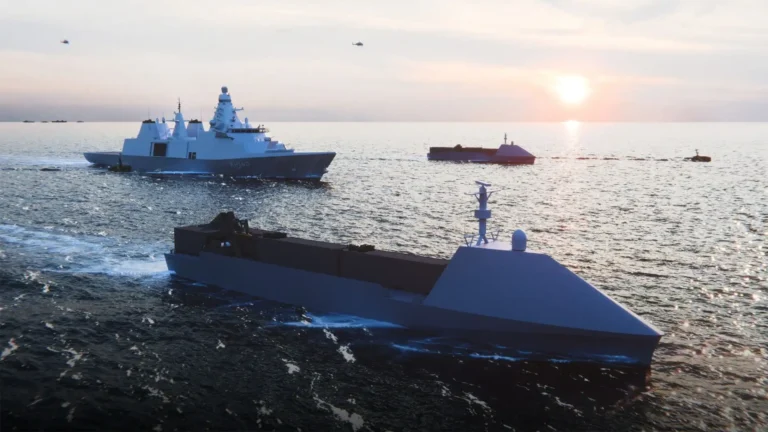
Those gaps carry operational weight. If the Thales UK fit proves to be a towed or variable-depth array, handling gear and tow stability in heavy seas become design drivers for a hull little more than a third the length of the Type 26 frigate shown alongside it in company imagery, which publicly available specifications put at about 150 meters. Sixty days would also double the 30-day endurance published for Reach Remote 1, the 23.9-meter, 230-gross-ton uncrewed offshore vessel Kongsberg designed for Reach Subsea.
The ship would operate from a forward support base inside the Arctic Circle, adding persistent acoustic coverage to the existing multi-asset ASW network in the High North. Kongsberg has not named the base. No UK territory lies inside the Arctic Circle, so the concept implies host-nation support.
Kongsberg describes Arctic Hunter as remotely operated with autonomous functions. Trained personnel in a shore-based Remote Operations Centre would supervise key maritime functions, and military effects would stay under human control. Taking sailors off the hull therefore shifts the manpower bill rather than removing it, because the Remote Operations Centre, its communications links and the forward base’s maintenance teams all remain program costs.
How Thales UK and Balaena Would Deliver Type 92 Hulls
The proposal separates commercial shipbuilding from military integration. Balaena acquired the Birkenhead yard, formerly Cammell Laird and builder of the polar research ship RRS Sir David Attenborough, through its June 2026 purchase of APCL Group. The partners aim to have ships ready for militarization and operational deployment by the end of the decade, subject to Royal Navy requirements. Kongsberg will sign Technology Collaboration Agreements with Thales UK and Balaena at the Atlantic Future Forum in Oslo this week.
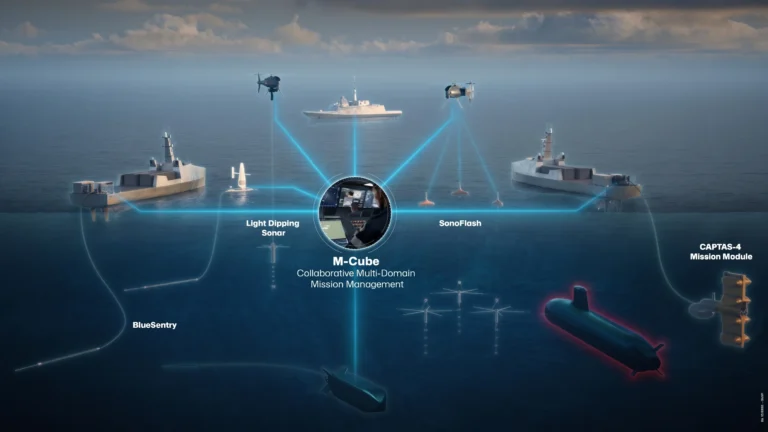
The mission system remains the least defined element. Thales UK would provide a sovereign submarine-hunting sonar, but the partners have not identified the model or released performance figures. Thales already supplies Sonar 2087, the low-frequency active and passive variable-depth system fitted to Royal Navy Type 23 frigates and selected for the Type 26. Neither firm has said whether Arctic Hunter’s sonar shares that lineage, which would shape detection range, processing commonality with the frigate force and operator training. Payload capacity and deck space would allow additional or alternative mission systems during the ship’s service life.
Kongsberg’s autonomy record comes from commercial programs, including Reach Remote and Yara Birkeland. Norwegian authorities permitted Reach Remote 1 to operate without a support vessel in October 2025. The company says its uncrewed technology holds approvals from classification society DNV and the Norwegian Maritime Authority, but those cover the commercial technology, and a militarized configuration would still need development and integration. Kongsberg Maritime CEO Lisa Edvardsen Haugan called the design “a robust and practical response to the growing need for additional submarine detection capability.”
Type 92 Requirement Remains Open Under Atlantic Bastion
Kongsberg is bidding against a requirement the MoD has not finalized. In a written answer published July 15, 2026, Defence Minister Luke Pollard said platform numbers and construction schedules for Types 92 and 93 had not been determined, with detailed requirements to follow through the concept and assessment phases. Pollard described Type 92 as an uncrewed underwater sensing platform, while a Ministry of Defence industry notice reported in February 2025 identified it as an uncrewed surface vessel, designated a sloop, for wide-area ASW search.
Size is also unsettled. Reporting on disclosed MoD material put Type 92 at about 90 meters, 34 meters longer than Kongsberg’s offering, although the Defence Investment Plan itself gives no dimensions. Navantia UK unveiled its 75-meter LASV75 concept, displacing more than 1,000 tonnes, in May 2026 with the same hybrid fleet in mind. Kongsberg also cites potential application across NATO and Joint Expeditionary Force (JEF) nations, tying the design to the Lunna House commitment for the UK and Norway to lead NATO’s adoption of autonomous systems in the High North.
Analysis: Kongsberg is offering the Royal Navy a shorter route to ASW mass by starting with a commercial hull and a UK yard, then adding military systems late. That sequence reduces shipbuilding risk and leaves the harder risks in place: sonar performance in Arctic seas, data links that hold under contest, and propulsion and power systems that must survive a 60-day patrol with nobody aboard to repair a fault. The bid also reverses the industrial flow of Norway’s £10 billion Type 26 purchase, placing a Norwegian design in a British yard.
The next public markers are the agreements expected in Oslo this week and any MoD statement on Type 92 numbers, dimensions and acquisition route. Kongsberg has not disclosed a price, production quantity or demonstrator date.