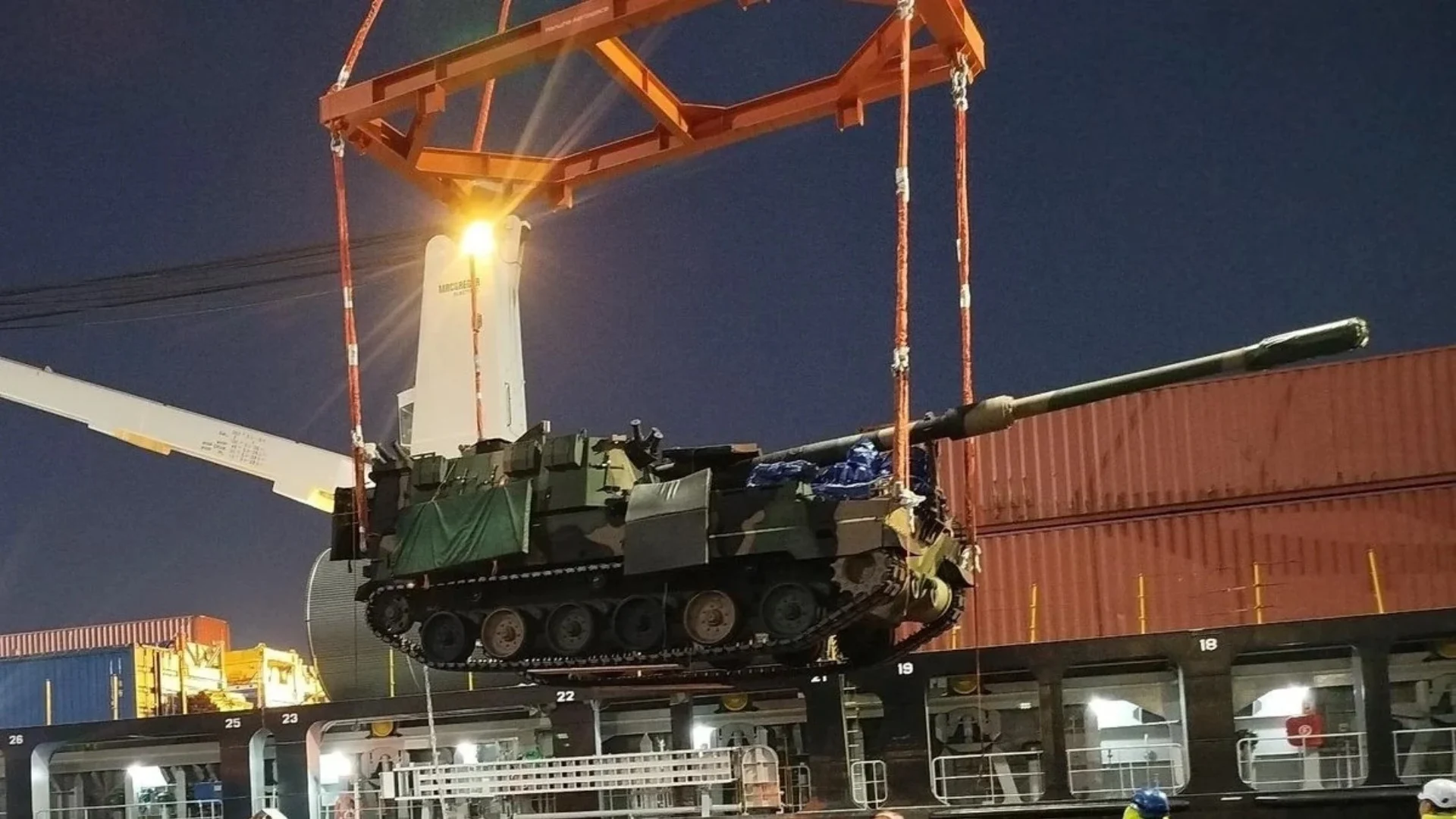
Poland’s Armament Agency said on November 9, 2026, that its final 2026 heavy equipment shipment from South Korea had arrived, with crews unloading dozens of K9 Thunder self-propelled howitzers and K2 tanks for the 16th Mechanized Division. The agency did not disclose exact quantities or the port of arrival.
The shipment draws on two executive contracts: the $2.6 billion K9 agreement signed December 1, 2023, and the $6.5 billion K2 agreement signed August 1, 2025. The agency said the vehicles will join operational units within days. The division, which covers northeastern Poland and the North Atlantic Treaty Organization (NATO) frontier with Russia’s Kaliningrad exclave, said the same day that new K2 tanks and K9 howitzers had reached two unnamed brigades, without linking them to this shipment.
How K2 Tanks Are Reequipping Poland’s 16th Mechanized Division
The tanks are K2 Black Panther main battle tanks in the K2GF (Gap Filler) configuration, built by Hyundai Rotem in South Korea. The August 2025 contract covers 116 K2GF for 2026 and 2027, followed by 64 Polonized K2PL tanks from 2028 to 2030. The first 28 arrived in late August, and 18 of them had joined the division’s 9th Armored Cavalry Brigade by mid-September. An October 20 delivery came without a published number.
The division has five tank battalions of 58 vehicles each, three in the 9th Armored Cavalry Brigade and one each in the 15th and 20th Mechanized Brigades, for a requirement of 290 tanks. The first contract’s 180 K2GF equipped three of those battalions and sent six tanks to the Land Forces Training Center in Poznań. The 116 K2GF now arriving match the two remaining battalions, replacing PT-91 tanks in the 9th Brigade. An even split across 2026 and 2027 would put about 238 K2GF in Poland by year-end, an unconfirmed estimate.
Publicly available specifications indicate the K2GF weighs about 55 to 56 tonnes and carries a three-person crew, a 1,500-horsepower diesel engine, and a 120 mm L/55 smoothbore gun fed by an autoloader holding 16 of its 40 rounds. It reaches about 70 km/h with a 450 km range. At roughly 27 horsepower per tonne, it holds a mobility margin over the 66.8-tonne M1A2 SEPv3 Abrams at about 22.5. That lower mass eases bridge and soft-ground limits in Warmia-Masuria.
K9PL Configuration Adds Polish Fire Control and Crew Protection
The Armament Agency’s statement refers only to K9 howitzers, but the contract points to the K9PL variant. The December 2023 agreement covers six K9A1 howitzers, delivered in late 2025, and 146 K9PL howitzers scheduled for 2026 and 2027. Imagery released by the agency shows only two howitzers, fitted with 81 mm smoke grenade launchers of the type used on Polish equipment and additional stowage boxes. The latest Krab howitzers carry the same launchers. Hanwha Aerospace reported that the first K9PL vehicles left its Changwon plant on July 3, 2026, yet the agency has not publicly confirmed an earlier arrival.
Publicly available specifications list a CN98 155 mm/52-caliber gun with a 40 km range using base-bleed high-explosive rounds, more than 50 km with extended-range ammunition, 48 stowed rounds, and a five-person crew. A 1,000-horsepower MTU MT 881 Ka-500 diesel and Allison X1100-5A3 transmission move the 47-tonne vehicle at up to 67 km/h over a 480 km range. That mobility lets the howitzer keep pace with tracked formations and displace after firing, a core survivability requirement under counter-battery and drone threat.
The Polish changes target integration and crew survival. They include the OBRA-3 laser warning system linked to smoke grenade launchers, automatic fire and explosion suppression, filtration and air conditioning, additional crew displays, and an auxiliary power unit relocated into the chassis. Fonet communications and the Topaz automated fire control system, already added to Poland’s K9A1 howitzers, are also planned for the K9PL, though their status on the delivered vehicles is unconfirmed. They would tie the gun into the artillery network already used by Polish units, reducing the integration work required when K9 batteries receive target data.
K2PL Production at Bumar-Łabędy Defines the Program After 2027
The K2GF phase buys time for a more heavily protected tank. Hyundai Rotem will build the first three K2PL tanks in South Korea, while Zakłady Mechaniczne Bumar-Łabędy in Gliwice will assemble the other 61. Polish officials present that work as a return to serial tank production in Poland. The K2PL is expected to weigh about 61.5 tonnes, with reinforced armor on the frontal hull and turret, an active protection system, a drone jammer, and a Kongsberg Protector RS4 remote weapon station. The defense ministry says the design also draws on Polish operating experience with the K2GF. Those additions narrow the K2’s mass advantage while adding defenses against drones and guided anti-tank weapons that the K2GF lacks.
The K2 contract also funds 81 tank-based support vehicles: 31 armored recovery vehicles and 25 combat engineering vehicles, both also fitted with Protector stations, and 25 armored bridge layers, plus a logistics and training package. A separate December 23, 2024, contract with Huta Stalowa Wola covers more than 250 accompanying K9 vehicles, valued at about 7.6 billion zloty net. The K9 deal includes technology transfer for maintenance, overhaul, modernization, and selected component production in Poland, although Huta Stalowa Wola’s role has not been publicly detailed. Polish planning assumes the K9A1 fleet will eventually move to the K9PL standard. The two contracts sit under 2022 framework agreements covering up to 1,000 K2 tanks and 672 K9 howitzers. Firm orders stand at 360 K2 tanks and 364 K9 howitzers, or 36% and about 54% of those ceilings.
Analysis: Poland continues to concentrate its K2 fleet in the division facing Kaliningrad and the approaches to the Suwałki Gap, simplifying crew training and sustainment in its most exposed sector. The cost is national fleet complexity, with K2GF, K2PL, Abrams, and Leopard 2 tanks alongside K9A1, K9PL, and Krab howitzers. Polish depot and component work will determine whether that mix delivers durable depth or a sustainment burden.
Remaining K2GF and K9PL deliveries are scheduled to conclude in 2027. The next markers are the first Polish-assembled K2PL, the 9th Brigade’s rearmament, and detailed K9 industrial agreements.