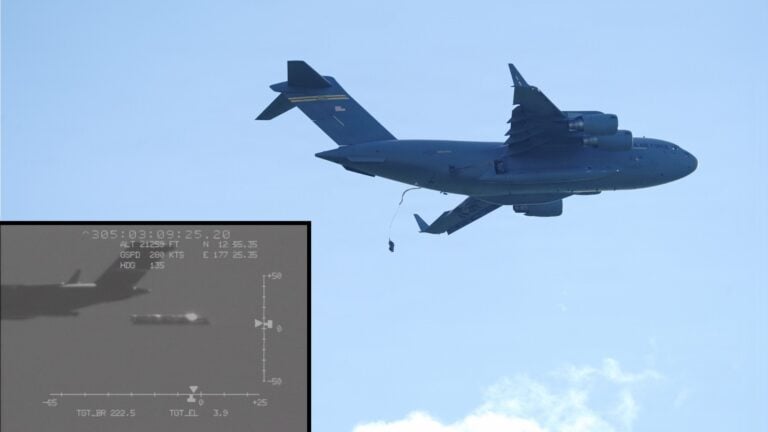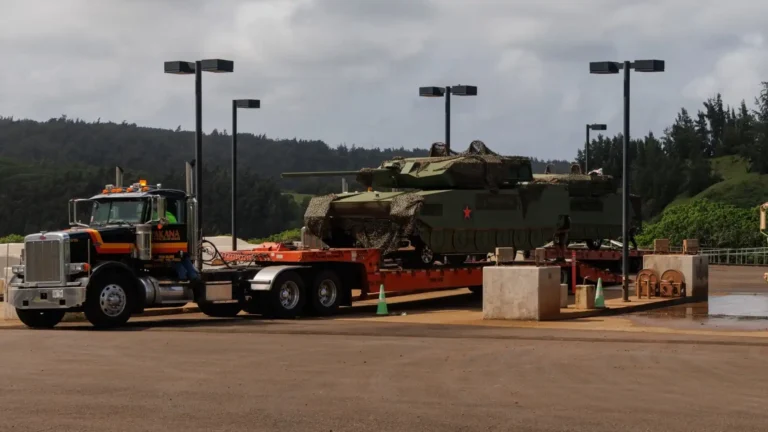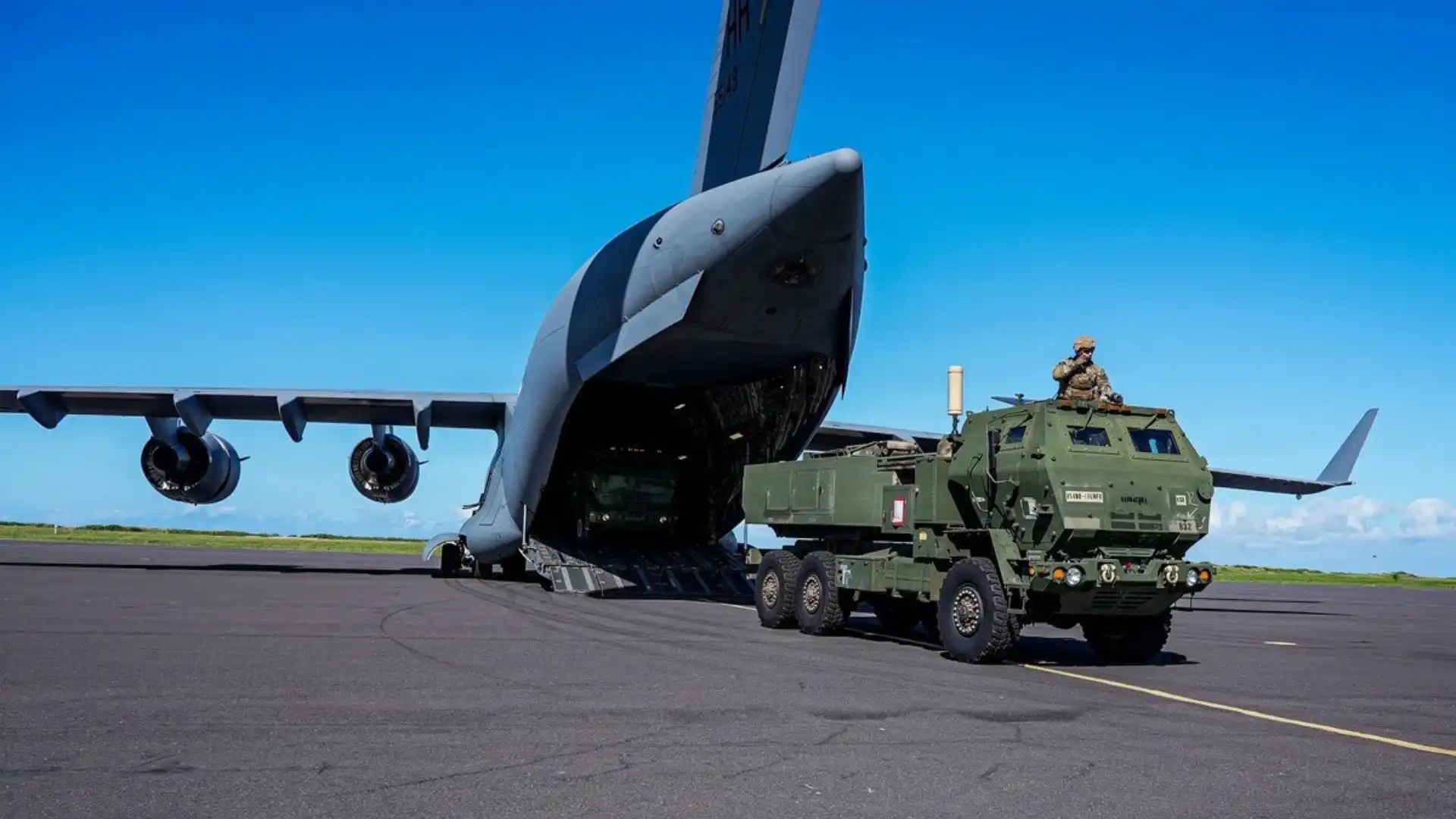
The U.S. Army’s 25th Infantry Division flew M142 High Mobility Artillery Rocket System (HIMARS) launchers onto the island of Kauai aboard U.S. Air Force C-17 Globemaster III transports and executed a HIMARS Rapid Infiltration (HIRAIN) dry-fire mission during Joint Pacific Multinational Readiness Center (JPMRC) Rotation 27-01, the Army announced on November 10, 2026. Launchers from the 2nd Battalion, 11th Field Artillery Regiment (2-11 FA) were offloaded, moved directly into a firing posture and executed a simulated fire mission.
Rotation 27-01 of JPMRC, U.S. Army Pacific’s regional Combat Training Center, runs throughout November 2026 and brings together approximately 7,000 personnel, with force-on-force operations that began on November 7. The Kauai event caps a year in which 2-11 FA has rehearsed expeditionary fires across the Pacific: the battalion flew a HIRAIN into Wake Island during JPMRC 26-01 on November 13, 2025, conducted a C-130-supported HIRAIN during Balikatan 2026 in the Philippines, and in February 2026 tested a maritime variant, the littoral rapid infiltration (LORAIN), aboard the Army’s new Maneuver Support Vessel (Light). The division is now preparing its forces for Operation Pathways deployments to the Philippines in spring and summer 2027.
How the HIMARS Rapid Infiltration Unfolded on Kauai
The HIRAIN concept trades permanence for survivability. A launcher is flown into an austere strip, fires and departs before an adversary can organize counterfire, denying the enemy a static target. On Kauai, C-17s from the 15th Wing, based at Joint Base Pearl Harbor-Hickam, delivered the launchers, and Army crews then had to drive them off the ramp ready to shoot.
That handoff depends on coordination between Army crews and Air Force loadmasters, who must load, secure and release the 6×6 launchers without delay. 1st Lt. Cameron Richardson, a platoon leader in Bravo Battery, 2-11 FA, said speed and accuracy define the mission. “For us, a strike means being quick, so making sure that we’re up on all communications, and it means being accurate,” he said. Col. Kyle Clinton, the 15th Wing commander, said the C-17 can reposition equipment into austere or contested environments regardless of distance.
The fire mission ran over what the Army described as encrypted networks, “Super-Intelligence” decision aids and next-generation command and control software. Commanders processed sensor data, confirmed targets and synchronized the simulated strike with the broader scheme of maneuver, while the close ground fight of the rotation played out on Oahu and Hawaii Island. The Army did not name the software or say whether it is linked to its Next Generation Command and Control (NGC2) effort.
Army imagery dates the Kauai mission to November 10, 2026, but several parameters remain undisclosed: the number of launchers and aircraft involved, the Kauai airfield used and the elapsed time from landing to takeoff. For reference, a HIRAIN during Red Flag-Alaska was completed in 49 minutes.
M142 HIMARS Payload, Range, and Air Mobility in the Pacific
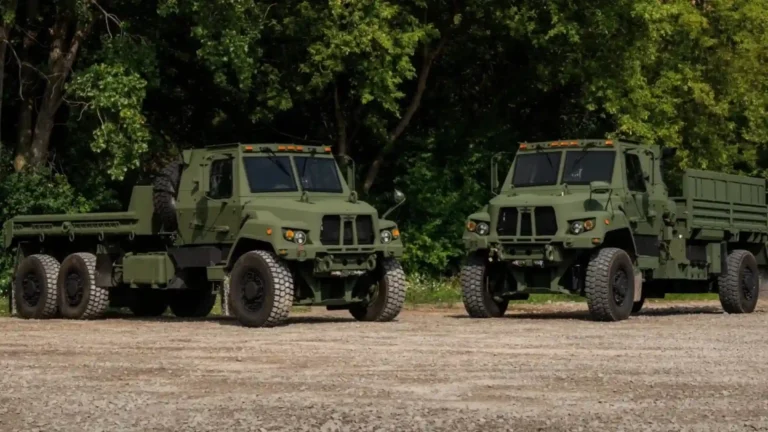
The M142 is a wheeled launcher built by Lockheed Martin on a 5-ton Family of Medium Tactical Vehicles (FMTV) 6×6 chassis and operated by a three-soldier crew. Publicly available specifications indicate it carries a single launch pod holding six Guided Multiple Launch Rocket System (GMLRS) rockets with a range of roughly 70 km, one Army Tactical Missile System (ATACMS) missile reaching up to 300 km, or two Precision Strike Missiles (PrSM), with the Increment 1 version rated beyond 400 km. A PrSM Increment 2 with a seeker for moving maritime targets is in development. The Army did not state which munition the Kauai dry-fire simulated.
Air mobility is the attribute HIRAIN exploits. HIMARS fits inside a C-130 Hercules, and a single C-17 has carried two launchers in previous HIRAIN missions. That separates it from the tracked M270 Multiple Launch Rocket System, which carries two pods but is too heavy for the C-130 and far harder to push into short island strips.
In an archipelago, range converts directly into geography. A PrSM-armed launcher landed on one island can hold straits and sea lanes at risk from a position the adversary must first detect and target before it moves. Col. Bryan Fanning, commander of the 25th Division Artillery Brigade, framed Kauai in those terms. “Training here in Hawaii is exactly what prepares us to fight anywhere in the Pacific by rehearsing these short-notice deployments into contested terrain,” he said.
Analysis: With at least four air and sea insertion rehearsals in roughly 12 months, the Army is treating HIRAIN as a routine capability for 2-11 FA rather than a set-piece demonstration. A dry-fire rotation, however, tests the logistics and command chain, not the hardest part of the problem. In a conflict, the C-17 and the austere runway are themselves high-value, highly visible targets, and the airlift fleet will face competing demands across the theater. That is why the parallel LORAIN track matters: watercraft give the division a second insertion path when airfields are contested or unavailable. Until the Army releases timelines and live-fire results, the gap between rehearsing the concept and sustaining it under fire remains the central unknown.
JPMRC 27-01 continues through November 2026. The next marker is Operation Pathways, which will send 25th Infantry Division forces to the Philippines in spring and summer 2027, where air and sea infiltration could be rehearsed alongside regional allies. Open questions include whether those rotations will feature live GMLRS or PrSM fires from partner territory, how many launchers the division can insert simultaneously, and whether the Army will publish timing data that would allow the concept’s survivability claims to be measured.