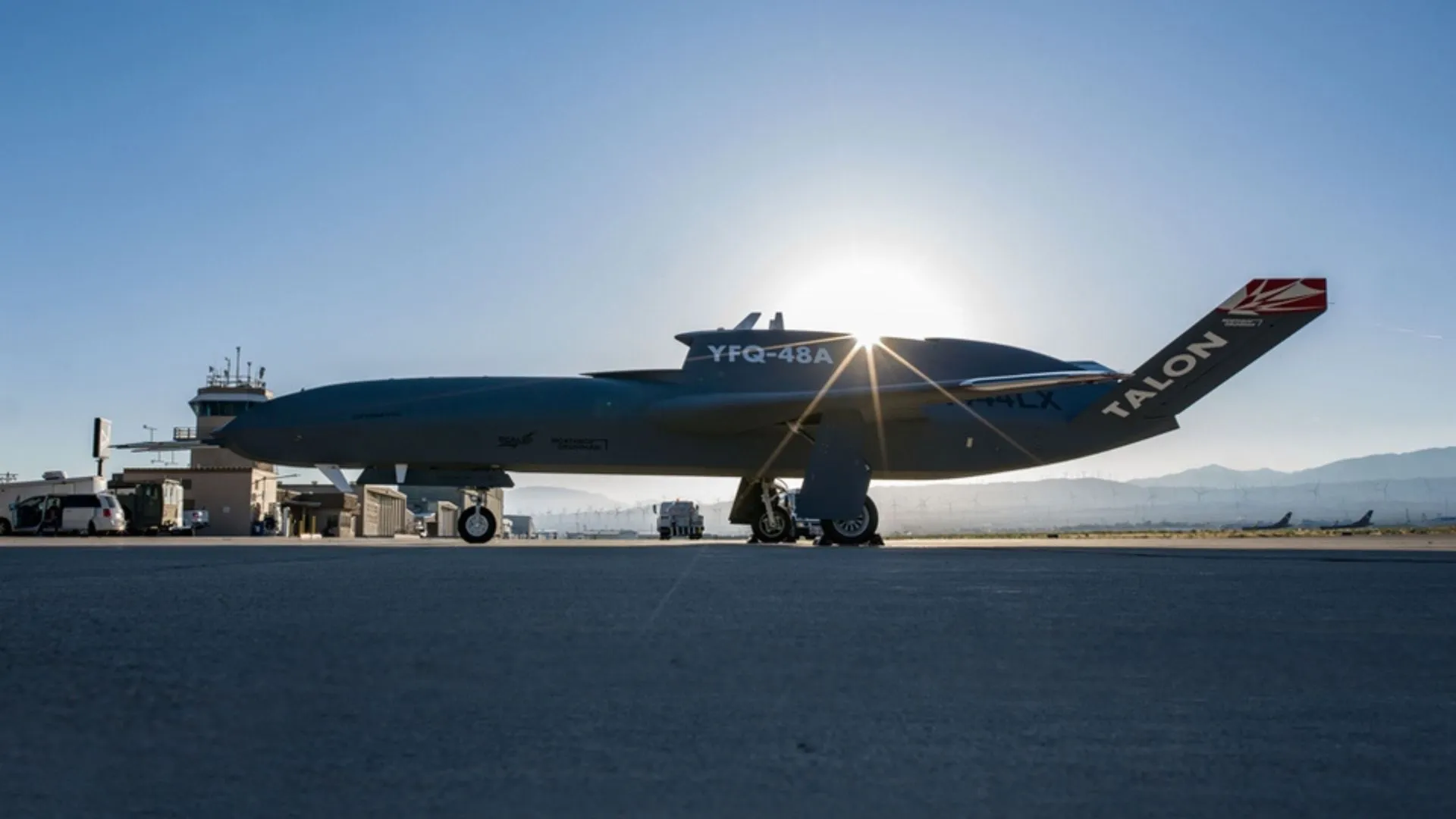
The Royal Navy will fly Northrop Grumman’s YFQ-48A Talon collaborative combat aircraft (CCA) from a Queen Elizabeth-class aircraft carrier in UK waters in 2027, First Sea Lord General Sir Gwyn Jenkins announced on November 10, 2026, as first reported by Navy Lookout. Speaking aboard HMS Prince of Wales at the International Sea Power Conference in Oslo, Norway, Jenkins said he would sign a statement of intent with Northrop Grumman on November 12, 2026, to prepare the Talon CCA demonstrator for trials under Project VANQUISH, including a launch from HMS Prince of Wales.
The announcement delivers on a target Jenkins set in his inaugural speech in September 2025, when he called for the first jet-powered CCA to launch from a carrier flight deck by 2027. The Ministry of Defence (MoD) told Parliament in June that it planned a carrier demonstration within 18 months, without naming an aircraft. The trial will generate evidence on how an autonomous jet operates alongside the F-35B Lightning II and the carriers’ Merlin and Wildcat helicopters; it does not commit the UK to buying the type.
Talon CCA Airframe, Propulsion and Low-Observable Design Choices
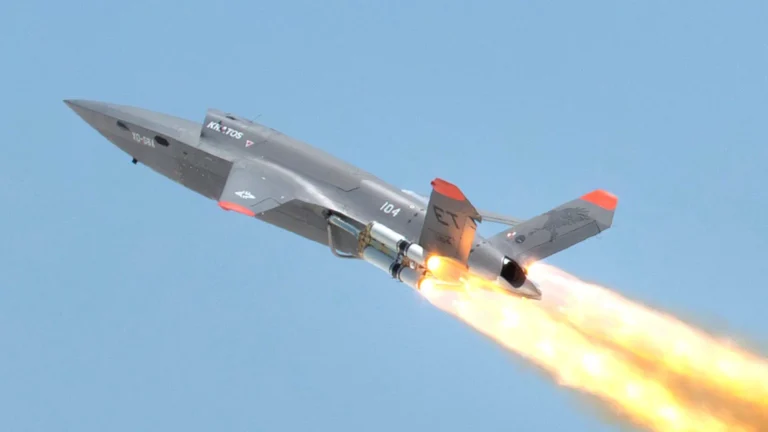
Developed by Northrop Grumman and its subsidiary Scaled Composites as a company-funded effort launched in 2023, Talon was unveiled at the Mojave Air and Space Port in California on December 3, 2025. The US Air Force subsequently assigned it the Mission Design Series designation YFQ-48A, with the name Talon Blue. The aircraft made its first flight from Mojave in October 2026; Northrop Grumman reported that the sortie was fully autonomous from taxi through takeoff, maneuvering and landing.
Talon traces directly to Northrop Grumman’s unsuccessful bid for the US Air Force CCA Increment 1 competition. According to the company, the new design is roughly 450 kg (about 1,000 lb) lighter and uses about half as many parts as that earlier proposal, reflecting a goal of validating faster, cheaper manufacturing for large uncrewed aircraft. Tom Jones, president of Northrop Grumman’s aeronautics systems business, has called the result cheaper and more capable.
The airframe is all-composite, with a low-aspect-ratio lambda wing planform, two outward-canted tail surfaces and a broad, flattened nose bounded by a sharp chine. A trapezoidal dorsal inlet feeds a single engine whose exhaust is partially recessed between the tails, and several panels carry sawtooth edges. The shaping points to deliberate radar cross-section reduction, particularly in the frontal aspect.
Propulsion comes from a single Pratt & Whitney Canada PW500-series turbofan, a commercial business-jet engine family. Northrop Grumman has not disclosed which variant Talon uses, nor its wingspan, maximum takeoff weight, payload or endurance. The company says the engine went through an extended test program to expand its operating limits for CCA missions. The landing gear is borrowed from an existing aircraft type, a choice that matters on a pitching deck.
Project VANQUISH and the Carrier Recovery Problem Without Arresting Gear
Project VANQUISH is the technical demonstration arm of the Royal Navy’s Fixed-Wing Short Take-Off and Landing Autonomous Collaborative Platform (FW STOL ACP) effort, itself part of the Maritime Aviation Transformation (MATX) strategy. MATX lays out a roadmap for moving the Fleet Air Arm toward a largely uncrewed aviation force by 2040, built around a hybrid air wing of F-35Bs, helicopters and uncrewed aircraft.
The original MoD request for information sought a high-subsonic, short take-off and landing jet with credible endurance and payload, able to embark and operate autonomously from a Queen Elizabeth-class carrier without catapults or arresting gear. Candidate missions included intelligence, surveillance and reconnaissance (ISR), strike and air-to-air refueling.
That requirement collides with Talon’s origins as a land-based design. The 65,000-tonne Queen Elizabeth-class ships are configured for short take-off and vertical landing (STOVL) operations, with a bow ski-jump and no recovery equipment for conventional aircraft. The announcement explicitly covers a launch; officials have not said whether the 2027 event will include a recovery aboard. Without arresting wires, a conventional jet must stop within the available deck run, a demanding profile for an undercarriage not designed for carrier impact loads. Whether Talon’s gear needs modification for repeated deck landings, potentially with other aircraft spotted on deck, remains open.
HMS Prince of Wales has relevant precedent. In November 2023, General Atomics Aeronautical Systems’ Mojave, a turboprop-powered, remotely piloted short-field aircraft, took off from and landed back aboard the carrier off the US East Coast, proving a large fixed-wing uncrewed aircraft could use the existing deck. Talon moves the problem into a different class: a jet-powered, autonomous aircraft intended to operate as a teammate to the F-35B.
Analysis: The value of the 2027 trial lies less in Talon as a candidate airframe than in the sortie-generation data it will produce. A hybrid air wing only adds combat power if uncrewed jets can be launched, recovered, moved and maintained without slowing the F-35B and helicopter flying cycle. Trialing an existing US demonstrator lets the Royal Navy test those assumptions before committing to an operational type. Recovery without arresting gear remains the decisive engineering risk for the VANQUISH concept.
Jenkins signs the statement of intent aboard HMS Prince of Wales on November 12, 2026. Talon must then build land-based flight experience before any shipboard attempt. Open questions include whether the 2027 demonstration will include a landing, what mission systems the aircraft will carry, and which operational aircraft, with what UK industrial share, eventually follows.