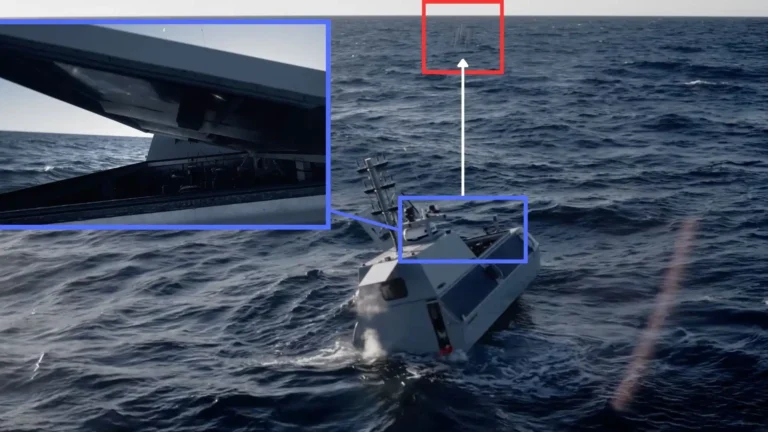
The Royal Navy has contracted Saab UK to integrate lightweight counter-drone radar systems into its fleet of Kraken K3 Scout uncrewed surface vessels (USVs), Minister for Defence Readiness and Industry Luke Pollard announced on November 10, 2026, at the International Sea Power Conference aboard HMS Prince of Wales in Oslo. Saab valued the award at £15 million and identified the sensor as its Sea Giraffe 1X.
The contract turns an industry experiment into a funded program within weeks. Saab UK and Fareham-based Kraken Technology Group unveiled a prototype “drone seeker” pairing the radar with a K3 Scout on October 5, 2026, after a development effort the companies say took less than seven months. The award also follows the commissioning of the Royal Navy’s 1st Autonomous Squadron in Portsmouth on November 5 and was announced alongside a framework agreement with Ocean Infinity Solutions that opens the door to an initial £90 million investment in the Atlantic Net undersea surveillance network.
How Sea Giraffe 1X Turns the K3 Scout USV Into a Picket
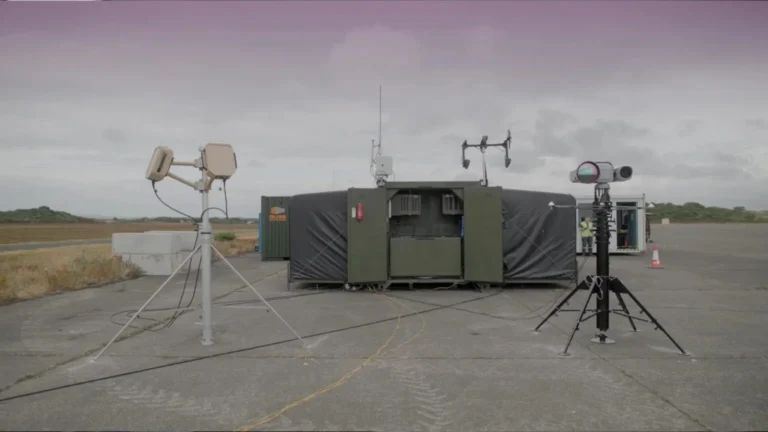
The Sea Giraffe 1X is an X-band, three-dimensional active electronically scanned array (AESA) radar. Saab lists the complete system at under 150 kg, with 100 kg mounted topside, and a full search-volume update every second. It detects air and surface targets simultaneously, and Saab UK and Kraken say trials showed the system detecting, tracking and classifying airborne targets while the boat operated autonomously at sea. On the K3 Scout, the radar is integrated into the vessel’s modular payload bay.
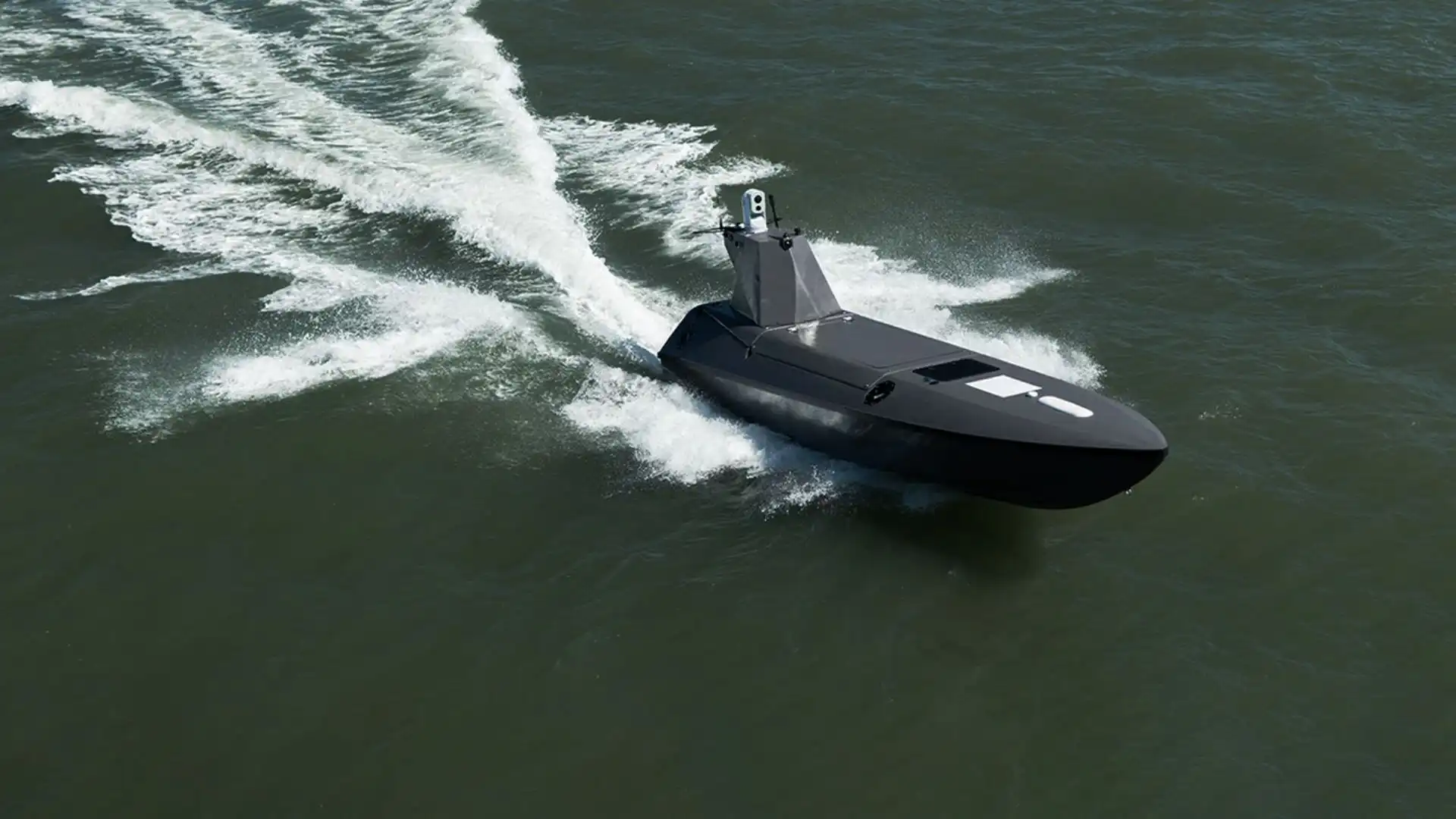
Publicly available specifications indicate the K3 Scout Medium measures 8.4 m in length, with a 1.93 m beam, a 0.8 m draft and a maximum displacement of 2,500 kg. Its payload capacity is 600 kg. An inboard diesel with stern drive gives a top speed of 55 knots and a range of 650 nautical miles at 25 knots, with endurance of up to 30 days depending on mission profile. The boat runs on the Auterion operating system, and Kraken says its modular payload bay lets the Royal Navy re-role the boat without modifying the platform. At under 150 kg, the radar uses only a quarter of that 600 kg payload allowance.
The operational logic is geometric. A frigate’s mast-mounted radar sees low-flying drones only out to its own horizon. A K3 Scout pushed forward along the threat axis moves that horizon with it, and Saab says the boats can operate alone or alongside crewed ships to extend surveillance coverage and provide earlier warning. According to the Royal Navy, the pairing will provide an air surveillance picture supporting the early detection of hostile air tracks for subsequent engagement. The contract funds a sensor, not a weapon.
Project Beehive Payloads and the Commercial X Acquisition Model
The K3 Scout entered Royal Navy service through Project Beehive, under which the Ministry of Defence (MoD) ordered 20 boats from Kraken in March 2026 for £12.3 million, along with training, tactical development and experimentation support. Beehive serves as the proving ground for the hybrid navy concept championed by First Sea Lord General Sir Gwyn Jenkins, which pairs crewed warships with uncrewed and autonomous systems. Captain Adam Ballard, deputy commander of the Royal Navy’s Surface Flotilla, called the Saab award Beehive’s “first major step in integrating complex payloads.” The contract covers further development and integration into Royal Navy operations, not only hardware delivery.
Pollard presented the K3 as a working capability rather than a demonstrator, describing “small, uncrewed, formidable boats” that patrol the UK coastline for extended periods without placing sailors in danger. He said the radar integration would further protect “our naval assets, ports and critical infrastructures.” He named Commercial X, a new unit set up to overhaul maritime acquisition, as part of the industry and Navy team behind Atlantic Net, which he said would go from concept to service in two years, around half the usual time.
Both suppliers build in Fareham, Hampshire, where the K3 Scout and the Giraffe 1X are manufactured. Series production of the K3 Scout has also been under way at Rheinmetall’s Blohm+Voss shipyard in Hamburg since April 2026.
Analysis: The contract shows the Royal Navy treating airborne early warning, not strike, as the first mission set worth funding for its small USVs. Drone and one-way attack campaigns in the Red Sea and Black Sea have demonstrated that warning time, as much as interceptor inventory, drives a warship’s survivability. Spreading sensors across inexpensive hulls also reduces dependence on a single high-value radar per task group. The constraints are equally clear: each picket extends coverage along a single threat axis, must carry enough fuel to hold station, and depends on a datalink that adversaries will target with electronic warfare.
Saab has said only that the contract covers several radars, and neither the MoD nor Saab has disclosed the exact quantity or a delivery schedule. The next indicators to watch are whether the integration extends to a cueing link with the weapons of crewed escorts, and whether radar-equipped K3 Scouts join UK contributions to Joint Expeditionary Force (JEF) operations in the North Atlantic, where the boat’s A400M airdrop capability, demonstrated in July 2026, offers a route to rapid deployment.