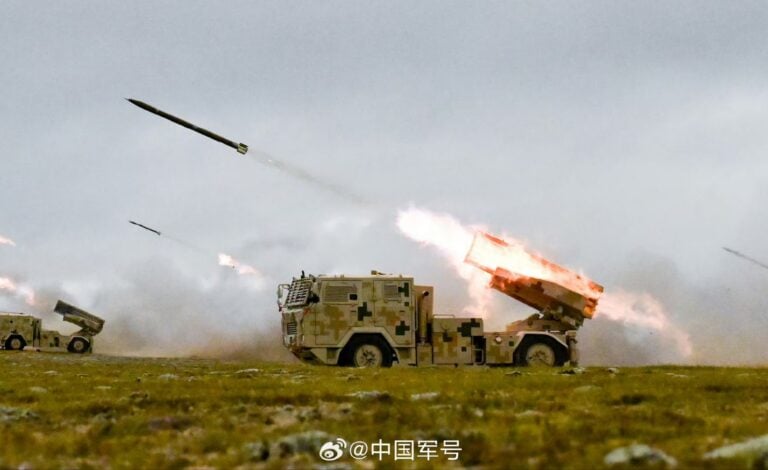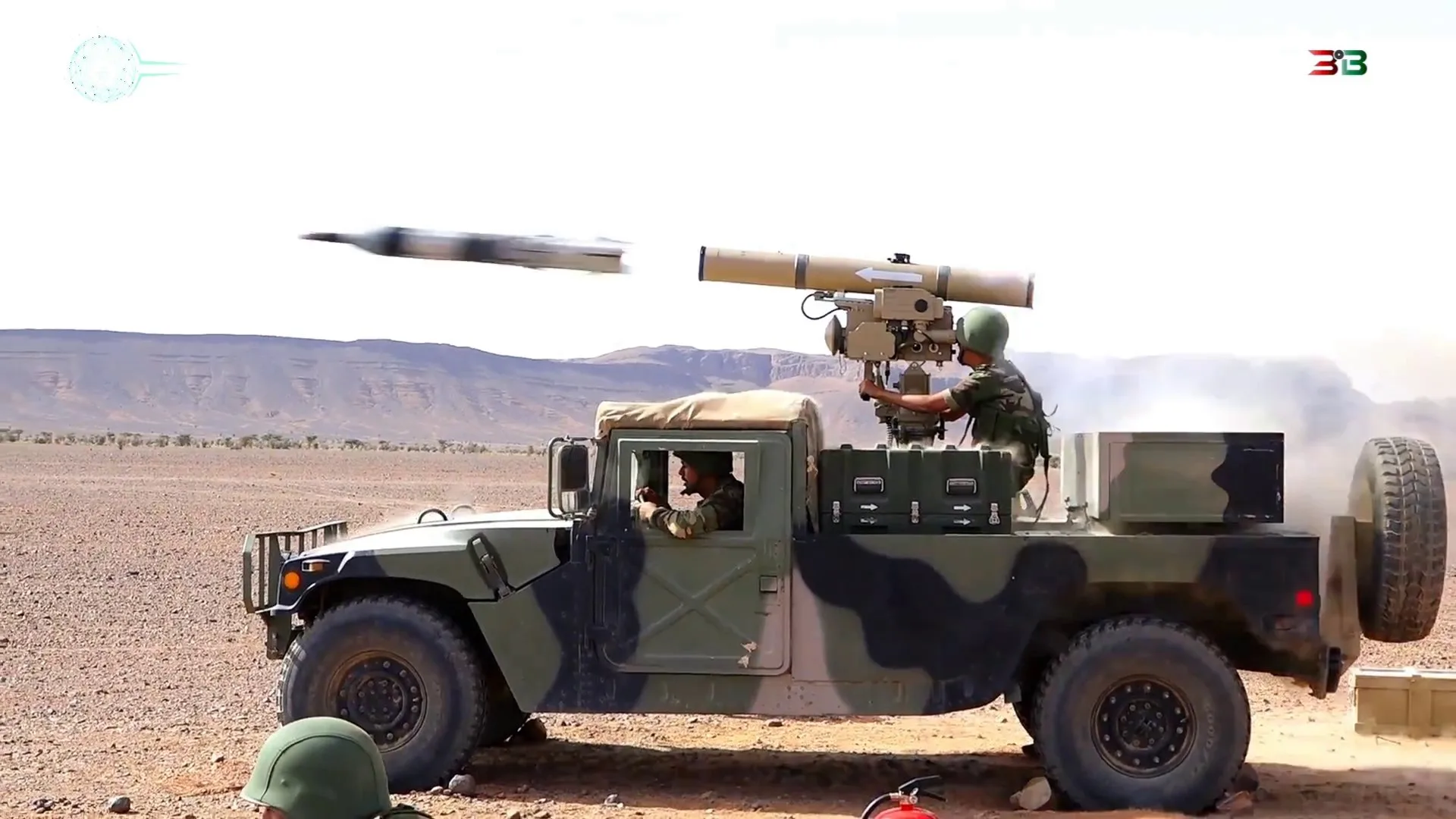
Officer cadets at Morocco’s Royal Military Academy in Meknes fired a Chinese HJ-9A anti-tank missile, also known as Red Arrow 9A, from a US-built Humvee during a graduation live-fire exercise this month. Imagery shared on November 15, 2026, by Chinese military commentator Dianbo shows the launcher mounted directly on the High Mobility Multipurpose Wheeled Vehicle (HMMWV), pairing a Chinese weapon system with an American carrier vehicle inside the same Moroccan unit. Dianbo credits the missile with a 5,500-meter maximum range and 1,200 mm of armor penetration.
The firing confirms the HJ-9A remains in active use with the Royal Moroccan Armed Forces (FAR) three and a half years after its first public appearance in May 2023, when Royal Moroccan Navy units showcased it during exercises marking the 67th anniversary of the armed forces. Its use in an officer graduation drill indicates the system is now part of the institutional training pipeline, not a niche purchase. It also sits inside an anti-armor inventory that Rabat has built overwhelmingly around US-supplied missiles.
HJ-9A Anti-Tank Missile Guidance, Range and Warhead
Developed by China North Industries Group Corporation (Norinco), the HJ-9A was first shown publicly in 2005 as an upgrade of the HJ-9 heavy anti-tank guided missile (ATGM) fielded by the People’s Liberation Army Ground Force. Dianbo described it as an export-oriented system of “second-and-a-half generation” design that uses millimeter-wave command guidance. A charge-coupled device (CCD) goniometer at the guidance station measures the missile’s deviation from the aiming line and generates correction commands, which a millimeter-wave antenna transmits to a receiver in the missile’s tail.
The baseline HJ-9 sends the same commands over a laser link. According to Dianbo, the millimeter-wave radio channel of the HJ-9A is more reliable in heavy fog, rain, and battlefield smoke, conditions that degrade optical transmission. Some open-source references instead describe the HJ-9A as using semi-active millimeter-wave radar guidance; either way, the gunner must keep the sight on the target until impact, so the system offers no fire-and-forget capability.
Dianbo gives the HJ-9A a maximum range of 5,500 meters and a tandem shaped-charge warhead designed to defeat explosive reactive armor (ERA), with the main charge credited with 1,200 mm of static rolled homogeneous armor (RHA) penetration. Published specifications for the HJ-9 missile family list a weight of about 37 kg in its launch container, a 152 mm diameter, and a length of roughly 1,200 mm. On paper, that range exceeds the roughly 3,750 meters commonly cited for the TOW-2A, giving Moroccan vehicle crews a longer standoff band against armor.
Morocco Mixes Chinese HJ-9A With US Javelin and TOW-2A
Morocco sources most of its heavy weapons from the United States, including M1 Abrams tanks and the M142 High Mobility Artillery Rocket System (HIMARS). Its two principal anti-tank missiles are also American. On September 12, 2019, the State Department approved a possible $776 million sale of 2,401 TOW-2A radio frequency missiles and up to 400 M220A2 or M41 Improved Target Acquisition System launchers. On March 19, 2024, it approved a further $260 million package of 612 FGM-148F Javelin missiles and 200 Lightweight Command Launch Units.
The HJ-9A is not Rabat’s only Chinese anti-armor system; the FAR also fields the wire-guided HJ-8L. Morocco has disclosed neither the number of HJ-9A launchers and missiles acquired nor the contract value or delivery date. Other African users include Rwanda, which displayed the HJ-9A on Otokar Cobra vehicles in December 2018, and Mauritania, which according to Dianbo purchased a vehicle-mounted quadruple-launcher version.
Analysis: The HJ-9A does not compete with the Javelin; it fills a different niche. Javelin gives Moroccan infantry a man-portable, fire-and-forget top-attack weapon, while the HJ-9A is a heavier, command-guided, vehicle-mounted system optimized for long-range engagements in open terrain and poor visibility. Mixing suppliers also gives Rabat a channel that does not depend on US congressional notification, a practical hedge as it modernizes its forces amid a sustained arms competition with Algeria.
Key questions remain open: how many HJ-9A systems Morocco holds, whether they are being distributed beyond the Navy and training units to army formations, and whether Rabat will pursue newer Norinco systems such as the HJ-10 or HJ-12. The next public indicator is likely the FAR anniversary exercises in May 2027, alongside the pace of Javelin deliveries under the 2024 approval.