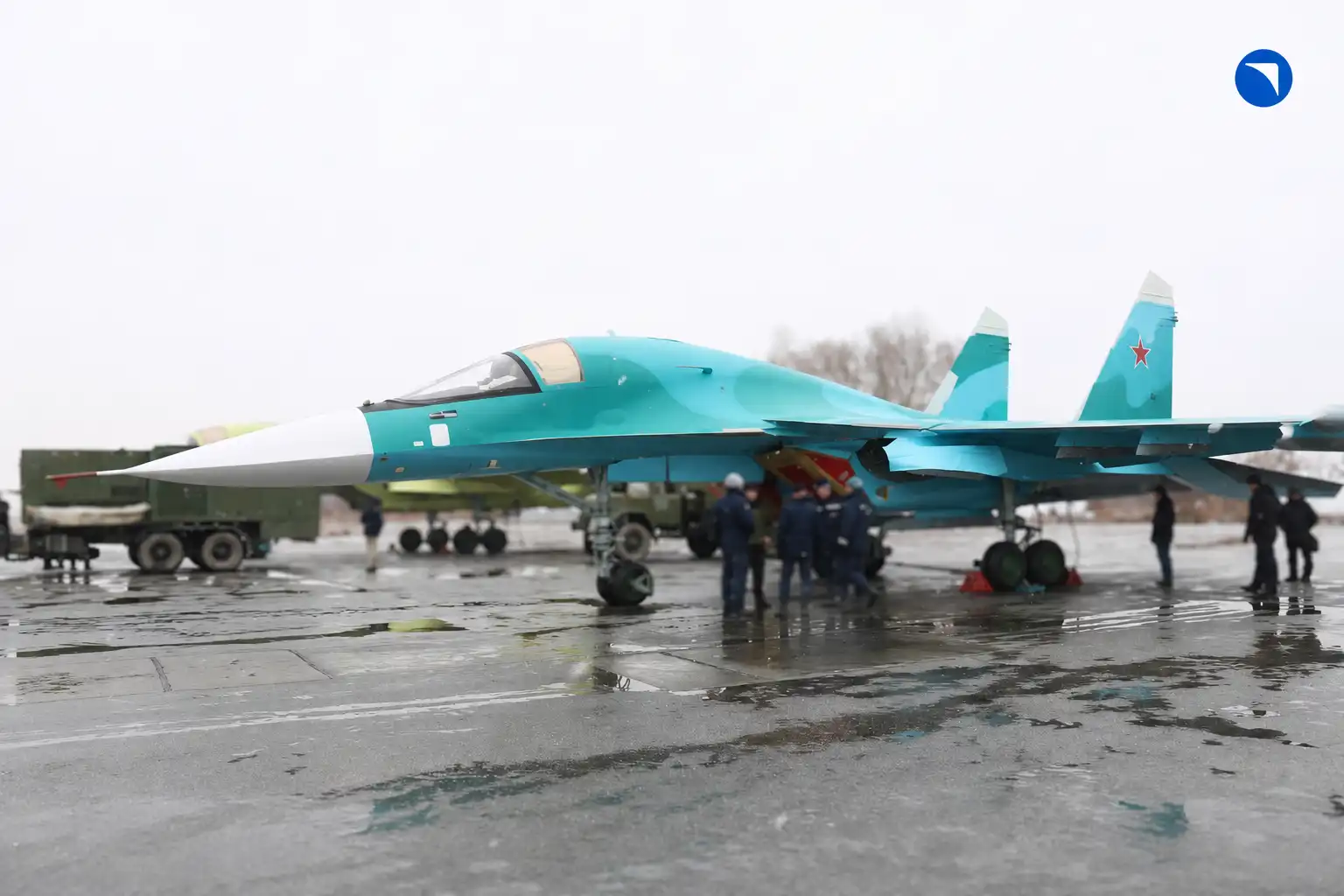
Russia’s United Aircraft Corporation (UAC), the aviation arm of state conglomerate Rostec, delivered a new batch of Su-34 fighter-bombers to the Russian Ministry of Defense on November 17, 2026, the third Su-34 handover the company has announced this year. According to a UAC statement, the aircraft completed the full cycle of ground and flight factory tests before flying to their assigned units. As with previous deliveries, the company disclosed neither the number of airframes nor their destination.
The handover follows announced deliveries on July 9 and October 7, 2026, and comes after a 2025 production year in which Rostec publicized seven Su-34 batches, the last on December 10, 2025. The cadence matters because the Su-34, known to NATO as Fullback, carries a large share of Russia’s air-to-ground campaign in Ukraine and has suffered some of the heaviest losses of any Russian combat aircraft type. The open-source group Oryx, which counts only losses backed by photo or video evidence, has documented more than 40 Su-34s destroyed or damaged since the full-scale invasion began in February 2022.
Third Su-34 Batch of 2026: Output and Fleet Numbers
Neither Rostec nor UAC publishes batch sizes. Analysts tracking the program estimate that a typical Su-34 batch comprises two to four aircraft. Moscow’s Center for Analysis of Strategies and Technologies (CAST) assessed that the Russian Aerospace Forces (VKS) had received 212 Su-34s by early 2026, including seven prototype and pre-production aircraft, with 15 to 16 serial airframes delivered in 2024 and about 18 in 2025.
Applied to three announced handovers, the two-to-four range implies six to 12 aircraft delivered so far in 2026, which would trail the 2025 figure. That estimate carries a wide margin: Rostec does not necessarily announce every delivery, and the 2025 pattern included a year-end batch in December.
Production takes place at the Chkalov Novosibirsk Aviation Plant, a Sukhoi branch within UAC. Rostec said its aviation plants are “constantly improving production processes” to keep deliveries on schedule. UAC General Director Vadim Badekha said the company maintains “a high pace of production of combat aviation equipment” and continues to refine aircraft in service using “the results of their combat use during a special military operation,” the Kremlin’s term for the war in Ukraine.
Fullback Design, Armament and Role in Glide-Bomb Strikes
Publicly available specifications describe the Su-34 as a two-seat, twin-engine strike derivative of the Su-27 family, with pilot and weapon systems officer seated side by side in an armored titanium cockpit capsule. Two Saturn AL-31F-M1 afterburning turbofans, each rated at about 13,500 kgf, give a maximum speed of around Mach 1.8 at altitude and a maximum takeoff weight of 45,100 kg. Open sources cite an unrefueled combat radius of about 1,100 km and a ferry range of 4,000 km, extendable through in-flight refueling.
The aircraft carries up to 8,000 kg of ordnance on 12 hardpoints, plus an internal GSh-30-1 30 mm cannon. Its sensor and survivability suite centers on the Leninets V004 passive electronically scanned array radar and the Khibiny electronic warfare system. An unnamed VKS crew commander quoted by Rostec said the type “can strike ground, surface and air targets, including in difficult weather conditions and with active opposition to air defense.”
Over Ukraine, that payload and radius have been channeled into one dominant mission: releasing FAB-series bombs fitted with UMPK glide-and-correction kits from Russian-held airspace, at standoff distances commonly cited at 40 to 70 km. The tactic keeps crews beyond most Ukrainian short-range air defenses while delivering bombs ranging from 250 kg to 3,000 kg against front-line positions and towns. It also exposes the fleet to long-range surface-to-air missiles and to Ukrainian strikes on its airfields.
Analysis: Su-34 deliveries now function as an attrition-replacement pipeline rather than a fleet expansion program. Documented losses of more than 40 airframes since 2022 average roughly nine per year, and that count is a floor given the visual-confirmation standard behind it. Against annual output of 15 to 18 aircraft, Novosibirsk replaces documented losses and adds modest net growth, not a step change in capacity. For NATO planners, the more relevant signal is that sanctions have not halted serial production of Russia’s primary tactical strike platform, and that UAC states it is feeding combat feedback into the build standard. That sustains the glide-bomb model of attack that has shaped front-line fighting in Ukraine.
The next marker is whether Rostec announces a fourth 2026 batch in December, mirroring last year’s year-end delivery. Key unknowns remain the size of each batch, the units receiving the aircraft, and the share of imported components in current airframes. Rostec also did not say whether the new jets are built to the modernized Su-34M standard, which has appeared in earlier deliveries; details of that configuration would offer the clearest indication of how far combat lessons are reshaping the Fullback.