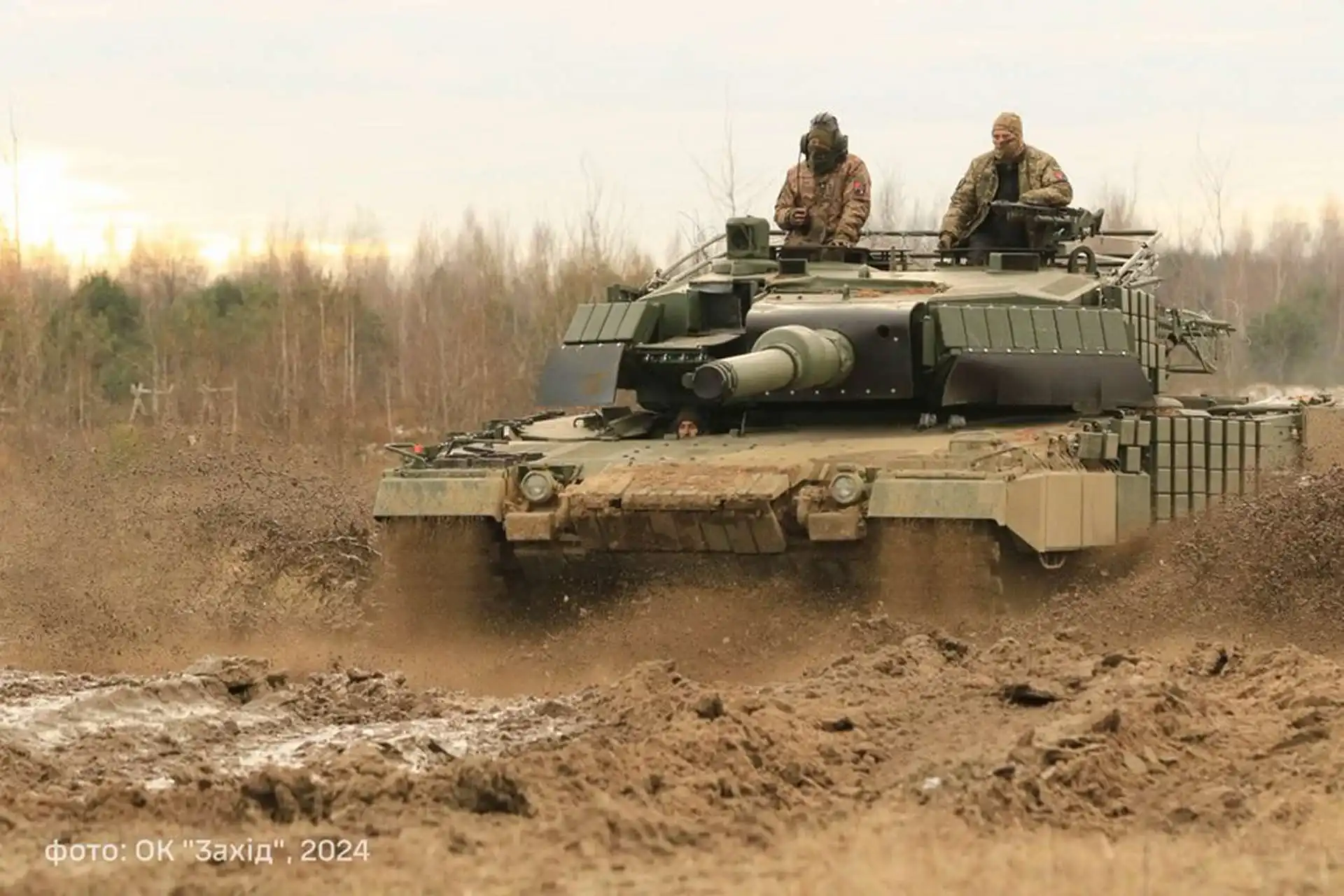
A Ukrainian Leopard main battle tank absorbed 45 first-person-view (FPV) drone strikes during Operation Vivaldi and remains operational, according to a Ukrainian brigade commander who took part in the offensive. Rob Lee, a senior fellow at the Foreign Policy Research Institute (FPRI), relayed the account on November 14, 2026, writing that the commander “still values tanks and thinks we will see successful armored assaults in the future.”
The claim lands in a renewed argument over armor on a drone-saturated battlefield. Satellite imagery compared by Radio Free Europe/Radio Liberty journalist Mark Krutov and other open-source analysts shows newly built T-90M tanks arriving at Russia’s 22nd Central Reserve Base in Buy, Kostroma region, between fall 2025 and October 2026, prompting some commentators to argue that Moscow is stockpiling vehicles with little combat value. Operation Vivaldi, the 3rd Army Corps counteroffensive in the Lyman sector of northern Donetsk Oblast, offers a field test of the opposite view. Brig. Gen. Andrii Biletskyi declared it complete on October 19, 2026, claiming 277 square kilometers retaken.
Ukrainian Leopard Tank Survivability Against Repeated FPV Drone Strikes
Neither the brigade nor the Leopard variant has been identified, and the 45-strike figure has not been independently verified. Ukraine operates Leopard 2A4, Leopard 2A6 and Stridsvagn 122 tanks alongside refurbished Leopard 1A5s, so the vehicle could belong to either generation. The count also refers to strikes, not penetrations. Most FPV drones carry a single shaped-charge or fragmentation warhead, often adapted from RPG-7 rounds, and many detonate against screens, slat armor or explosive reactive armor (ERA) before reaching the base hull.
The account fits an established pattern. In February 2026, a Leopard 1A5 of the 5th Separate Heavy Mechanized Brigade took 52 hits from FPV drones and Molniya-type loitering munitions in a single day without armor penetration; the crew drove it off the position and the tank returned to service after repair. The brigade had developed its own protection package, known as Leopard 1A5V. Ukrainian Leopard 2A4s have similarly been fielded with Kontakt-1 ERA and overhead cages.
Design matters as much as add-on kits. Publicly available specifications indicate the Leopard 2A4 weighs about 55 tonnes, runs on a 1,500 hp MTU MB 873 diesel and carries 42 rounds for its 120 mm L/44 smoothbore gun. Fifteen rounds sit in a turret bustle magazine separated from the crew by a sliding door and fitted with blow-out panels that vent an ammunition fire outward. The other 27 are stowed in the forward hull beside the driver, a known weak point. The layout reduces, but does not eliminate, the odds that one penetrating hit triggers a catastrophic loss.
Ammunition Stowage and Armored Assault Lessons From Operation Vivaldi
The Russian side of the same battle illustrates the point. Ukrainian analyst and veteran Dmytro Putyata said Ukrainian forces used 52 FPV drones over a couple of hours against a Russian T-62M obr. 2022, a refurbished Soviet-era tank with a newer thermal sight, and it did not burn “because it didn’t have ammunition inside.” Ammunition cook-off, not structural damage, is what usually produces the fireballs seen in strike videos. T-72 and T-90 derivatives keep 22 rounds in a carousel autoloader under the turret floor, inside the crew volume.
Russia is pursuing hard-kill answers too. During a July 2026 mechanized assault near Maiak, Russian tanks used an Arena-M active protection system modified against FPV drones; Putyata reported that the system on one tank destroyed seven drones, and that Ukrainian operators needed 15 to 20 FPVs per tank kill.
Vivaldi also showed how Ukraine now employs armor. In an October 20, 2026 review, Biletskyi described two mechanized assaults. In the first, four armored vehicles crossed the line of contact and delivered infantry close to Russian drone crews; one vehicle was hit but withdrew under its own power, and the action helped partially envelop Nove. In the second, vehicles pushed about 4.5 kilometers past the line before dismounting infantry, who held out for several days destroying drone positions. Crews trained specifically for the raids, vehicles received extra equipment, and commanders wargamed the plan. Biletskyi said he remained skeptical almost until launch but chose not to block the brigade’s initiative. The vehicle types have not been disclosed.
Analysis: The Vivaldi accounts move the question from whether tanks survive FPV drones to what it costs the attacker to stop one. A tank that absorbs 45 strikes and stays in service has consumed drones and operator sorties unavailable against infantry or logistics. That holds only under specific conditions: compartmentalized ammunition, layered protection, electronic warfare cover and corps-level planning. Frontline testimony shows the limits. A tank operator with the 28th Separate Mechanized Brigade says tanks are used noticeably less than in previous years, and a drone operator with the 23rd Separate Mechanized Brigade calls them very rare in his sector because of the depth of the kill zone. For NATO armies fielding Leopard 2A8s and modernized Abrams, survivability now depends on integration with counter-drone assets as much as on armor. Russia’s new T-90Ms face the same test.
Key unknowns remain: the Leopard’s variant and unit, how many of the 45 strikes penetrated, and how much repair the tank required. Kyiv has not said whether the 3rd Army Corps raid model will spread to other formations. Satellite monitoring of Russian storage bases will show whether new T-90Ms stay in reserve or move to the front, and whether they arrive with drone-specific protection.