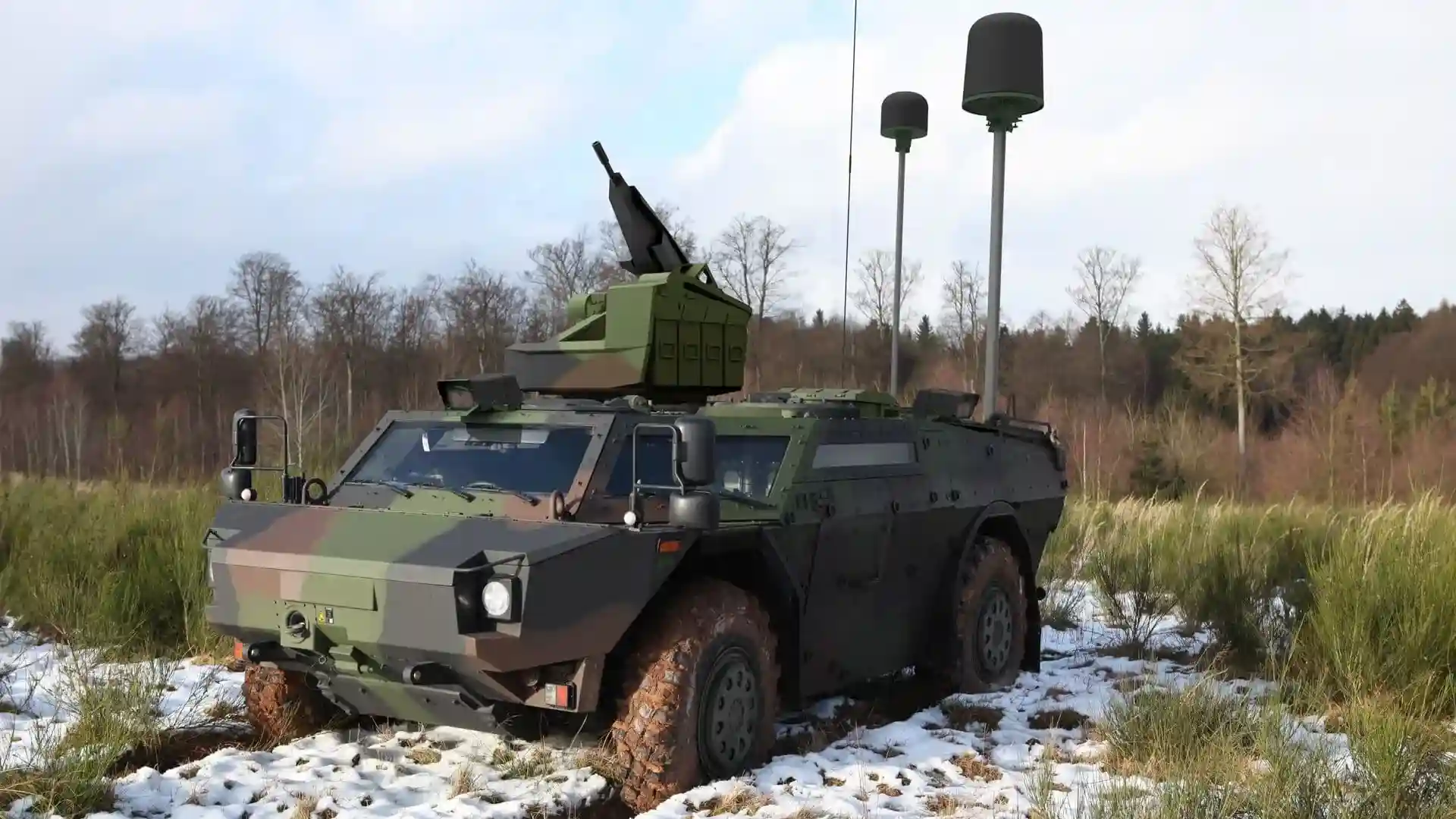
KNDS Deutschland unveiled a FENNEK AIR prototype, an AI-powered counter-drone variant of its FENNEK 4×4 reconnaissance vehicle, on November 18, 2026, at the NIDV Exhibition Defence & Security (NEDS) in Rotterdam. It is the first public showing of the counter-unmanned systems (C-UxS) vehicle. Short for Artificial Intelligence Revolvergun, FENNEK AIR pairs a modular software architecture, multi-sensor fusion and AI-powered decision support with the KNDS France ARX30 Remote Controlled Weapon System (RCWS) and its 30×113 mm automatic cannon, according to the company’s press release.
The venue matters. The Royal Netherlands Army is the largest FENNEK operator, with 410 vehicles ordered against about 220 for the German Army, according to publicly available program data. The unveiling also lands as European governments scramble for affordable point defense after repeated drone incursions over airports, military bases and energy sites in Denmark, Germany and Belgium since 2025. KNDS frames the system as a rapidly available layer within a multi-layered drone defense, aimed squarely at critical infrastructure protection.
FENNEK AIR AI Architecture and the Sensor-to-Shooter Loop
The core of FENNEK AIR is a fully integrated AI solution. Depending on the level of AI support selected by the crew, the software processes data from multiple sensors in real time, detects and tracks targets, and can ultimately engage drones. KNDS says this AI-based processing compresses the sensor-to-shooter loop to mere seconds, cutting crew workload and accelerating decisions when the vehicle faces drone swarms.
Two further claims stand out. First, the AI is designed to adapt continuously to evolving drone threats by learning from the data it collects. Second, FENNEK AIR vehicles can share that data through what KNDS calls meshed intelligence, meaning a track or threat signature acquired by one platform becomes available to every vehicle in the network. KNDS describes the software as a closed system, so customers retain full sovereignty over it, a selling point for European buyers wary of foreign code dependencies.
“Protecting critical infrastructure against drone attacks has become a key concern for national security,” said Frank Schnur, Senior Vice President of the Wheeled Armored Vehicles Division at KNDS Deutschland. “With FENNEK AIR, we’re working on equipping a proven platform with a powerful AI algorithm that potentially outpaces the speed at which new drones are developed.”
KNDS has not identified the sensor suite. The company has named no radar, electro-optical and infrared (EO/IR) sight, or radio-frequency (RF) detector, and has published no detection or engagement ranges. It has also not explained how the selectable autonomy levels map to human authorization of fire, a question every buyer will raise.
ARX30 Cannon, Adaptive Camouflage and FENNEK Platform Specifications
The effector is the ARX30, armed with the 30M781 MPG, the land version of the electrically driven 30M781 gun fitted to the Tiger attack helicopter. Publicly available KNDS France specifications indicate all-electric 360-degree traverse and weapon elevation from -15 to +55 degrees.
KNDS markets the ARX30 as a replacement for both 12.7 mm machine gun and 40 mm grenade launcher stations, with greater practical range and terminal effect. The French Army has ordered the turret for 24 Serval LAD counter-drone vehicles, with deliveries due from 2028. KNDS has not stated which ammunition FENNEK AIR will use, including whether airburst rounds are part of the package.
Publicly available specifications for the baseline FENNEK list a length of 5.58 m, a width of 2.55 m, a roof height of 1.79 m and a weight of 12 t. A 177 kW diesel engine delivers a top speed above 100 km/h and a range of about 1,000 km. The three-person crew sits behind ballistic, mine and IED protection. KNDS has not released weight or mobility figures for the ARX30-equipped configuration.
The prototype also carries a new adaptive camouflage linked to both the AI and the weapon station. According to KNDS, it can alter the vehicle’s outline so that FENNEK AIR appears to be an entirely different vehicle type, or blend it into its surroundings. The underlying technology and the spectral bands it covers have not been disclosed.
Originally designed for reconnaissance and observation, the FENNEK has proven mobile in all weather and suitable for urban operations. KNDS says the AI-powered C-UAS mission kit, designated AIR, can be integrated into existing FENNEK fleets and into other systems.
Analysis: The retrofit option is the most consequential part of the announcement. A mission kit that converts in-service FENNEKs into gun-armed C-UAS vehicles offers the Netherlands and Germany a faster route to mass than new-build platforms, and would sit below heavier systems such as Rheinmetall’s Skyranger 30 in footprint and, likely, cost. A 30 mm cannon also offers a far lower cost per engagement than interceptor missiles against inexpensive drones.
The open questions are technical: whether the baseline ARX30’s +55-degree elevation limit suffices against steep diving attacks, and whether the AI can genuinely keep pace with drone development, as KNDS asserts.
KNDS has announced no customer, test schedule, production timeline or price. The next milestones to watch are live-fire demonstrations against representative drone swarms, integration with national air defense command-and-control networks, and whether either FENNEK operator funds the AIR kit as a fleet upgrade.