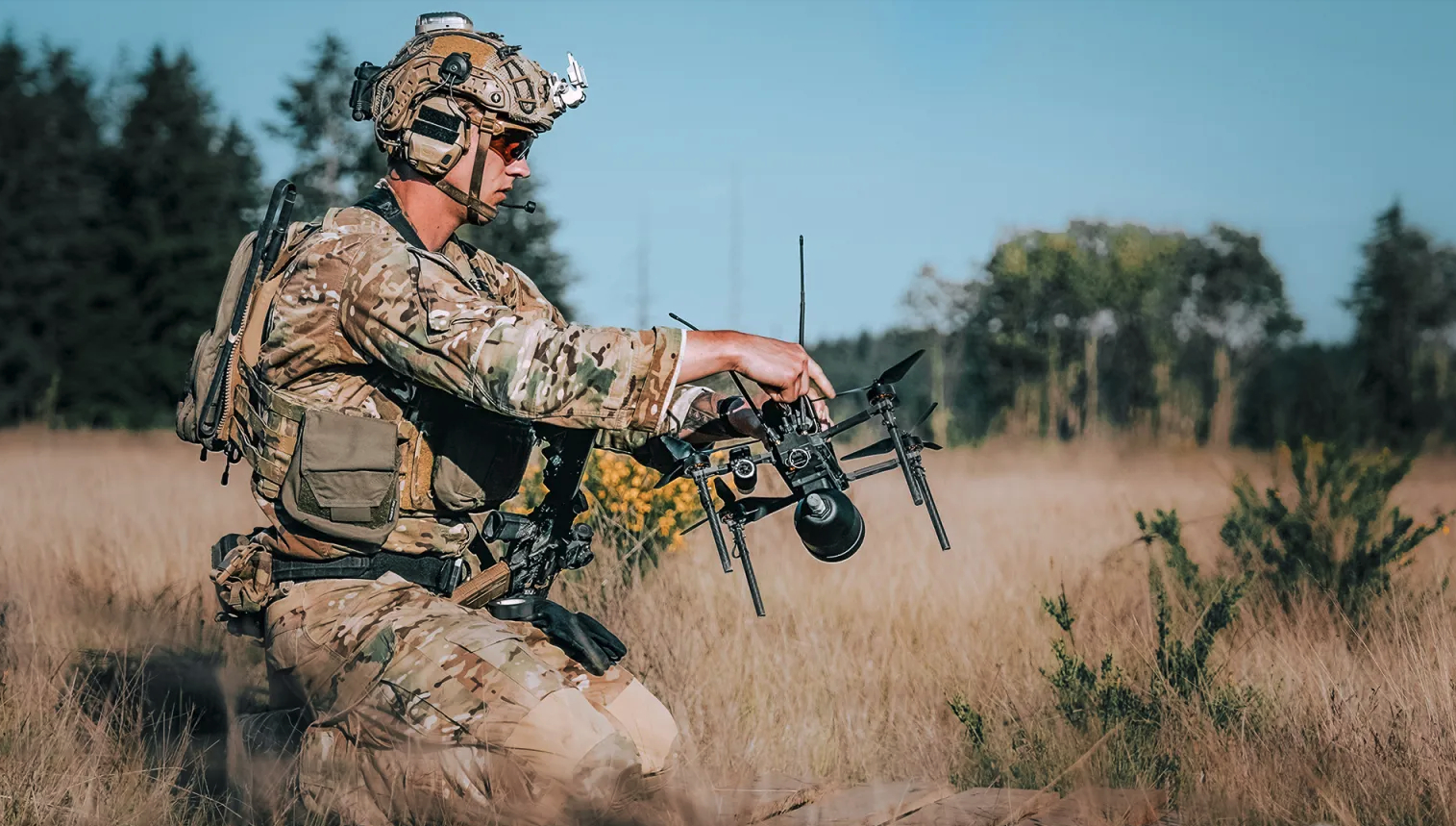
Neros Technologies has received an order for 14,000 Archer first-person-view (FPV) strike drones and explosive payloads, valued at more than $100 million, through Gauntlet II of the Department of War’s Drone Dominance Program (DDP). The Torrance, California, company announced the award on September 30, 2026, after placing first in the Close Quarters Battle mission area and third in Deep Strike at the August evaluation at Fort Carson, Colorado.
The DDP is a $1.1 billion effort, funded by the 2025 reconciliation law and run by the Defense Innovation Unit (DIU) and the Test Resource Management Center, to field low-cost one-way attack drones at squad level through six-month Gauntlet competitions. Phase II carries a projected buy of 60,000 drones, double the Phase I target. Neros placed second in Gauntlet I in February 2026 and had its entire base order accepted. It has now received a second Gauntlet I bonus order, covering 800 drones reallocated from competitors that missed their production deadline.
How Neros Converted Drone Dominance Gauntlet II Scores Into Orders
Gauntlet II raised the bar over the first round, which tested inert payloads at 10 km: 19 companies flew 23 platforms across 1,858 sorties. Deep Strike required hits at 15 km stand-off with a warhead of at least 2 kg. Close Quarters Battle required engagements under 2 km with a warhead of at least 0.5 kg, including flight through a window into a building and on into an adjacent room. Some lanes were repeated at night, while others pitted drones against counter-UAS jammers. Scores combined flight results, military operator evaluations and each vendor’s production and supply chain capacity.
Neros scored 88.1 in Close Quarters Battle, ahead of ORQA US at 82.8 and XTEND Reality at 80.2. In Deep Strike it scored 69.8, behind Perennial Autonomy at 80.1 and Hyperscale at 70.9. Those placings carried projected allocations of 8,000 and 6,000 drones respectively, which together account for the full 14,000-unit order.
Phase II also prices airframes and warheads separately: $4,500 per Deep Strike drone, $3,500 per Close Quarters Battle drone and $3,250 per munition, with ground control equipment, 5 percent spares and operator training folded into the airframe price. On those figures, Neros’ airframes come to $55 million, and a munition for every airframe adds $45.5 million, for a total of about $100.5 million, consistent with the company’s figure. The solicitation requires fire sets on only 60 percent of deliveries, and Neros has not disclosed its ratio. Drones delivered between five and eight months after award are paid at a 20 percent discount.
Archer AI Terminal Guidance and the APEX Payload Architecture
According to Neros, the Department is prioritizing Archer AI, the company’s flagship 10-inch quadcopter. Its Terminal Guidance function flies the drone autonomously to a target the operator has already selected, allowing the strike to be completed if the video and control link drops. That matters in the final seconds of an FPV attack, when low altitude and target-area jamming most often break the link, and it answers the Phase II requirement to operate in a contested spectrum and resist GNSS denial. Target selection stays with the operator. The order also includes substantial volume of the Archer 5-inch, a smaller variant optimized for urban and indoor combat.
Specifications released during a US Marine Corps live-fire exercise in South Korea in August 2026 credit the Archer with a maximum range of 25 km, a top speed of about 130 km/h and a payload of up to 3 kg, with an anti-armor warhead able to penetrate up to 100 mm of rolled homogeneous armor. Neros itself quotes a range of about 20 km. The Archer Block 2 airframe shares components across 5-, 8- and 10-inch configurations. Neros builds its own radios, offers a fiber-optic variant for jammed environments and states its drones contain no Chinese components.
Gauntlet II also marks the first mass shipment of drones fitted with APEX, short for Adaptive Payload Exchange, an open-source, low-cost interface standard Neros introduced for modular payload integration. It lets operators swap conventional warheads, fiber-optic modules, signal repeaters and future payloads in the field. The design tracks the program’s direction: Phase II warheads came from five providers, including Kraken Kinetics and Northrop Grumman, and Phase III will require every vendor to integrate with at least two munitions suppliers.
Analysis: The program is now rewarding production as much as flight performance, and Neros is the clearest beneficiary. In Phase I, the Gauntlet I winner had none of its 2,560 drones recorded as accepted by September 10, while Neros completed its base order. Phase II folded production capacity into the score, and Neros now holds 14,000 of the 60,000 projected Phase II drones, about 23 percent, alongside a $500 million-ceiling Army Purpose-Built Attritable Systems contract awarded June 30, 2026. That gives the Pentagon a proven supplier but ties a growing share of US squad-level strike capacity to a single company’s supply chain, in tension with a program built to broaden the industrial base.
Neros must deliver within five months of award to collect full price. The eight-month cancellation point for late Gauntlet I deliveries falls in early November 2026, the Phase 2.5 reusable bomber qualifier opens at Camp Grayling, Michigan, in October, and Phase III runs from February to July 2027. Neros has not disclosed the split between Archer AI and Archer 5-inch units, the share shipped with live warheads, or the receiving units.