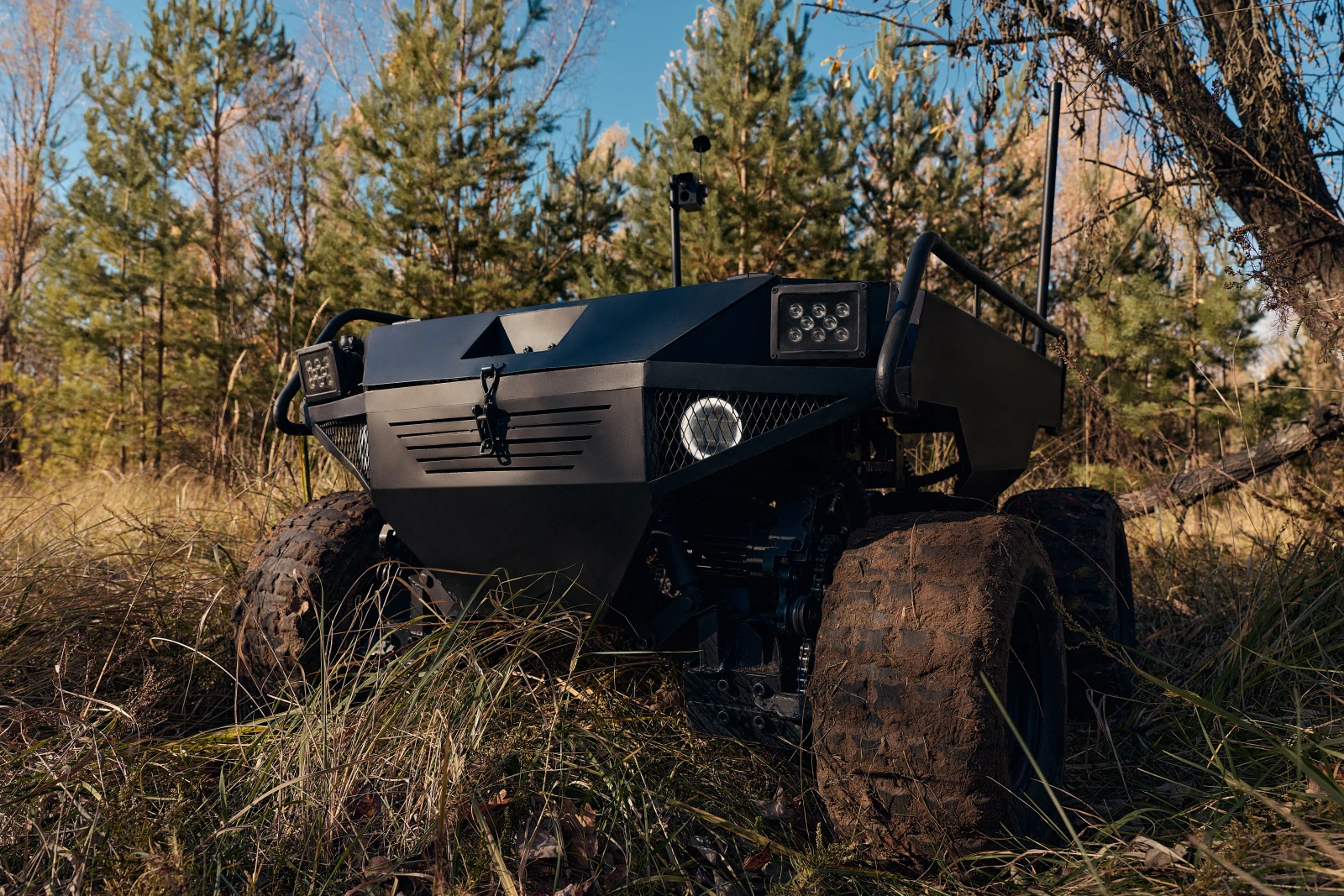
Ukraine’s Ministry of Defense has codified and approved the Varkhan unmanned ground vehicle (UGV) for service with the Armed Forces of Ukraine. Built by Ukrainian manufacturer Air3F, the Varkhan is an electric 4×4 cargo platform designed to move weapons, ammunition and supplies to frontline positions, with a peak payload of 300 kg and a loaded range of up to 37 km, according to the company.
Air3F disclosed the approval on September 24, 2026, formalizing a system already in combat use; serial production began in November 2025, and the company says the Varkhan has been delivering supplies to positions where sending personnel would be too risky. The decision lands as Kyiv shifts frontline logistics onto robots at scale: Ukrainian forces logged more than 100,000 UGV logistics and evacuation missions between January 1 and August 20, 2026, and the ministry had contracted more than 22,000 ground robotic systems by late August, nearly double its total for all of 2025.
Varkhan UGV Payload, Range and Control Link Architecture
The Varkhan rides on a fully electric, four-wheel-drive chassis with 220 mm of ground clearance. Suspension descriptions conflict: the Ministry of Defense calls it independent, while Air3F specifications describe a dependent layout and, in earlier releases, portal axles that raise the axle above the wheel centerline. Air3F lists curb weight at 320 kg and dimensions of 1,300 x 1,250 x 800 mm, extending to 1,400 mm depending on configuration.
The 300 kg peak payload compares with a nominal 220 kg rating, which puts the payload-to-weight ratio near 1:1 at maximum load. Loaded, the Varkhan covers up to 37 km across rough terrain; empty, range extends to 50 km. Top speed is 20 km/h. The loaded range covers a round trip through the drone-saturated band where crewed vehicles are routinely engaged, which Ukrainian commanders describe as reaching more than 10 km from the line of contact.
Air3F rates the system for up to 72 hours of operation but has not said whether that figure covers continuous driving or a mix of movement and standby; its November 2025 specifications listed five hours of continuous movement. Quick-change battery packs let crews turn the vehicle around without waiting on a full recharge.
Command and data travel over a secure analog radio channel, with Starlink and LTE integration as alternate paths. That channel diversity is the platform’s main survivability feature: Russian electronic warfare routinely targets UGV control links, and fallback to satellite or cellular connectivity makes the vehicle harder to strand. Air3F has not published protection specifications. Infrared illumination supports movement in darkness, and the Varkhan sits within an Air3F ecosystem of T-Bone ground control stations, antennas, masts, repeaters and rotary mechanisms, giving the company ownership of the relay chain that typically limits UGV employment beyond line of sight.
Within Ukraine’s crowded cargo segment, the Varkhan sits in the light class. Ministry descriptions credit the tracked TERMIT with up to 300 kg of payload, the Vepr logistics and evacuation platform with up to 350 kg, and the tracked Murakha with more than 500 kg. Publicly available specifications for Milrem Robotics’ THeMIS, the Estonian tracked UGV supplied to Ukraine by Western partners, indicate roughly 1,200 kg of payload on a hybrid-powered chassis weighing about 1.6 tonnes.
How Codification Positions Air3F in Ukraine’s UGV Procurement Drive
Codification moves a system from battlefield trial into the ministry’s equipment catalog, clearing it for centralized purchasing and making it eligible for the Brave1 Market platform, where frontline units spend ePoints, the state’s performance-linked digital credits. Troops have ordered nearly UAH 1.9 billion worth of ground robotic systems through Brave1 Market since January. Air3F said the approval will let it scale production and deliveries; mass production is already underway.
The timing matters. In late August 2026, the ministry began shifting UGV purchases to class-based tenders run by the Defense Procurement Agency against ministry-set technical specifications, covering both logistics and strike platforms. Bidders must hold at least one codified system, and no single manufacturer may take more than half of any class. For Air3F, codification is the entry ticket to a crowded market: the ministry codified 67 new UGV models in the first half of 2026 alone.
Earlier company statements indicated that units of the Main Intelligence Directorate (HUR), the Air Assault Forces and the Ground Forces had used the Varkhan, with some brigades placing follow-on orders. The ministry has not disclosed which formations will receive codified production vehicles or in what quantities.
Analysis: The Varkhan matters less as a single platform than as evidence of how Ukraine is industrializing the last tactical mile. Light electric 4x4s carrying around 300 kg are becoming consumable logistics assets, bought by the thousand, competed by class and judged by logged mission counts. The model trades individual vehicle survivability for volume and redundancy, with multipath communications rather than armor doing the protective work. For NATO armies still treating UGVs as experimentation line items, Ukraine’s mix of rapid codification, capped supplier shares and mission-data demand signals is the more transferable lesson.
The ministry has not released order quantities, unit pricing or delivery schedules for the Varkhan, and Air3F has not reconciled its 72-hour endurance figure or its suspension description with earlier data. The next indicators are whether Air3F wins lots in the Defense Procurement Agency’s first class-based UGV tenders and whether weapon-station or casualty-evacuation variants follow on the same chassis.