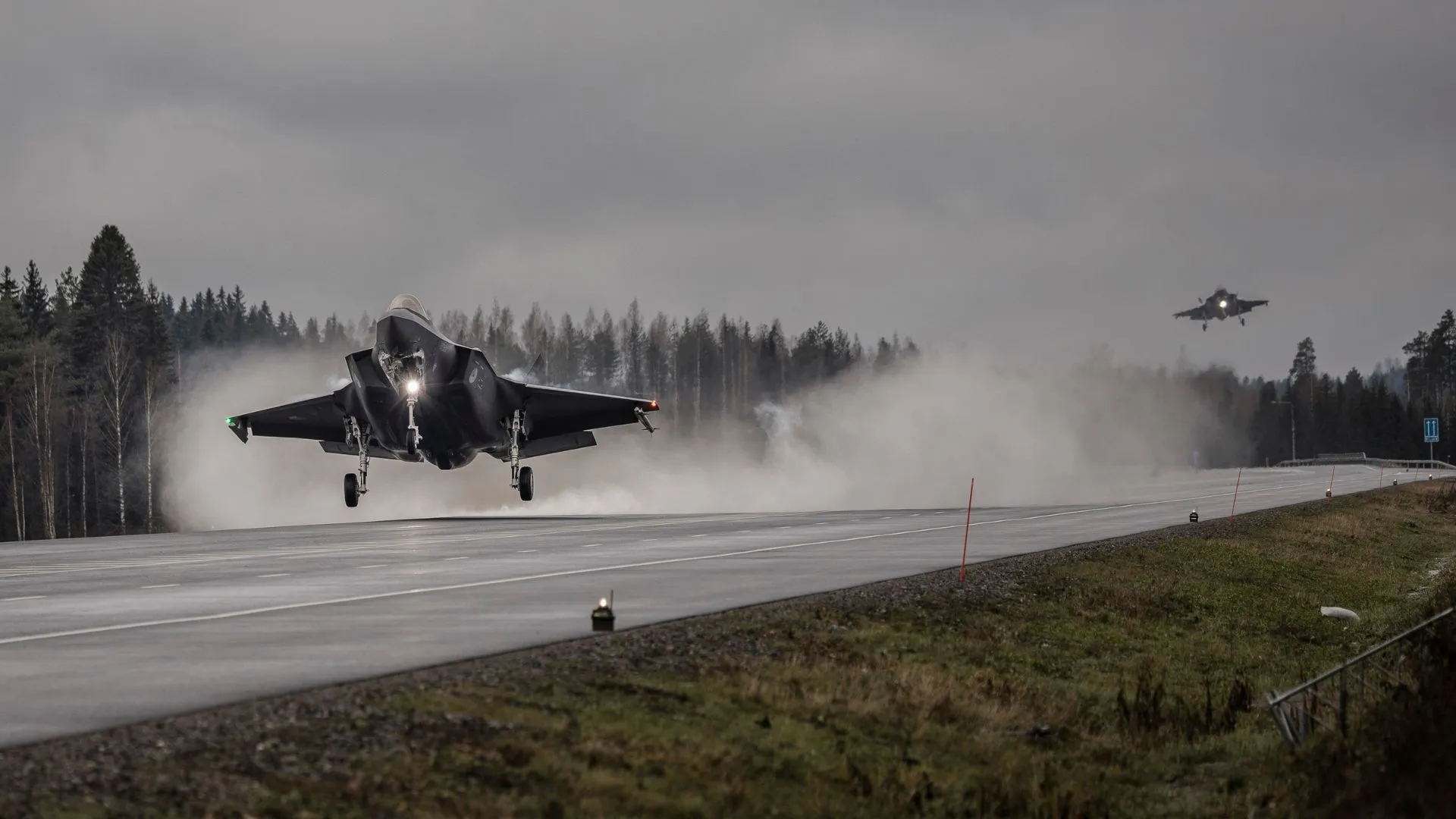
Several Dutch F-35A Lightning II fighters of the Royal Netherlands Air and Space Force landed on Highway 9 near Kuopio, in eastern Finland, on November 20, 2026, during the Finnish Air Force exercise Protective Fence 26. The Dutch Ministry of Defence said the road landing shows the service is becoming less dependent on fixed air bases. The ministry has not disclosed how many aircraft took part.
The landing is the second time Dutch F-35As have operated from a Finnish road. In May 2025, during exercise Baana 25, Dutch jets flying from Pirkkala Air Base flew touch-and-go landings on Highway 4 near Tikkakoski, the first Dutch road operations since 1984. This year, the Finnish deployment is one half of a split Dutch effort built around Agile Combat Employment (ACE), the dispersal concept NATO air forces have adopted to keep fighters generating sorties if main operating bases are struck or denied.
Dutch F-35 Highway Landing at Finland’s Jännevirta Road Strip
The landing took place on the Jännevirta reserve strip on Highway 9, just south of Kuopio Airport, which shares its runway with Rissala Air Base, home of the Finnish Air Force’s Karelia Air Wing. The Dutch F-35As are operating from Rissala for the exercise. Finnish authorities closed parts of Highway 9 to civilian traffic from November 18 to 25, 2026. The strip was upgraded under a Highway 9 project led by the Finnish Transport Infrastructure Agency, which adapted it to European Union civil-military dual-use requirements and added two aircraft parking positions. The wider road project received €25.13 million from the EU’s Connecting Europe Facility military mobility program.
Protective Fence 26 runs from November 19 to 27, with round-the-clock flying planned during the main phase from November 22 to 24. More than 40 aircraft and about 4,100 personnel are taking part across 10 operating bases in Finland and Sweden. Finland is dispersing 20 F/A-18C/D Hornets across military bases, civilian airports and the highway strip. French Air and Space Force Rafales are deployed to Rovaniemi, while Swedish Air Force Gripens fly from Kallax Air Base near Luleå. Beyond the road landing, Dutch crews are also training from civilian airfields in Finland.
The F-35A is the conventional takeoff and landing variant of the Lockheed Martin fighter, powered by a single Pratt & Whitney F135 engine. US Air Force figures give the engine 43,000 pounds of thrust and the aircraft more than 18,000 pounds of internal fuel. Road operations expose what fixed bases mask: a narrower usable surface, minimal lighting and navigation aids, no hardened shelters, and ground support that must travel with the jets. Repeated road landings build procedural confidence; they do not demonstrate a new airframe capability.
Agile Combat Employment Split Between Finland and Gilze-Rijen
Protective Fence runs in parallel with a second Dutch exercise, Agile Tiger. One F-35 squadron operates from Finland while the other flies from Gilze-Rijen Air Base in the Netherlands, a helicopter base rather than the F-35 main operating bases at Leeuwarden and Volkel. At Gilze-Rijen, the squadron concentrates on combat skills including night flying, refueling with engines running, and weapons loading. These are the core ACE tasks, since they set how quickly a dispersed fighter returns to the fight. Both exercises run through November 27.
The Finnish leg is also designed as knowledge transfer with a NATO ally. Road operations form part of the basic training of every Finnish military pilot, and the country maintains dozens of reserve road strips. Finland also offers room for realistic scenarios that are difficult or impossible to train in the Netherlands. Lieutenant Colonel Pascal “Smiley” Smaal, commander of 322 Squadron, said the Finnish Air Force holds a unique position because Finnish society as a whole is organized around national defense. “We must also be able to defend our Northern European allies, so training and integrating here is enormously important for us,” he said.
Analysis: The value of the Highway 9 landing lies less in the aircraft than in the procedures behind it. Finland’s own F-35A transition has begun: the first two of 64 aircraft arrived at Rovaniemi on September 18, 2026, Lapland Air Wing is due to reach initial operational capability in early 2028, and Karelia Air Wing at Rissala is scheduled to receive its first jets later that year. By the time Finnish jets join dispersed exercises, allied operators such as the Netherlands, which has flown the F-35A from its home bases since 2019, will have validated dispersal procedures on the same roads the Finns intend to use. That builds a pool of interchangeable fifth-generation operators on NATO’s northern flank able to disperse, refuel and rearm across national borders, which complicates any adversary targeting plan built around a small number of known runways.
Protective Fence 26 enters its round-the-clock main phase on November 22, and both Dutch exercises conclude on November 27. The Ministry of Defence has not released the number of aircraft deployed, sortie figures, or whether refueling and rearming were practiced on the road strip itself. The next markers are Finland’s integration of its own F-35s into dispersed operations from 2028 and whether the Netherlands makes Nordic road-basing a fixed part of its annual training cycle.