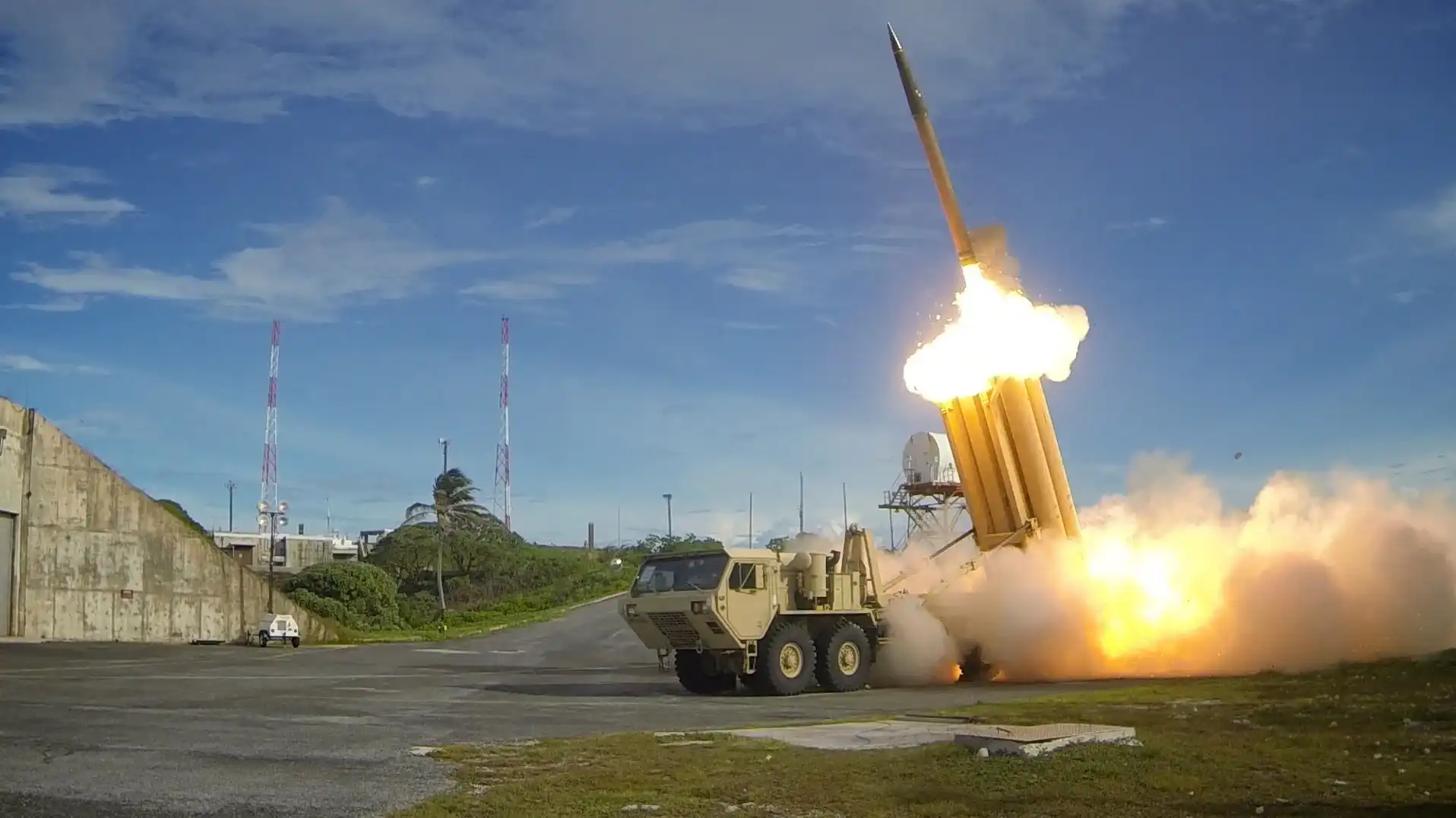
Leonardo DRS has been awarded a contract by BAE Systems to develop a next-generation infrared focal plane array for the seeker of the Terminal High Altitude Area Defense (THAAD) interceptor, the company announced on November 19, 2026. Development work is underway at its 200,000-square-foot foundry in Dallas, Texas, where Leonardo DRS is also adding capacity to support a program objective of raising seeker production to about four times historical levels. Contract value, period of performance, and delivery schedule were not disclosed.
The award lands as the THAAD program works to quadruple interceptor output. In January 2026, prime contractor Lockheed Martin signed a framework agreement with the Department of War to lift interceptor output from 96 to 400 per year over seven years, and the Missile Defense Agency (MDA) followed in June with a seven-year contract worth up to $35 billion. BAE Systems, which builds the current THAAD seeker in Nashua, New Hampshire, and Endicott, New York, signed its own seven-year agreement in March to quadruple seeker capacity. The pressure is operational: the Center for Strategic and International Studies (CSIS) estimated in July that the US inventory fell from about 452 THAAD interceptors before the 2026 war with Iran to between 234 and 278 by late July.
How Leonardo DRS Fits Into the THAAD Infrared Seeker Supply Chain
The focal plane array is the detector at the heart of the seeker: a grid of infrared-sensitive pixels bonded to a readout integrated circuit (ROIC) that converts thermal energy into the imagery the kill vehicle uses for terminal homing. THAAD carries no explosive warhead. Its kill vehicle destroys ballistic missiles by direct hit-to-kill impact, inside or outside the atmosphere, so the detector’s performance bears directly on terminal homing. BAE Systems states that its seeker locks onto targets travelling at up to 17,000 miles per hour.
Under the new arrangement, Leonardo DRS sits one tier below BAE Systems, supplying the detector while BAE Systems integrates the seeker subsystem for Lockheed Martin. BAE Systems began work on a next-generation THAAD seeker under a Lockheed Martin contract announced in March 2020, with stated goals of engaging more threats and improving manufacturability. Neither company has publicly explained how the Leonardo DRS array relates to that earlier design effort.
The Dallas site is a vertically integrated cooled infrared foundry whose staff includes veterans of infrared imaging work that began in the 1960s at Texas Instruments’ Defense Systems and Electronics Group, according to the company. Leonardo DRS grows its own mercury cadmium telluride (HgCdTe) detector material there and has supplied 2nd- and 3rd-generation forward-looking infrared (FLIR) systems. The company has not disclosed the detector material, array format, pixel pitch, or spectral band selected for THAAD.
Scaling Seeker Output to Match a 400-Per-Year Interceptor Line
The production objective cited by Leonardo DRS tracks the wider THAAD ramp. On BAE Systems’ first-half 2026 earnings call, BAE Systems Inc. chief executive Tom Arseneault said the company expected a contract to procure 2,800 seekers over seven years, an average of 400 per year that matches Lockheed Martin’s interceptor target. Whether that procurement award has since been finalized has not been publicly confirmed.
Cooled infrared detectors go through several manufacturing steps, from detector material growth to mounting on readout circuits and radiometric testing at wafer level, according to Leonardo DRS, and yield at each step limits output. Expanding detector capacity addresses a constraint that final-assembly capacity cannot solve on its own. Lockheed Martin’s new Munitions Acceleration Center in Camden, Arkansas, expands integration capacity, but that line depends on component tiers keeping pace. With each interceptor costing $12.77 million in fiscal 2025 according to Pentagon budget documents, seeker cost and yield also weigh on unit price.
Jerry Hathaway, senior vice president and general manager of DRS Electro-Optical and Infrared Systems, framed the award as part of a broader push into munitions seekers. “Our ability to combine high-end performance with scalable, cost-effective production makes DRS a strong partner for a wide range of mission requirements,” he said.
Analysis: The contract shows the Pentagon’s munitions ramp reaching the sub-tier suppliers that decide whether framework agreements become delivered rounds. CSIS has estimated that restoring THAAD, Patriot, and Tomahawk inventories to prewar levels will take three years or more at current production rates, and seeker output is one of the factors that sets that pace. By pairing a performance upgrade against more complex threats with a manufacturability objective, the program is trying to solve two problems with one component. The risk is schedule: qualifying a new detector for a hit-to-kill interceptor is likely to require flight testing, and any slip would leave the ramp dependent on the legacy seeker.
Key unknowns remain the contract value, the qualification timeline, and the production lot in which the new array will be introduced. The next indicators to watch are MDA flight tests incorporating the next-generation seeker, confirmation of BAE Systems’ seven-year seeker procurement award, and fiscal 2027 appropriations that will set the pace of interceptor buys. Progress on the Dallas capacity expansion will show whether the fourfold target is achievable within the seven-year window.