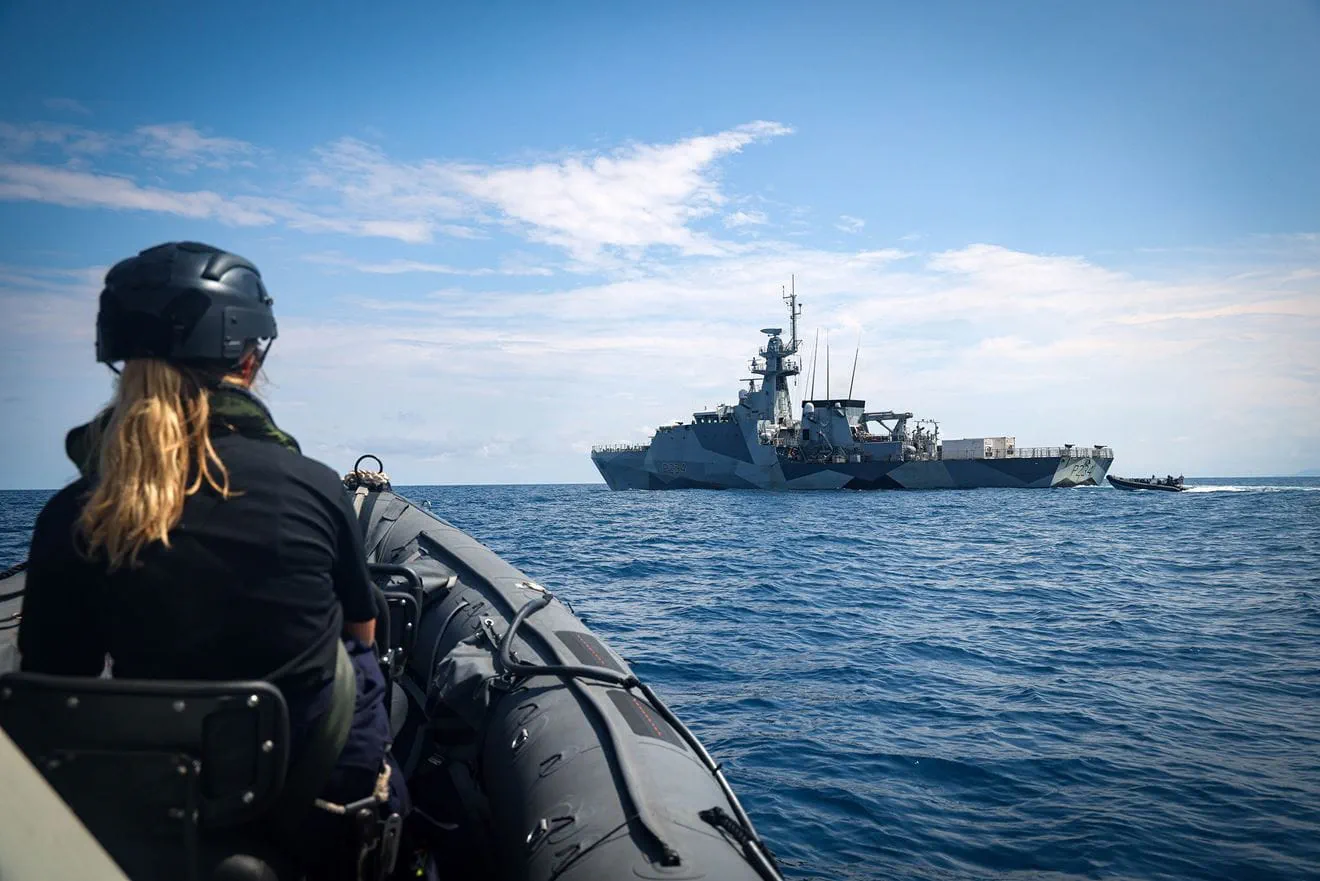
Royal Navy offshore patrol vessels HMS Spey and HMS Tamar will join naval, land and air forces from Australia, Malaysia, New Zealand and Singapore in Exercise Bersama Lima 26, the annual tri-service exercise of the Five Power Defence Arrangements (FPDA), the Royal Navy said on October 2, 2026. Each ship sails with around 60 sailors for a ten-day exercise in the South China Sea.
Established in 1971, the FPDA reaches its 55th year in 2026 and remains Southeast Asia’s only multilateral defence arrangement. It commits members to consult, not to act collectively, if Malaysia or Singapore faces external attack or the threat of one. Bersama Lima, Malay for “Together Five,” rotates between Malaysian and Singaporean hosts and anchors the FPDA training calendar alongside Bersama Shield and Suman Warrior. The British contribution is sharply smaller than in 2025, when a UK Carrier Strike Group took part.
Bersama Lima 26 Scenarios: Naval Gunfire, Boarding and Submarine Hunts
The Royal Navy says the exercise begins on October 5, with the first week devoted to familiarization: vessel and system capabilities, working procedures and common terminology. Senior officers will run the planning exercises that set the blueprint for the live phase in parallel. Published schedules place the main exercise window at October 12 to 21; the split between harbour and sea phases has not been officially detailed.
The declared force package spans surface, subsurface and air domains. Divers, specialist boarding teams, a tanker, a corvette, patrol vessels, frigates and a submarine are committed at sea, while Royal Australian Air Force (RAAF) F-35A Lightning II fighters will lead the opposed air scenario. The Royal Navy has not identified the hulls or flag states behind most of these assets, including the submarine and the tanker.
Planned serials include soldiers directing naval gunfire, board-and-search drills, a submarine hunt and naval air defence supported by FPDA air forces. Integration reaches below fleet level: a Royal New Zealand Navy boarding team under Lieutenant Williams is embarked on Tamar, operating from a British deck. Williams described the embark as a first for his team, built on a long record of cooperation between the two navies. Tamar’s executive officer, Lieutenant Commander Cheryl Goodwin, said the exercise tests the crew “in a traditional war-fighting role.”
The serial mix continues a trend of rising complexity. The 2024 edition introduced fifth-generation fighters with six RAAF F-35As, while the 2025 iteration added the first aerial resupply drop in a Bersama Lima and the first unmanned aircraft systems in the land component, according to Australia’s Department of Defence.
River-Class Batch 2 Design: What Spey and Tamar Bring to FPDA
Spey and Tamar are River-class Batch 2 offshore patrol vessels built by BAE Systems in Glasgow, ordered under a separate £287 million Ministry of Defence contract signed on December 8, 2016, which also covered support for all five Batch 2 hulls and took the programme’s total value to £635 million. Publicly available specifications indicate a 90.5-meter hull, a full-load displacement of around 2,000 tonnes, and two MAN 16V28/33D diesel engines driving twin shafts with controllable-pitch propellers for a top speed of 24 knots. Range is 5,500 nautical miles, with endurance of up to 35 days.
Armament is limited to a 30 mm automated cannon, two Mk44 miniguns and four 7.62 mm general-purpose machine guns. Open-source data list a Terma Scanter 4100 2D surveillance radar alongside navigation radars. The flight deck takes a Merlin-sized helicopter but there is no hangar; each ship carries two Pacific 24 rigid-hull inflatable boats and can accommodate up to 50 embarked troops.
Those parameters define the ships’ exercise roles. With no hull-mounted sonar and no missile armament, Spey and Tamar cannot prosecute a submarine or engage aircraft beyond gun range. Their value lies in surface surveillance, boarding operations, small-calibre gunnery and flight-deck access for partner helicopters. The Royal Navy has not specified their assignments in the anti-submarine or air-defence serials.
Endurance and modest crew demand underpin the forward presence model. The pair left Portsmouth on September 7, 2021, for a deployment of at least five years, with no fixed home port and logistics routed through the British Defence Singapore Support Unit. Spey returns to duty after a summer overhaul in Singapore. Tamar recently joined the US Navy-led Pacific Partnership humanitarian mission, spent a week in Cambodia and conducted a freedom of navigation activity with the Royal Australian Navy.
Analysis: The step down from a carrier strike group in 2025 to two patrol vessels in 2026 shows what Britain’s routine FPDA commitment looks like between high-end deployments. The ships deliver persistence, partner access and boarding capacity, which suit the constabulary and gray-zone challenges that dominate Southeast Asian maritime security. They add little to the exercise’s high-end serials, where Australian F-35As and partner frigates and submarines carry the war-fighting load. For London, FPDA credibility now rests on keeping those hulls on station between carrier visits.
The live phase will test how far a 2,000-tonne patrol ship can integrate into a multi-threat scenario built around fifth-generation aircraft. The larger question concerns the deployment itself. Its five-year minimum passed in September 2026, and the Ministry of Defence’s last public position, given in September 2024, was an intent to retain a persistent forward presence with both ships. No replacement hulls or end date have been announced.