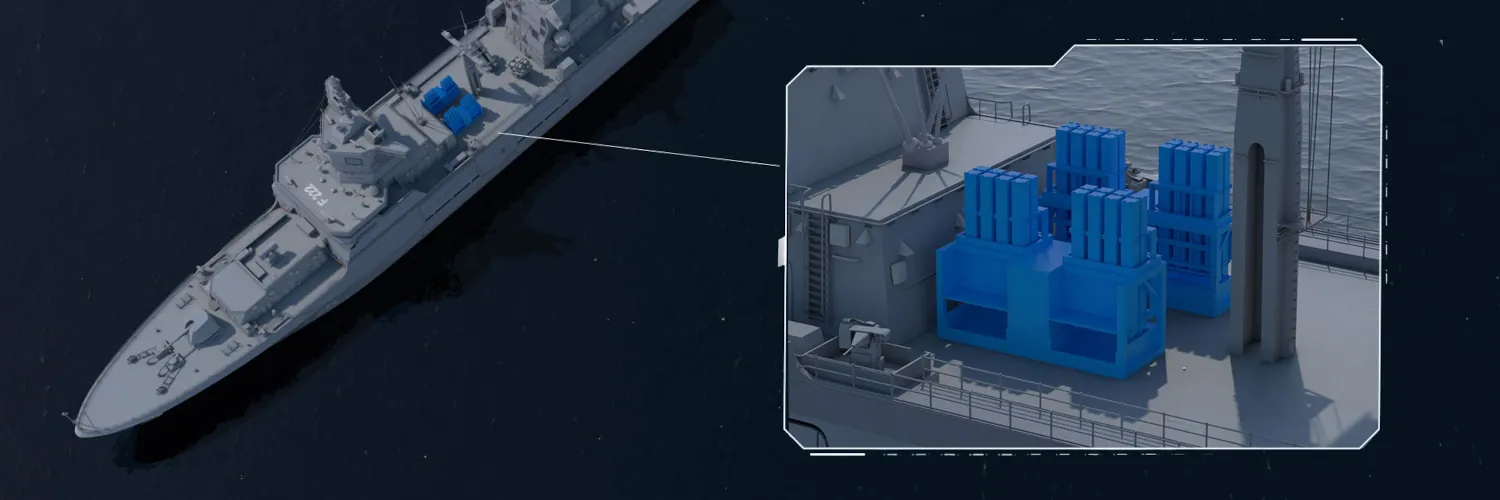
Germany’s Federal Office of Bundeswehr Equipment, Information Technology and In-Service Support (BAAINBw) has signed a contract with Diehl Defence to adapt the IRIS-T SLM (Surface Launched Medium Range) air defense system for the German Navy’s four F125 Baden-Württemberg-class frigates, the company announced on October 2, 2026. Under the agreement, Diehl will build prototypes and conduct a comprehensive test-firing campaign to make the system mission-capable within the existing F125 architecture.
The contract targets the most criticized gap in the F125 design. At 7,200 tonnes and 149.5 meters, the class ranks among the largest frigates in service, yet it was built for stabilization, crisis-response and long-endurance intervention missions, with air defense limited to two RIM-116 Rolling Airframe Missile (RAM) launchers. The Navy launched the IRIS-T SLM effort after the 2024 Red Sea deployment of the F124 air defense frigate Hessen under the European Union’s Operation Aspides, where the ship engaged Houthi drones.
From Andøya Demonstrator to IRIS-T SLM Naval Contract
The contract caps a compressed demonstration cycle. BAAINBw awarded Diehl a feasibility study, including a system demonstrator, in December 2024. Diehl then developed an Anti-Air Warfare (AAW) module with the Navy and installed it on the C-deck of the frigate Baden-Württemberg, moving from concept to live firing in under 10 months.
During Maritime Firing Exercise (MFE) 2025 Andøya off northern Norway in October 2025, which Diehl described as the German Navy’s largest missile firing exercise in three decades, the frigate fired three IRIS-T SLM interceptors at night. According to BAAINBw, the ship’s radar fed track data directly into the air defense system, establishing the first functional link between F125 sensors and the weapon. Diehl reported that the demonstrator met all test and evaluation objectives.
That demonstrator used a lightly modified land launcher. The new contract moves the effort from proof of concept to a dedicated shipboard design. Neither party has disclosed the contract value. German defense trade reporting in September referred to a €25 million submission prepared for parliament, while observers estimate the adaptation work at about €40 million. The Bundestag Budget Committee approved the project on September 23, 2026.
Two 16-Round Launchers and 32 Missiles per F125 Frigate
Diehl has outlined a shipboard configuration of two new launchers per frigate, each holding 16 missiles, for 32 IRIS-T SLM rounds per hull. Speaking at the ILA Berlin Air Show in June 2026, Diehl Chief Program Officer Harald Buschek said the launch canisters would be fixed permanently in a vertical position, with deflector plates at the launcher base to shield the deck from motor exhaust. A naval launcher dispenses with the stabilizing supports and hydraulic elevation gear of the truck-mounted land variant, saving topside space and weight.
Diehl expects a prototype of the new launcher in 2027, with a first test firing of that configuration possible the same year. Buschek also said integration with CMS 330, the German Navy’s future combat management system, would likely fall within the contract, and the F125s are reportedly slated to be the first German warships to receive it. Neither Diehl nor BAAINBw has confirmed the combat management scope of the signed contract. Integration into the Mk 41 Vertical Launch System, already in German Navy service, remains a possible later option under discussion with industry partners. Across four hulls, the planned fit adds 128 ready interceptors to the class.
How IRIS-T SLM Extends F125 Air Defense Beyond RAM Range
The IRIS-T SLM interceptor derives from the IRIS-T short-range air-to-air missile, fitted with a larger rocket motor. Diehl specifies an engagement range of up to 40 kilometers, a ceiling of 20 kilometers and a speed above Mach 3. The missile combines an imaging infrared seeker, thrust vector control and a smokeless solid-fuel motor, with an uplink that lets operators update target data or abort the engagement in flight. Rounds ship in sealed storage, transport and launch canisters rated for a service life beyond 30 years. On land, the system has seen combat use in Ukraine against aircraft, cruise missiles and drones.
Publicly available specifications indicate that RAM Block 2 reaches roughly 10 kilometers, with 21 rounds per Mk 49 launcher. IRIS-T SLM extends the F125’s engagement radius about fourfold, pushing intercepts of cruise missiles and one-way attack drones well outside terminal range. Cueing comes from the ship’s Hensoldt TRS-4D NR, a non-rotating active electronically scanned array (AESA) radar whose fixed faces are distributed across the frigate’s two pyramid-shaped deckhouses. The upgrade remains local area defense: IRIS-T SLM is not a ballistic missile interceptor, and fleet area air defense stays with the F124 Sachsen class.
Analysis: The contract converts the F125 from a point-defense hull into a ship with a credible local area air defense layer, at modest cost and on a short timeline by German naval procurement standards. Its main advantage is commonality. By taking to sea the same interceptor that the Bundeswehr and several European Sky Shield Initiative (ESSI) partners field on land, the Navy draws on an existing production line, training base and supply chain instead of funding a bespoke naval missile. The trade-off is competition for rounds, since 128 naval interceptors will draw on the same output as ground-based orders from Ukraine, ESSI customers and German air defense units.
The next milestones are the prototype launcher, expected in 2027, and a sea firing of the production-representative configuration, which observers anticipate as early as the second quarter of 2027. The contract value, the combat management integration path, the retrofit schedule for all four hulls and the size of the missile buy remain undisclosed. Diehl and Lockheed Martin have also said they foresee no obstacles to integrating IRIS-T SLM into Aegis, the combat system selected for the future F127 air defense frigate.