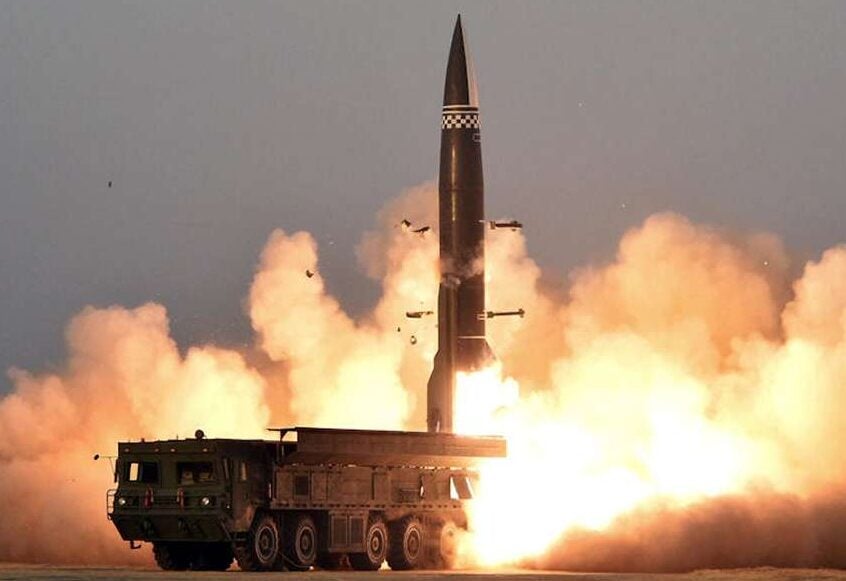
North Korea fired what it called an intermediate-range strategic missile from the Wonsan area on October 3, 2026, and claimed the weapon used a maneuvering, AI-assisted flight mode that South Korean and Japanese sensors could not track. South Korea’s Joint Chiefs of Staff (JCS) detected the launch at around 6:30 a.m. local time and said the missile flew more than 700 km toward the East Sea. Kim Jong Un oversaw the drill, according to a statement by his sister Kim Yo Jong carried by the Korean Central News Agency (KCNA).
The launch came a day after Kim Yo Jong, a department director of the ruling Workers’ Party of Korea, rejected Seoul’s demand for an apology over a September 21 mine blast in the Demilitarized Zone (DMZ) that injured three South Korean soldiers. A joint investigation with the US-led United Nations Command (UNC) found an active North Korean anti-personnel mine south of the Military Demarcation Line (MDL), a finding Pyongyang denies. The shot was North Korea’s first ballistic launch since a September 20 test of the Hwasongpho-11Ma-1, a short-range missile carrying a hypersonic glide vehicle.
North Korea IRBM Test: Flight Data From Seoul and Tokyo
Japan’s Ministry of Defense logged the launch at around 6:36 a.m. and assessed that the missile reached a maximum altitude of about 90 km and flew roughly 680 km before falling into the Sea of Japan outside Japan’s Exclusive Economic Zone (EEZ). Seoul’s National Security Office convened an emergency meeting, and the JCS said it was analyzing the missile’s specifications with US authorities.
Neither government has identified the missile. A South Korean government source left open the possibility of a medium-range or intermediate-range ballistic missile (MRBM or IRBM) flown at reduced range, and pointed to similarities with an August 12 launch. Tokyo assessed that earlier missile at roughly 690 km of range and about 90 km of apogee, a near-identical profile.
The apogee is telling. A minimum-energy trajectory to 700 km would peak near 170 km. An apogee of about 90 km points to a depressed or shaped trajectory, consistent with either an IRBM deliberately flown short or a maneuvering reentry profile. Pyongyang cannot fly an IRBM to full range without overflying Japan, which it last did on October 4, 2022, so the 700 km figure reflects test geometry rather than reach. Open-source estimates credit North Korea’s solid-fuel hypersonic IRBMs, flight-tested since 2024, with range to reach Guam, roughly 3,400 km away.
Skip-Glide Trajectory and AI Guidance: Assessing Pyongyang’s Claims
Kim Yo Jong said the drill was carried out by “a firepower sub-unit undertaking an exclusive special mission,” and argued that the divergent Seoul and Tokyo range figures exposed the limits of allied tracking. “Whenever we applied the wave-like trajectory mode to missiles, the enemy failed to track the targets from their first skip points,” she said, adding that both countries “should acknowledge the speed of the missile” without disclosing a figure. She claimed the missile can change its flight orbit at low altitude using artificial intelligence technology, meaning “there is no way to avoid this attack.” KCNA added that the missile can be set to at least four flight orbit modes according to purpose and target.
None of these claims has been independently verified. A wave-like profile with discrete skip points describes a skip-glide or pull-up maneuver, in which a reentry vehicle dips into the upper atmosphere and uses aerodynamic lift to climb again. After its January 6, 2025 hypersonic IRBM test, state media reported a 1,500 km flight at Mach 12 with a secondary apogee of 42.5 km; the JCS tracked roughly 1,100 km, detected no second peak, and judged the claims exaggerated.
The roughly 20 km gap between the two range figures does not by itself prove a tracking failure; sensor geometry and radar horizon limits have produced similar discrepancies before. Pyongyang offered no data to support its AI claim.
What Low-Altitude Maneuvering Means for Allied Missile Defense
The claims target the layered defenses of South Korea and Japan. Standard Missile-3 (SM-3) interceptors aboard US and Japanese Aegis destroyers engage in the exo-atmosphere. The US Army’s Terminal High Altitude Area Defense (THAAD) battery at Seongju, publicly reported to engage at altitudes of about 40 to 150 km, covers the upper endo-atmosphere. Patriot Advanced Capability-3 Missile Segment Enhancement (PAC-3 MSE) and South Korea’s Cheongung-II anchor the lower tier of the Korea Air and Missile Defense (KAMD) network.
A reentry vehicle maneuvering between 40 and 90 km flies largely beneath the regime where SM-3 performs best, in a band covered on the peninsula by a single THAAD battery. Japan fields no THAAD. Unpredictable maneuvers also widen impact-point uncertainty, forcing later interceptor commitment with less margin. Persistent track custody, backed by trilateral US, Japan, and South Korea missile warning data-sharing since December 2023, becomes decisive, and that is exactly what Kim Yo Jong sought to discredit.
Analysis: The October 3 launch reads less as a technology test than as a doctrinal signal. Framing it as a drill by a dedicated firepower sub-unit suggests maneuvering IRBMs are moving from development into operational strategic forces. Paired with the September 20 test, North Korea is now advertising glide or maneuvering payloads across short- and intermediate-range classes, a mix designed to stress allied defenses at multiple altitudes. The timing also shows Pyongyang using strategic signaling to raise the cost of South Korean pressure over the mine blast while rejecting President Lee Jae Myung’s offers of dialogue.
Seoul and Washington have not released a joint assessment of the missile’s designation, speed, or any recorded pull-up maneuver; that analysis will determine how much of Pyongyang’s claim survives scrutiny. Japan has framed the launch as a Security Council violation, though Russian and Chinese vetoes have blocked new sanctions since May 2022. October 10 marks the 81st anniversary of the Workers’ Party founding, a date Pyongyang has used for weapons displays. Along the MDL, the unresolved mine dispute keeps the risk of further escalation open.