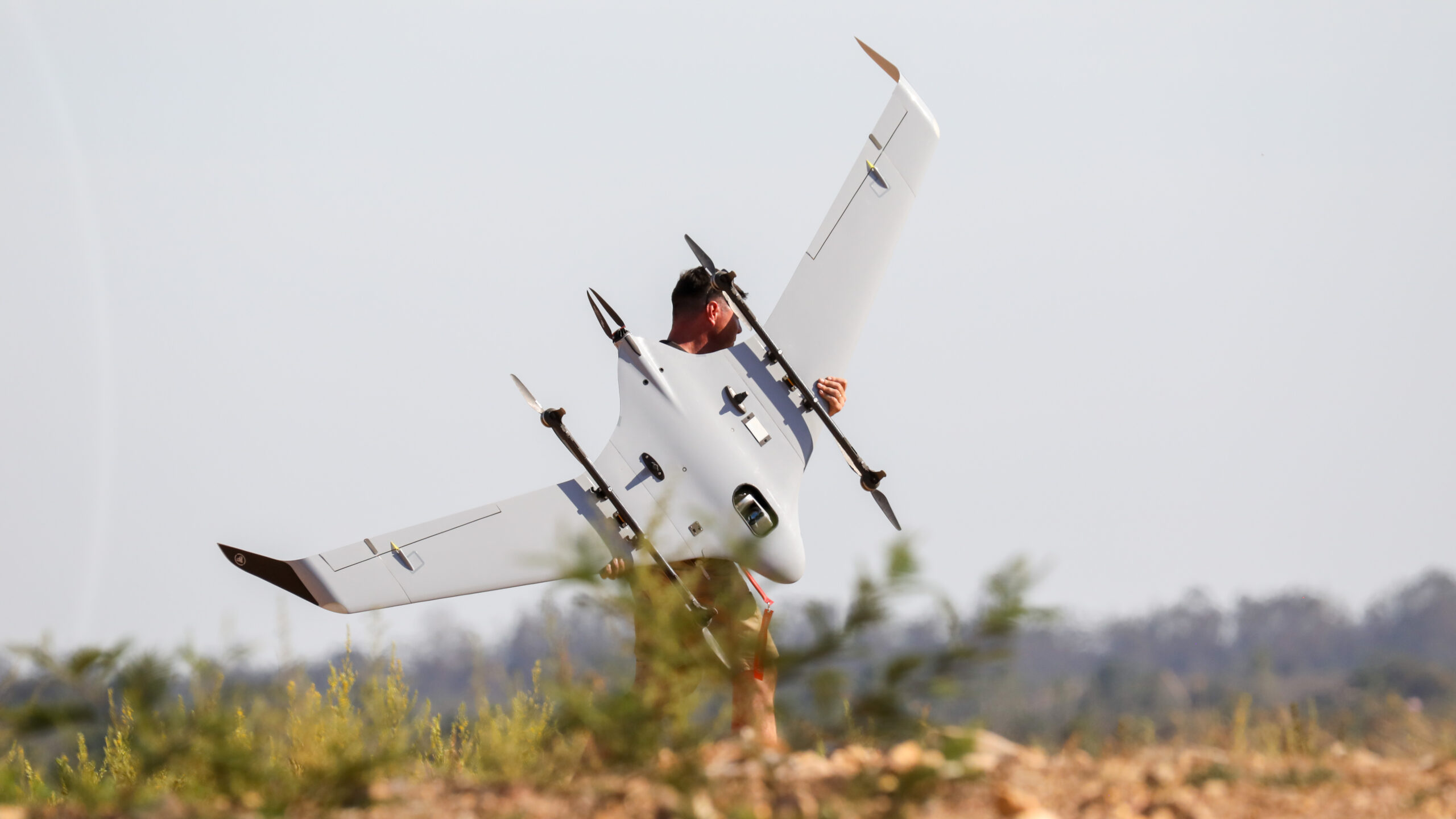
The European Defence Agency (EDA) and the Portuguese Army opened EU OPEX 2026 on September 28, 2026, at the Santa Margarida Military Training Area in Constância, putting uncrewed aerial and ground systems, loitering munitions and tactical communications through field trials alongside military end users. EDA describes the campaign as Europe’s flagship operational experimentation effort, with more than 200 innovators, military experts and operators taking part through October 14.
This is the second EU-level edition. The inaugural campaign, held in 2025 at the Italian Army’s Multifunctional Experimentation Center (CEPOLISPE) in Montelibretti, tested six companies’ drones and ground robots, focused on autonomous logistics. For 2026, EDA said it would shift OPEX from proof of concept toward a multinational experimentation network under its Hub for EU Defence Innovation (HEDI). The Agency folded the campaign into ARTEX 26, the Portuguese Army’s annual technology experimentation exercise, and has said Santa Margarida will become a national regulatory sandbox for emerging technology testing.
How EU OPEX 2026 Structures Testing at Santa Margarida
The campaign combines four strands. EU OPEX is the European experimentation core. ARTEX 26 is the national framework, run by the Army’s Military and Technological Experimentation Center (CEMTEx). BraveTech EU is the EU-Ukraine innovation track, and the Sentinel Strike Challenge is a prize contest dedicated to loitering munitions.
Participation figures differ by counting method. EDA cites more than 40 companies, start-ups and innovation organizations. The Portuguese Army puts the total at more than 70 entities from 22 nationalities, including universities, research centers and public bodies, fielding roughly 110 technological solutions. According to the Army, the test matrix spans uncrewed air and ground systems, counter-drone, electronic warfare, loitering munitions, reconnaissance and surveillance, communications and command and control, logistics support, force protection, camouflage, chemical, biological, radiological and nuclear (CBRN) defense, and additive manufacturing. All systems first cleared a technical, regulatory and safety acceptance phase from September 21.
The first week is limited to stand-alone tests and single-domain missions. Later scenarios require drones to fly reconnaissance and surveillance in a hostile environment while streaming real-time data to commanders, uncrewed ground and aerial vehicles to cooperate on resupply runs to frontline troops, and loitering munitions to engage multiple targets at night. Cross-domain field experiments peak on October 7 and 8.
BraveTech EU Phase II runs in parallel. Linking the European Commission, EDA and Ukraine’s BRAVE1 platform, its six Phase II companies cover hierarchical drone swarms (Soraccel, France), a modular 4×4 uncrewed ground vehicle (EdgeX Robotics, Poland), a multi-radio mesh combining LoRa, Wi-Fi HaLow, Wi-Fi and Bluetooth Low Energy (Smaesh, Germany), low-altitude autonomy (Kova Labs, Finland), a multi-rocket launcher concept for counter-UAS and ground targets (Tempterno Defence, Estonia) and rocket-propelled ammunition for drone-to-drone combat (Rannon, Latvia). Scenarios include holding connectivity under deliberately degraded conditions. EDA manages a €35 million Phase II budget through 2028.
Sentinel Strike Challenge Puts Five Loitering Munitions Head to Head
The most closely watched strand is the Sentinel Strike Challenge, which uses a two-stage award procedure that extends assessment from written proposals to live field testing within the same competition. Stage 1 drew more than 140 expressions of interest. After scoring on technical maturity, operational relevance, safety and demonstration feasibility, EDA advanced five finalists: Helsing (Germany), Destinus (Netherlands), C-Astral (Slovenia), UAVision (Portugal) and Spirit Aeronautical Systems (Greece). Each received a €30,000 Stage 1 prize and now competes for €1.8 million in Stage 2 prizes. The remaining top-ten entrants, including Thales LAS (France) and ALTUS LSA (Greece), received €10,000 each.
Military users from EU member states will score each finalist’s system across the full mission cycle: planning and launch, target detection and identification, engagement, and effects assessment. The Portuguese Army lists precision, reliability, safety, resilience in degraded or electromagnetically contested environments and integration with other military systems among the criteria. Because all five finalists fly identical scenarios, the output is comparable performance data that individual ministries otherwise generate one procurement at a time.
EDA has not disclosed which airframes, warheads or datalinks each finalist is fielding, and it has published no range or endurance parameters for the specific test articles. Publicly available company material indicates Helsing’s HX-2 strike drone is rated for ranges up to 100 kilometers, but the Agency has not confirmed which system Helsing entered. EDA is explicit that reaching Stage 2 does not signal procurement readiness; the contest carries no contract promise, and overall winners are expected to be named in 2027.
Analysis: The EU is not buying anything at Santa Margarida; it is building a shared evidence base. That matters most for loitering munitions, where EDA acknowledges battlefield adaptation now outpaces traditional development cycles, and where the Agency’s 27 participating member states would otherwise evaluate overlapping vendor pools separately. Side-by-side trials under contested electromagnetic conditions give smaller members data they could not afford to generate alone. The constraint is scale: €1.8 million in prizes and a €35 million BraveTech budget are marginal next to national procurement lines. OPEX will be judged on conversion, meaning whether its data surfaces in capability plans and contracts.
Cross-domain experiments run October 7 and 8, the main trial window closes October 9, and a High Visibility Event for political and military leaders follows on October 14. The four most advanced BraveTech companies continue experimentation in 2027, when Sentinel Strike winners are also due. Still unknown: how much performance data EDA will release beyond participating ministries, and whether any tested system enters a national program before then.