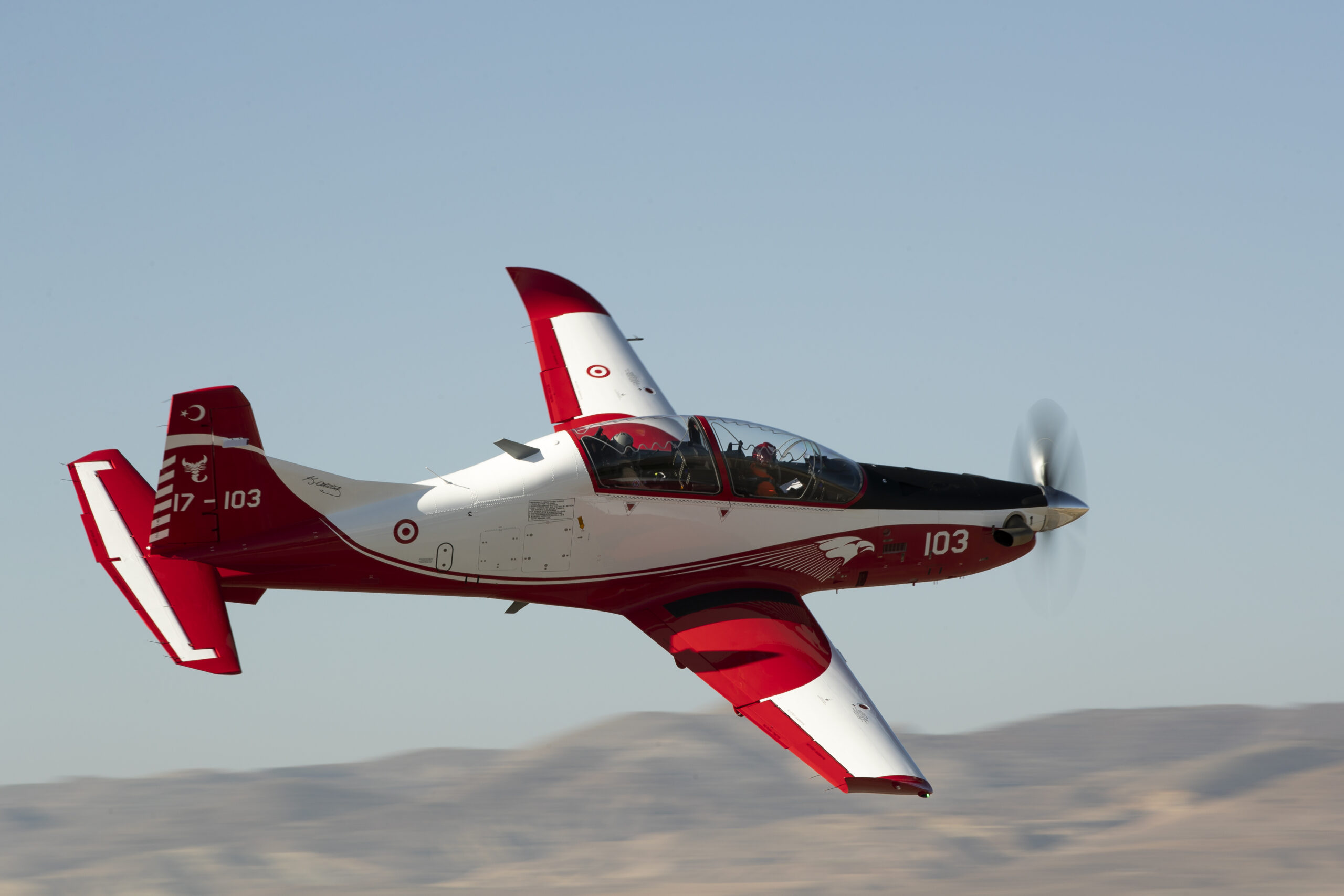
Turkish Aerospace Industries (TUSAŞ) delivered the first two Hürkuş II basic trainers to the Turkish Air Force Command on September 28, 2026, after roughly three weeks of acceptance testing covering flight performance, avionics and structural integration. The handover at the TUSAŞ facility in Kahramankazan, near Ankara, opens deliveries under a 55-aircraft contract that Türkiye’s Presidency of Defense Industries (SSB) aims to complete by the end of 2028.
The induction closes a program that began in 2006 and has been marked by delays. The Turkish Air Force ordered 15 first-generation Hürkuş aircraft but never took delivery, and TUSAŞ redirected those airframes to export customers. A contract amendment signed on May 3, 2021, reoriented the effort toward a redesigned Hürkuş II, and SSB later expanded the order by 40 aircraft to 55. The new variant flew in December 2024 and received its Military Type Certificate on September 9, 2026, from a board of SSB and Air Force personnel, which SSB describes as the first certification of an indigenous platform conducted entirely by Turkish authorities.
Hürkuş II Trainer Specifications and Certification Record
The Hürkuş II is a tandem-seat, single-engine turboprop powered by a 1,600 shp Pratt & Whitney Canada PT6A-68T. TUSAŞ gives a service ceiling of 30,000 ft and a maximum speed of 320 knots calibrated airspeed (KCAS). Reported figures put maximum takeoff weight at 3,300 kg, the result of a redesign that reworked the fuselage, engine intake, exhaust and control surfaces to cut structural weight and improve aerodynamic performance over the first-generation airframe.
That power class places the aircraft alongside the Pilatus PC-21, which publicly available specifications indicate also uses a 1,600 shp PT6A variant, and well above the KT-1T it is expected to succeed, whose PT6A-62 is rated at 950 shp according to open-source data. For the syllabus, the margin matters: a high-performance turboprop lets instructors push energy management, aerobatics and tactical formation work into the propeller phase, shifting hours away from costlier jet sorties.
SSB reports that engineers verified 1,790 requirements across 12 certification disciplines, reviewed 950 evidence documents and ran 153 certification tests. Ground, laboratory and system integration work accumulated about 23,000 test hours. SSB says the cockpit and avionics architecture was designed in common with other TUSAŞ platforms and paired with a digital training infrastructure. Detailed avionics data, including display layout, mission computer and embedded simulation functions, has not been released.
SSB puts domestic content above 70 percent and says indigenous subsystems and software ease the integration of national munitions. The Hürkuş II can also fly light attack and close air support missions, although the Air Force has not said whether it intends to use its fleet in an armed role.
How Hürkuş II Anchors the Hürjet and KAAN Training Chain
The Turkish Air Force’s undergraduate pilot pathway currently runs through three foreign-origin types: the SF-260D for initial screening, the KT-1T for basic training and the T-38M for advanced jet training. The KT-1T, 40 of which were ordered from Korea Aerospace Industries under a $350 million contract signed in 2007, is the aircraft Hürkuş II was built to replace. Basic training on the KT-1T is currently conducted by the 122nd Squadron at the 2nd Main Jet Base in Çiğli, Izmir. The Air Force has not specified which squadron will receive the first aircraft or when the KT-1T will begin to draw down.
Hürkuş II is designed to cover both basic and advanced primary training on one airframe, and TUSAŞ positions it as the first rung of a domestic continuum leading to the Hürjet supersonic trainer and the KAAN fifth-generation fighter. That sequence is now converging. The first Hürjet built for the Air Force flew on August 30, 2026, with deliveries targeted to begin between late 2026 and 2027. Hürjet is slated to replace a T-38M fleet that open-source estimates put at about 68 aircraft.
Commonality is the operational payoff. A student who learns cockpit logic, display philosophy and mission system workflows on Hürkuş II should find a familiar architecture on Hürjet, which in principle reduces conversion time and simulator hours. Air Force Commander Gen. Rafet Dalkıran described the aircraft as a foundation for training that will integrate with Hürjet and KAAN. Whether TUSAŞ will field a common ground-based training system across the three types remains undisclosed.
Analysis: The strategic value of Hürkuş II lies less in the airframe than in the certification authority behind it. By certifying a military aircraft through its own board, Türkiye has built the airworthiness infrastructure it will need for Hürjet, KAAN and its unmanned combat aircraft, reducing reliance on foreign regulators for each new type. The limit is propulsion. The PT6A-68T remains a Canadian engine, just as Hürjet relies on the GE Aerospace F404, so the domestic content figure leaves the most export-sensitive component in foreign hands. For a NATO air force removed from the F-35 program, and whose suppliers have faced allied export restrictions in the past, that residual exposure is the variable to watch.
SSB plans to deliver 12 more Hürkuş II aircraft between September and December 2026, a pace that will test production-line stability. The Air Force aims to stand up Hürkuş II squadrons in 2027 and to hold all 55 aircraft by the end of 2028. Key unknowns remain the KT-1T retirement schedule, the undisclosed contract value, and whether export customers follow now that a launch operator is flying the type.