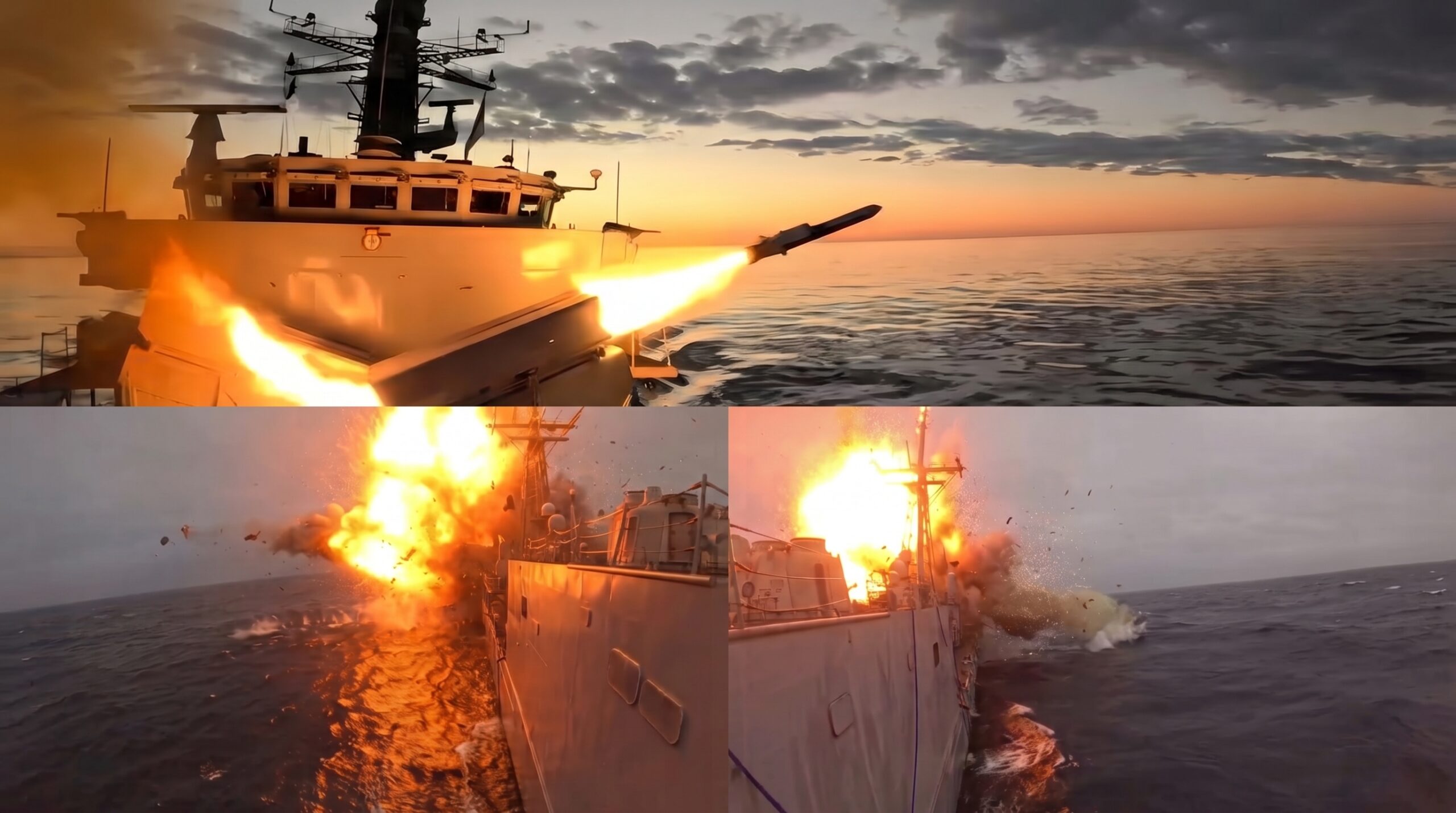
The Royal Navy fired a live Naval Strike Missile (NSM) from the Type 23 frigate HMS Portland, and a Sea Venom missile from an embarked Wildcat helicopter of 815 Naval Air Squadron, at the decommissioned frigate USS Klakring during Atlantic Thunder 26, a US-UK sinking exercise (SINKEX) held off the Hebrides from September 14 to 25, 2026. Both British weapons hit, and the attack submarine USS Massachusetts finished the ship with a Mark 48 torpedo.
The shots tested weapons the fleet has only recently fielded. Harpoon left Royal Navy service in 2023, and the Naval Strike Missile entered under an interim arrangement that moves launch equipment between hulls as ships enter and leave refit. HMS Somerset fired the first Royal Navy NSM at Norway’s Andøya range in September 2025; Portland’s round carried a warhead and targeted a real ship. Captain Kelechi Ndukwe, commander of Task Force 65 and Destroyer Squadron 60, said the Sea Venom shot was the missile’s first live firing since initial operating capability.
Naval Strike Missile and Sea Venom: What the Royal Navy Fired
Publicly available specifications indicate the Kongsberg-built Naval Strike Missile weighs about 407 kilograms (897 pounds) and measures 3.96 meters (156 inches) with its booster. A turbojet sustainer gives it high subsonic speed, though the Royal Navy describes it as flying close to Mach 1. The service cites a range beyond 100 miles, while Kongsberg’s current brochure lists more than 300 kilometers; which figure applies to the British configuration is not stated. Inertial, GPS and terrain-reference navigation feed an imaging infrared seeker whose autonomous target recognition classifies the ship and selects the hit point. A titanium-cased blast and fragmentation warhead of roughly 120 kilograms (264 pounds) and a sea-skimming profile are meant to defeat shipboard air defenses.
Sea Venom, built by MBDA, occupies the lighter tier. Open-source data list a 30-kilogram semi-armor-piercing blast and fragmentation warhead, a range beyond 20 kilometers, an imaging infrared seeker steerable through a two-way datalink, and up to four rounds per Wildcat. The Royal Navy says it can defeat corvette-size vessels or disable frigates and destroyers, so a frigate hull was a representative target. The service says the helicopter crew completed the full kill chain, detecting, identifying and striking the target.
Kill Chain Sequence From SM-6 to the Mark 48 Torpedo
The US side began with the longest-range weapon and moved to shorter-range systems, Ndukwe said, a sequence designed to get the most from the sensors fitted to the hull for battle damage assessment. The destroyer USS Paul Ignatius, an Arleigh Burke-class Flight IIA ship forward-deployed to Rota, Spain, opened with an anti-surface variant of the Standard Missile 6 (SM-6) to demonstrate maximum range and damage. Royal Air Force and US Air Force aircraft also took part, including P-8 maritime patrol aircraft from both countries and F-15E Strike Eagles. The Virginia-class submarine USS Massachusetts closed with a 21-inch Mark 48 Advanced Capability torpedo, which delivered the final hit.
The target was the 138-meter (453-foot) Oliver Hazard Perry-class frigate Klakring, commissioned in 1983 and decommissioned on March 22, 2013. She sank roughly 150 nautical miles offshore in about 6,000 feet (1,800 meters) of water. Naval Surface Warfare Center Carderock Division and Naval Information Warfare Center Pacific installed the hull sensors, and US Sixth Fleet says the data will feed assessments of failure modes and repair needs. Ndukwe said both fleets worked from a common tactical picture over a Sixth Fleet link architecture shared with Portland without difficulty. Range was the main change from the 2022 iteration, when “we weren’t able to test at the longest range.”
Uncrewed Systems Absent From Atlantic Thunder 26 Despite Industry Call
The Ministry of Defence (MoD) had scoped the event around uncrewed technology. Its August 2025 request for information sought high-resolution scanning at depths to 6,000 feet, autonomous mission tools and long-endurance, low-signature platforms, while stressing that Atlantic Thunder 26 was a development exercise rather than a showcase. Asked whether any uncrewed systems took part, Ndukwe said none did. The strike phase relied on crewed ships, a submarine and aircraft, and damage data came from hull sensors. US European Command has said in a social media post that uncrewed underwater vehicles will later scan the seabed to measure the damage. The exercise was originally planned for May 11 to 22, 2026.
Analysis: The value of Atlantic Thunder 26 lies in integration rather than any single round. A Royal Navy escort fired the newly fielded Naval Strike Missile inside a US-built kill web, with weapons drawn from surface, subsurface and air forces, the kind of combined targeting NATO navies would need in the North Atlantic. Officials billed the exercise as “strategic messaging through kinetic demonstration,” and Ndukwe described it as a display of long-range reach that shows peace through strength, without naming an adversary. Two limits apply. Hit points, rounds expended and ranges flown remain unpublished, so effects are unquantified, and the interim NSM arrangement implies a limited number of launch sets ahead of the heavier Future Cruise/Anti-Ship Weapon.
Results will be processed over the coming months and shared between the two navies, and Ndukwe expects them to shape tactics, techniques and procedures. He said North Atlantic weather created obstacles, but all primary objectives were met and nothing the team wanted to test failed. Planning for the next Atlantic Thunder has begun, with execution targeted for 2028. Open questions include the number of rounds fired, the seabed survey of the wreck, and the timeline for the Future Cruise/Anti-Ship Weapon, which the Royal Navy intends as its premier long-range anti-ship missile on the Type 26 and Type 31 frigates through the Mk 41 vertical launch system.