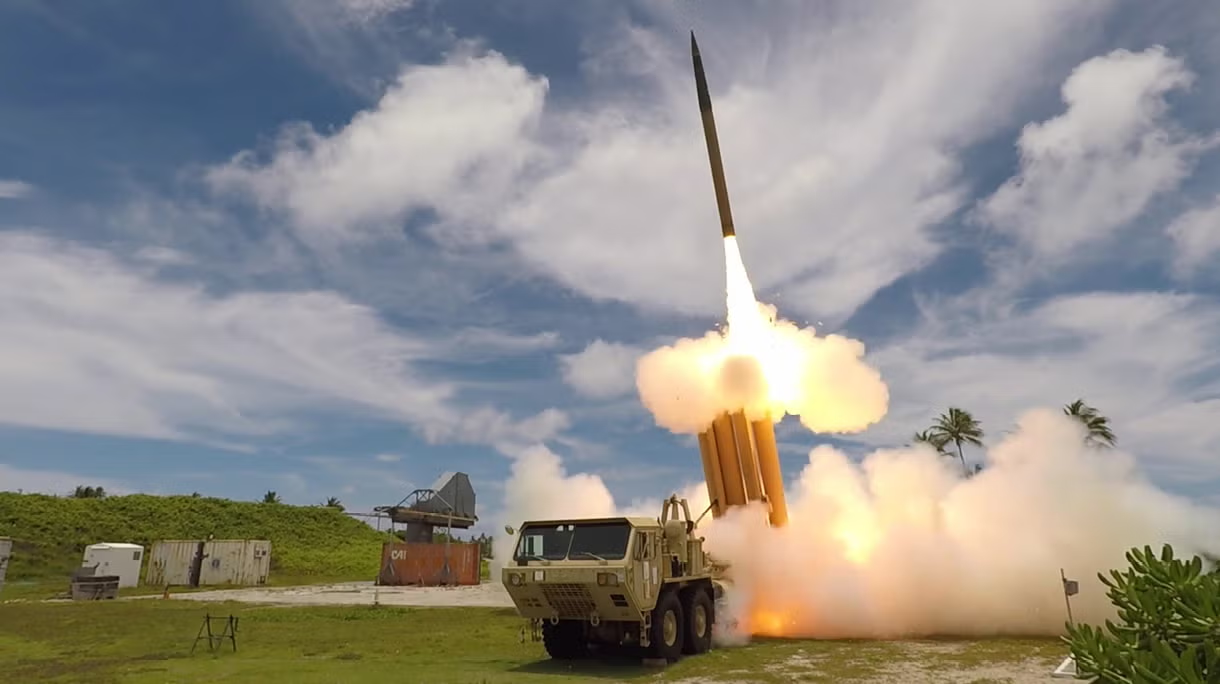
L3Harris Technologies has received an undefinitized contract from Lockheed Martin valued at more than $6 billion, excluding escalations, to expand production of propulsion systems for the Terminal High Altitude Area Defense (THAAD) interceptor over seven years, the company announced on September 29, 2026. The award covers THAAD’s Solid Rocket Boost Motor (SRBM) and Liquid Divert and Attitude Control System (LDACS), and funds a new facility dedicated to boost motor manufacturing.
The contract turns into a funded award the framework agreement that L3Harris, Lockheed Martin and the Department of War announced on July 27, 2026, which set a goal of quadrupling THAAD propulsion output. It follows the potential $35 billion undefinitized contract action Lockheed Martin received in June 2026 to raise annual THAAD interceptor production from 96 to about 400 rounds, an effort accelerated after interceptor expenditures in the conflict with Iran drew down U.S. air defense stockpiles. Every one of those interceptors requires one L3Harris boost motor and one LDACS.
What the THAAD Propulsion Contract Buys: Boost Motor and LDACS
The THAAD interceptor is a single-stage, hit-to-kill missile with no explosive warhead. Publicly available specifications indicate a length of about 6.17 meters, a launch weight of roughly 900 kilograms, an engagement range near 200 kilometers and an intercept ceiling around 150 kilometers, with burnout speed commonly cited at about Mach 8. Those figures define THAAD’s place in the U.S. layered architecture: terminal-phase engagements of short-, medium- and intermediate-range ballistic missiles both inside and outside the atmosphere, above the Patriot PAC-3 Missile Segment Enhancement (MSE) tier.
The SRBM delivers that envelope. Open-source descriptions point to a solid-propellant booster with thrust vector control that drives the interceptor out of its canister and shapes the flyout toward the predicted intercept point. After booster separation, the kinetic kill vehicle relies on the LDACS, a liquid-fueled thruster package that L3Harris says keeps the kill vehicle on target during the final stages of an intercept. Because THAAD destroys targets by direct impact, divert authority in the last seconds of flight determines whether the seeker’s track converts into a kill against a maneuvering or separating reentry vehicle.
Both components entered the L3Harris portfolio through its July 2023 acquisition of Aerojet Rocketdyne. The company builds the boost motor in Huntsville, Alabama, and Camden, Arkansas, and the LDACS in Los Angeles. In 2024 it delivered its 1,000th SRBM and 1,000th LDACS. In February 2026, L3Harris received a contract worth nearly $400 million for additional motors and divert systems, making the new award roughly 15 times larger in headline value.
L3Harris states that THAAD has achieved a 100% intercept success rate in flight tests since production began, a record the company put at 17 for 17 in February 2026.
From 96 to 400 Interceptors: Scaling the THAAD Industrial Base
A standard THAAD battery fields six truck-mounted launchers carrying eight interceptors each, according to open-source data, for 48 ready rounds alongside an AN/TPY-2 X-band radar and a fire control element. At the pre-surge rate of 96 interceptors a year, U.S. industry produced two full battery loads annually. At 400, it would produce more than eight. Propulsion output has to track that curve before Lockheed Martin Missiles and Fire Control can deliver complete rounds.
L3Harris is combining new construction with expansion of existing lines: a new facility for SRBM manufacturing and added capacity for LDACS production. Ken Bedingfield, President of Missile Solutions at L3Harris, said the award “underscores L3Harris’ demonstrated ability to quickly deliver critical defense technologies at the scale and speed required by the Department of War,” adding that planned facility expansions and portfolio investments would “continue to enable a wartime footing.”
The THAAD award lands three weeks after a $4.7 billion, seven-year undefinitized contract from Lockheed Martin for PAC-3 MSE propulsion, covering that interceptor’s two-pulse solid rocket motor, Lethality Enhancer and Attitude Control Motors. L3Harris said both awards are consistent with its previously announced expectations. Across its propulsion business, the company reports building approximately 60 new facilities and adding more than 1 million square feet of manufacturing space in Alabama, Virginia and Arkansas.
The contracting model matters as much as the dollar value. Both awards flow from framework agreements under the Department of War’s Acquisition Transformation Strategy, which is designed to give suppliers multiyear demand signals that justify capital investment in energetics, production bays and workforce before contracts are definitized.
Analysis: The award shifts the THAAD debate from funding to execution. With more than $10.7 billion in combined THAAD and PAC-3 MSE propulsion work now under contract, L3Harris anchors propulsion for both the upper and lower tiers of U.S. ballistic missile defense interceptors. That concentration enables a coordinated ramp, but it also exposes both programs to the same risks in energetics supply, test infrastructure and qualification of new production lines. Propulsion is also only one input: seeker output, kill vehicle integration and flight test capacity will determine whether 400 rounds a year becomes a delivery rate rather than a contract ceiling.
The next milestone is definitization, when L3Harris and Lockheed Martin must lock in quantities, unit prices and delivery schedules; neither company has disclosed a timeline. The site and completion date of the new SRBM facility also remain unannounced. Two new PAC-3 propulsion facilities under construction at Camden are expected to be operational in 2027, a benchmark for how quickly the THAAD expansion could yield additional motors.