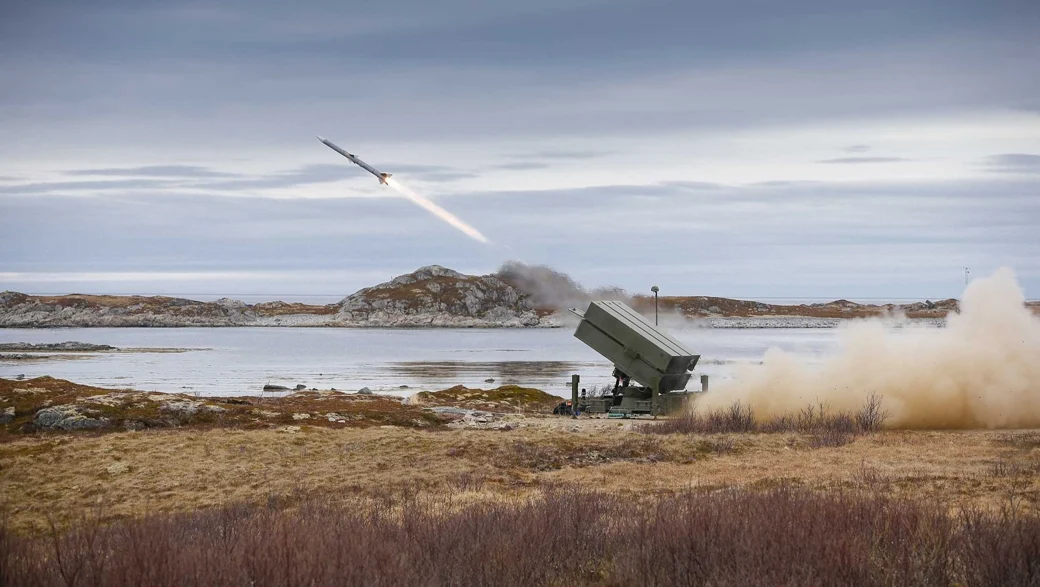
Kongsberg Gruppen has signed a contract worth about NOK 1.5 billion, roughly €135 million, with the Netherlands to expand the country’s CITADEL integrated air and missile defense program, the Norwegian company announced on September 29, 2026. The order adds several National Manoeuvre Air Defence System (NOMADS) short-range units and increases Dutch National Advanced Surface-to-Air Missile System (NASAMS) medium-range capacity. Neither Kongsberg nor the Dutch Ministry of Defense has disclosed quantities or a delivery schedule for the additional systems.
The award builds on the NOK 12 billion, approximately €1 billion, CITADEL contract signed on November 21, 2024, which made the Netherlands the first export customer for NOMADS and set first deliveries for 2028. The Netherlands has operated NASAMS since 2006, and CITADEL replaces that legacy medium-range capacity while adding a mobile short-range layer to protect maneuver brigades. When the Ministry of Defense submitted the program to parliament on October 14, 2024, it budgeted €2.6 billion for six medium-range and four short-range fire units, plus munitions and support.
Inside the NOMADS Air Defense System on the ACSV G5
NOMADS is Kongsberg’s mobile short-range air defense (SHORAD) configuration, derived from NASAMS, developed with the Norwegian Armed Forces and unveiled in June 2024. The mission module rides on the Armoured Combat Support Vehicle (ACSV) G5, a tracked carrier built by Germany’s Flensburger Fahrzeugbau Gesellschaft (FFG) and powered by a six-cylinder MTU diesel rated at 460 kW, roughly 616 hp. The Dutch vehicles are sourced through a government-to-government arrangement with Norway.
Each launcher carries two canisters holding two missiles apiece, for four ready rounds. Norway and the Netherlands selected the AIM-9X Sidewinder Block II, an imaging-infrared missile common to allied F-35A fleets, easing stockpile management. The Dutch Ministry of Defense credits NOMADS with engagements out to 15 km against helicopters, fixed-wing aircraft and unmanned aircraft systems. Surveillance and fire control rely on an organic 3D radar that open-source reporting identifies as a Weibel Scientific XENTA-M X-band set; publicly available specifications indicate detection ranges of up to 75 km. A Kongsberg PROTECTOR remote weapon station with a 12.7 mm M2 heavy machine gun adds a gun layer for close-in drone engagements and self-defense.
NOMADS inherits NASAMS command-and-control functions and supports Link 16 and JREAP-C, so each vehicle can fight autonomously or cue off the wider NATO air picture. The baseline CITADEL order covered 18 NOMADS launchers supported by five armored fire control modules, according to the Dutch Ministry of Defense. The new contract enlarges that fleet, though the precise increment remains undisclosed.
The chassis choice carries logistics weight. The Netherlands announced in January 2025 that it would buy 22 Rheinmetall Skyranger 30 gun systems on the same ACSV G5 hull, giving the Royal Netherlands Army a common tracked platform for both missile and cannon-based SHORAD. Shared spares and training reduce the sustainment burden of fielding two new systems in the same window.
NASAMS and CITADEL: Building a Benelux Medium-Range Air Defense Layer
On the medium-range tier, CITADEL fields NASAMS with the Canister Launcher Mk II, firing the AIM-120C-8 AMRAAM and the extended-range AMRAAM-ER, both procured from the United States through Foreign Military Sales. The Dutch Ministry of Defense cites intercepts out to 50 km against aircraft, helicopters, large drones and cruise missiles. The baseline plan called for 21 NASAMS launchers controlled by eight Fire Distribution Centers, organized into four platoons able to operate independently or alongside Patriot to protect ports, cities and logistics nodes.
Rather than the Raytheon AN/MPQ-64F1 Sentinel fitted to the standard NASAMS configuration, the Netherlands cues its fire units with the domestically built Thales Nederland Multi-Mission Radar (MMR). CITADEL added eight MMRs, raising the national inventory to 26. Five fire coordination modules link the NASAMS, NOMADS and Patriot layers into a single engagement architecture. A November 2024 letter to parliament earmarked funding for additional Patriot and NASAMS launchers beyond the baseline program, though the ministry has not tied the new contract to that line.
Kongsberg’s NOK 10 billion NASAMS contract for Belgium, announced the same day, was signed by the Dutch armed forces’ procurement authority, with the Belgian Air Force as end user. Belgian Defense Minister Theo Francken has said one of the 10 systems in that package is intended for Luxembourg, and Belgium expects to lease an initial NASAMS capability from 2027 pending deliveries.
Analysis: A NOK 1.5 billion top-up is modest against the original NOK 12 billion award, but its timing matters. The Netherlands is enlarging CITADEL before the first system has been delivered, securing additional output from a production line that now also serves Norway, Belgium and a widening NASAMS user base. By contracting for Belgium as well, The Hague is shaping a single ground-based air defense standard across the Benelux, easing NATO integration over the ports and corridors that allied reinforcements would use. The binding constraint is interceptor supply rather than launchers: AIM-9X and AMRAAM variants come through US Foreign Military Sales, and additional fire units add real capacity only if missile deliveries keep pace.
Deliveries under the original CITADEL contract are due to begin in 2028. Open questions include the exact number of NOMADS and NASAMS units added, whether the expansion shifts the fielding timeline, and the size of the matching missile orders. Further detail is likely in the ministry’s next project reporting to parliament. Belgium’s leased NASAMS capacity, expected in 2027, will mark the first fielding under the shared Benelux model.