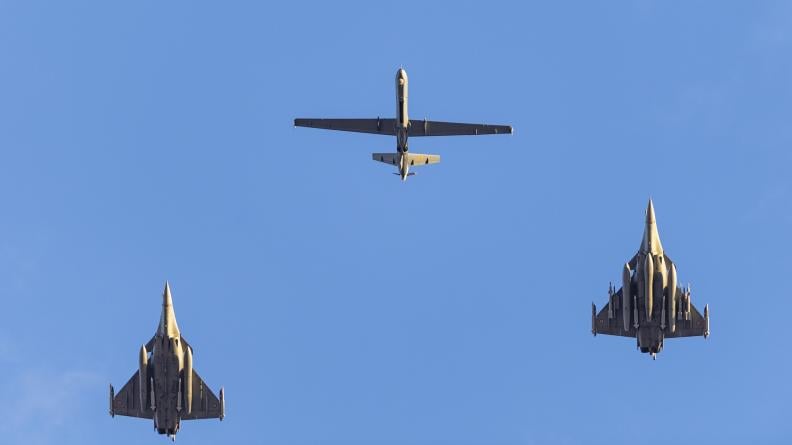
France’s Ministry of the Armed Forces on October 1, 2026, detailed HypAIRion, an experimental program that brings every artificial intelligence initiative of the French Air and Space Force (Armée de l’Air et de l’Espace, AAE) under a single fighter modernization effort. Launched in July 2026 and run jointly with the Directorate General of Armaments (DGA) and the Ministerial Agency for Defense Artificial Intelligence (AMIAD), the program is designed to prepare the AAE for collaborative combat drones flying alongside its Rafale fleet.
The announcement comes three weeks after the DGA disclosed, on September 10, 2026, that it had notified upstream development contracts for the Rafale F5 standard to Dassault Aviation, Thales, Safran and MBDA. France committed in October 2024 to a stealthy uncrewed combat aerial vehicle (UCAV) derived from the nEUROn demonstrator to fly with the F5 around 2033. HypAIRion is meant to supply the AI layer both platforms will depend on, shaped by lessons from Ukraine and the Middle East.
How HypAIRion AI Rebuilds Mass Around the Rafale Fleet
The operational rationale comes from Colonel Cédric, head of the capability development office at the AAE staff. His premise is that in high-intensity warfare, quality never fully exempts a force from quantity. The Rafale remains the core of French air combat, but the AAE intends to thicken it with collaborative combat drones, which he describes as simplified, uncrewed and, above all, cheaper fighter aircraft. Pushed ahead of the crewed jet, these platforms would extend sensor reach, force adversary air defenses to reveal themselves, and concentrate risk on the uncrewed airframe rather than on the pilot.
Decision speed is the second driver. The side that detects, understands, decides and acts faster than its opponent gains the upper hand, the colonel argued, and AI must convert the abundance of sensor data into an operational edge. The third is adaptability. He cited the Russian Geran one-way attack drone, a derivative of the Iranian Shahed-136 now in its fifth version, as evidence that airborne systems must evolve at the pace of the threat through open, modular architectures. “Tomorrow, our platforms will be true flying computers,” he said. Two Mirage 2000 fighters have already been converted into AI testbeds at Mont-de-Marsan Air Base, home of the Military Air Expertise Center (CEAM). The variant was not specified.
AMIAD contributes the software foundation. Colonel Thibault, who heads the agency’s AI employment sub-directorate, said AMIAD will provide sovereign AI technologies for platform autonomy and for command and control, aimed at mission autonomy that keeps pilots ahead of the threat. The agency, created on May 1, 2024, will reuse work from Pendragon, the robotic combat unit project it has run with the French Army for 18 months. He identified three technical challenges: training models on operational data, distributing the architecture across platforms, and securing the AI itself. Pilot involvement and iterative experimentation are the stated success factors.
TALIOS AI Pod and Rafale F5: Where Embedded AI Enters Service
The DGA’s Rafale program director, General Engineer of Armament Sébastien, aims to ease what he called a phenomenal crew cognitive load while improving combat effectiveness. The first concrete building block is the Thales TALIOS (Targeting Long-range Identification Optronic System) laser designation pod, whose embedded AI automatically detects and categorizes ground targets. Deliveries are planned from 2027. Thales, which develops the function through its cortAIx AI accelerator, says onboard processing analyzes airborne imagery up to 100 times faster than earlier methods and pre-selects objects of interest, while the engagement decision remains with the pilot. France has ordered 67 TALIOS pods for its Rafale fleet.
These experiments feed the Rafale F5, expected in 2033 and described as a true mid-life upgrade with reinforced computing power, an open architecture and national control of data. The summer 2026 contracts cover the RBE2-XG radar and the Inter-Vehicle Data Link (IVDL) from Thales, the SPECTRA F5 self-protection suite from Thales and MBDA, a low-drift inertial navigation unit from Dassault, and preliminary design of the Safran M88 T-REX engine. Per the ministry’s 2024 description, the accompanying stealth UCAV will be air-refuelable and support first-entry, air-to-air, air-to-surface and suppression of enemy air defenses (SEAD) missions, with AI native to its mission system. HypAIRion is presented as the first beneficiary of the F5 architecture.
Analysis: France is building the software and data layer ahead of the airframe, a sequence that matters because a UCAV is only as useful as the autonomy a Rafale pilot can supervise under heavy workload. The logic mirrors the US Air Force’s Collaborative Combat Aircraft (CCA) push for affordable mass, but on a slower clock, since CCA Increment 1 prototypes flew in 2025 while France targets 2033 for an operational pairing. The unresolved variable is cost. Colonel Cédric’s framing of a cheaper, simplified fighter sits uneasily alongside a stealthy, refuelable, nEUROn-derived UCAV, and no unit price or fleet size has been disclosed. If the drone ends up closer to an exquisite platform than an attritable one, the mass argument underpinning HypAIRion weakens.
The next milestone is the full Rafale F5 development contract, expected by the end of 2026, followed by AI-enabled TALIOS deliveries from 2027. The ministry has not disclosed HypAIRion’s budget, the flight test schedule of the Mirage 2000 testbeds, or how many drones a single Rafale will control. Those answers will determine whether HypAIRion remains an experimentation framework or becomes the backbone of French collaborative air combat.