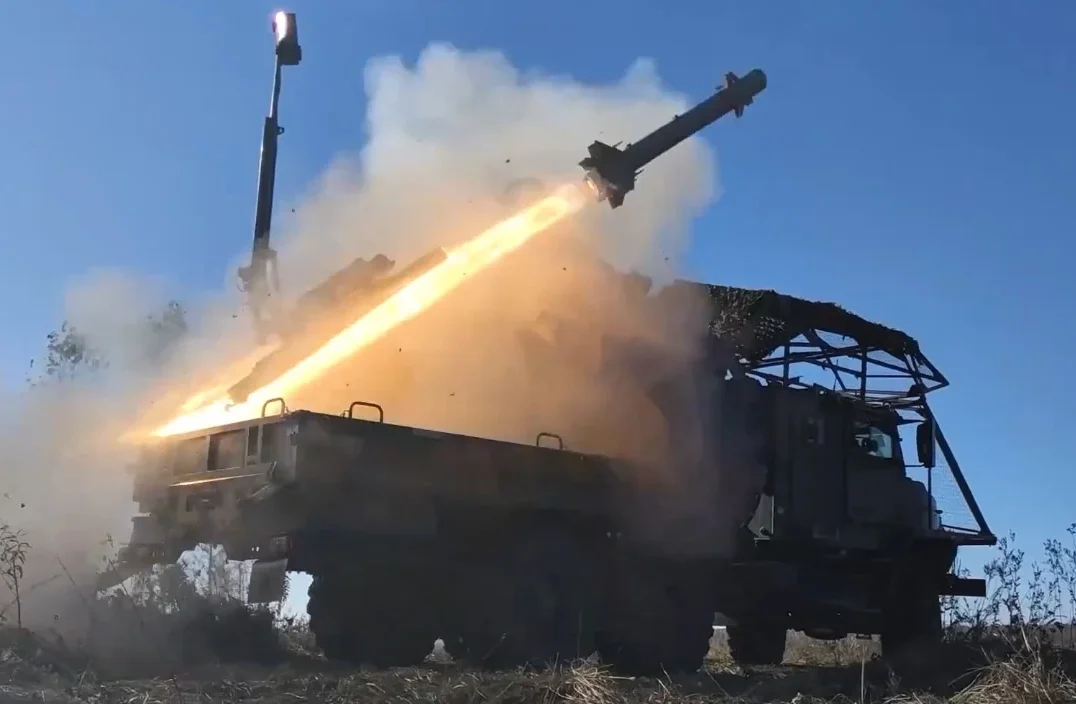
Russia’s Ministry of Defense said on October 2, 2026, that its forces fired the new Izdeliye 347 ground-based missile system against simulated enemy artillery positions spotted by aerial reconnaissance during the main phase of the Tsentr-2026 strategic command-staff exercise at the Chebarkulsky training ground in the Chelyabinsk Region. The system fires a modified light multipurpose guided missile, known by its Russian acronym LMUR, and can strike stationary and moving targets at up to 20 km, with an operator steering the missile in the terminal phase.
The firing marks the first official appearance of a ground launcher for a missile Russian attack helicopters have used extensively in Ukraine. Tsentr-2026 (Center-2026), held from September 28 to October 3, closes the Russian Armed Forces’ annual training cycle and involves more than 47,000 personnel across 11 training grounds and the Caspian Sea, according to the ministry. The October 2 phase at Chebarkul, observed by President Vladimir Putin, drew more than 6,000 troops, 1,479 of them foreign, and more than 600 pieces of equipment, including over 500 unmanned aerial vehicles (UAVs).
Izdeliye 347: How Russia Adapted the LMUR for Ground Launch
The missile at the core of Izdeliye 347 is the LMUR, also designated Izdeliye 305 and reportedly indexed Kh-39, developed by the KBM design bureau in Kolomna, part of Rostec’s High Precision Systems holding. Publicly available specifications indicate a launch weight of 105 kg, a 25 kg high-explosive fragmentation warhead, a body diameter of about 200 mm, a length under 2 m and a solid-propellant motor giving a speed of roughly 230 m/s. The air-launched baseline carries a stated maximum range of 14.5 km.
The LMUR flies toward preset coordinates using inertial and GLONASS satellite navigation, then streams imagery from its thermal seeker over a two-way datalink. The operator identifies the target, locks on and can correct the missile until impact. The shooter can therefore engage targets it cannot see at launch, which is what a counter-battery mission against drone-spotted artillery requires.
The 20 km figure stands out. A ground launcher gives up the altitude and forward speed a helicopter imparts at release, so exceeding the air-launched range points to changes in propulsion, flight profile or both; the ministry has not specified the modifications. Datalink geometry also shifts: a helicopter elevates the control antenna, while a ground station must rely on the missile’s cruise altitude to hold line of sight over terrain at 20 km.
Imagery released after the firing shows the launcher on a wheeled truck chassis rather than an armored vehicle. The ministry has not disclosed the chassis, ready-round count, fire control and sensor fit, crew size, manufacturer or service entry date.
Why Russia Is Moving LMUR Strikes Off Attack Helicopters
The LMUR’s path to service was slow. The program, launched around 2007, stalled in 2009, was revived around 2012 under a contract widely attributed to the Federal Security Service (FSB) for its Mi-8MNP-2 helicopters, and moved to Mi-28NM trials in 2019 and Ka-52M trials in 2020. Russian army aviation has fired it in Ukraine since 2022, with crews launching from standoff positions to stay outside the reach of man-portable air defense systems (MANPADS).
Standoff has not removed the risk. Attack helicopters remain scarce, costly and exposed to short-range air defenses and, increasingly, to interceptor drones. A ground launcher delivers the same man-in-the-loop strike without pushing an aircraft and its two-person crew forward, and it plugs directly into the reconnaissance UAV networks that now cue most Russian fires.
This is not Moscow’s first attempt. Open-source analyses describe an earlier ground-launched LMUR project codenamed Baikal, built around a tracked armored vehicle similar in concept to the 9P157-2 Khrizantema-S tank destroyer and intended to engage slow, low-flying aerial targets as well. Its outcome was never disclosed. Izdeliye 347 trades that protection for a cheaper, more mobile truck.
The closest Western analog is Rafael’s Spike NLOS, which launches from helicopters, vehicles and ships. Rafael rates the sixth-generation Spike NLOS at 32 km from land and naval platforms and 50 km from helicopters, and the US Army adopted the missile as an interim long-range munition for the AH-64E Apache. On the figures released so far, Izdeliye 347 offers less reach than a ground-launched Spike NLOS but follows the same operator-in-the-loop concept.
Analysis: Izdeliye 347 targets a counter-battery niche that Russia currently fills largely with Lancet loitering munitions and first-person-view (FPV) drones. At the reported 230 m/s, an LMUR would cover 20 km in under 90 seconds, far faster than a loitering munition, compressing the window an artillery crew has to displace after firing. Its 25 kg warhead also dwarfs the charges on most strike drones. The constraint is cost: open-source analyses cite a 2018 unit price of about $227,000 per LMUR, making it a premium round for high-value targets, not a volume weapon. For NATO, the system shows Russia shifting man-in-the-loop precision strike from scarce aviation assets into ground formations, raising the bar for artillery survivability on the eastern flank.
The ministry has not said whether Izdeliye 347 has entered serial production, which formations will receive it or whether it has already been used in Ukraine. Deputy Defense Minister Yunus-Bek Yevkurov told Putin that about 800 combat-experienced troops and roughly 300 vehicles would return to the front after the exercise; whether any Izdeliye 347 launchers are among them is unknown. Any export offering alongside the existing Izdeliye 305E would be the next signal to watch.