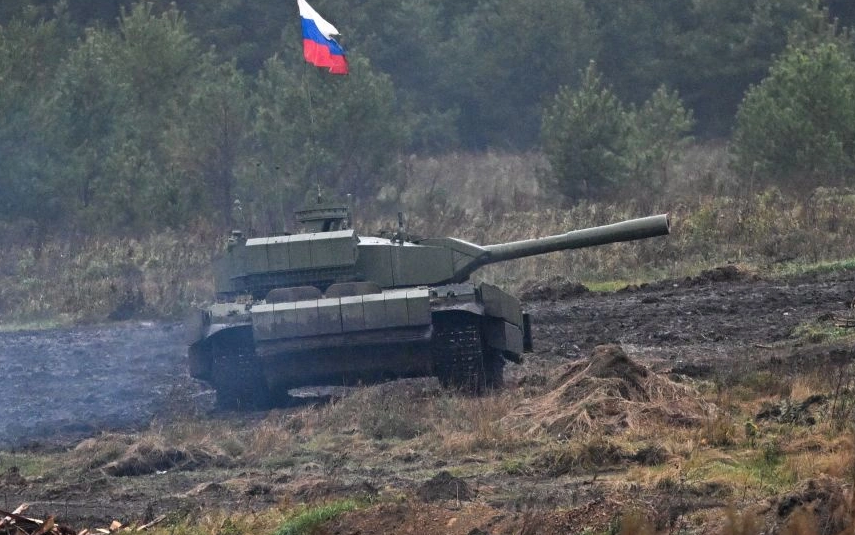
Russia used uncrewed tanks from its Shturm heavy robotic assault system to provide fire support to assault units during the main stage of the Tsentr-2026 strategic command-and-staff exercise, the Russian Defense Ministry said on October 2, 2026. President Vladimir Putin was shown the remotely operated vehicles, built on the T-72B3M main battle tank chassis, at the Chebarkul training range in the Chelyabinsk region, the first time the system has been publicly shown in a major exercise.
The appearance moves Shturm from factory trials into a doctrinal showcase. Uralvagonzavod began developing the system under a Ministry of Defense order around 2018, but the first images of a test vehicle only emerged in July 2025 at the company’s Nizhny Tagil plant. Deputy Defense Minister Army General Yunus-Bek Yevkurov told Putin that uncrewed tank fires were among the defining features of the Chebarkul phase, alongside mass drone use, ground robotic systems and counter-drone mobile fire teams. Tsentr-2026 ran across ten training ranges, with more than 6,000 personnel at Chebarkul alone.
Shturm Robotic Tank Armament, Protection and T-72B3M Chassis Details
According to the Defense Ministry, the vehicles shown at Chebarkul combine the T-72B3M hull with an uncrewed fighting compartment in two configurations: one with a tank-type turret and one carrying a combat module derived from the BMPT (Boyevaya Mashina Podderzhki Tankov), the tank support fighting vehicle commonly known as Terminator. Both retain crew stations, so the vehicles can be driven manually for road marches, recovery or if the remote link fails.
Publicly available specifications indicate that the gun-armed variant, identified in open-source reporting as Combat Vehicle No. 1, mounts a shortened 125 mm D-414 smoothbore with a 4,000 mm barrel, roughly L/32, fed by a 22-round autoloader and paired with a 7.62 mm PKTM coaxial machine gun. The short tube answers a specific Ministry of Defense requirement for unrestricted 360-degree turret rotation in narrow streets, where the T-72B3M’s full-length 2A46M-5 gun would foul on walls and debris. The trade is reduced muzzle velocity and long-range penetration, an acceptable cost for a vehicle intended to engage strongpoints at urban distances.
Protection is tailored to the same fight. Open-source reporting describes all-around armor against shoulder-fired anti-tank weapons, with the vehicle reportedly required to survive up to 15 hits from handheld grenade launchers, a figure not independently verified. A bulldozer blade clears rubble and barricades, and turret-mounted launchers can carry Shmel rocket flamethrowers or other short-range weapons. A variant armed with a 152 mm gun is reportedly in development.
The BMPT-type configuration has not been described in detail. Early program descriptions called for twin 30 mm 2A42 automatic cannons, a PKTM machine gun and Shmel launchers, but the Defense Ministry has not confirmed whether the module shown at Tsentr-2026 follows that layout.
Three Operators per Vehicle and a 3 km Control Radius
Shturm is remotely piloted, not autonomous. During the drills, operators steered the armored group from a dedicated control vehicle using joysticks, first-person view (FPV) headsets and tablets over a multichannel, jam-resistant data link, according to Rostec. Russian pro-government media reported that each combat vehicle required three operators, acting as commander, gunner and driver, seated in the control vehicle. The arrangement relocates the T-72’s three-person crew rather than eliminating it.
The control vehicle is itself a turretless T-72 or T-90 hull, and earlier Russian reporting put its control radius at about 3 km. Its crew therefore still operates near the line of contact under armor, where it presents a high-value target: disabling one control vehicle could idle every combat vehicle it commands. Rostec did not disclose the link’s frequency bands, bandwidth or latency. Open-source reports cite a maximum speed of 40 km/h under remote control.
The Defense Ministry said the control system duplicates its most vulnerable components and described the uncrewed tanks engaging targets from short halts before displacing to new firing positions, a tactic that limits exposure to return fire and loitering munitions. It published no data on link performance under heavy electronic warfare (EW), the primary threat to remotely operated systems in Ukraine, where both sides jam drones and ground robots daily. Precedent counsels caution: after the Uran-9 combat uncrewed ground vehicle (UGV) deployed to Syria in 2018, Russian military researchers acknowledged that operators lost control at 300 to 500 meters in built-up terrain.
Analysis: Shturm is a distinctly Russian answer to the drone-saturated battlefield. Instead of a purpose-built UGV, Uralvagonzavod has converted the most plentiful armored hull in the Russian inventory into an expendable breaching asset, accepting the logistics burden of a tank weighing more than 40 tonnes in exchange for protection that light robots cannot carry. The concept removes crews from the point of contact but keeps them within artillery and drone range, and it requires as many operators per gun as a conventional tank. For NATO planners, the signal is doctrinal: Moscow is integrating uncrewed direct fire into combined-arms assault groups at strategic-exercise level, and viability rests on whether the control link survives contested spectrum.
The Defense Ministry has not announced a serial production contract, a delivery schedule or the number of Shturm sets built. Open questions include whether the system will be sent to Ukraine for combat evaluation, the maturity of the 152 mm variant and whether Uralvagonzavod can spare capacity from T-72B3M and T-90M production for robotic conversions. Performance under live Ukrainian EW conditions, not range demonstrations, will decide whether Shturm reaches frontline units.