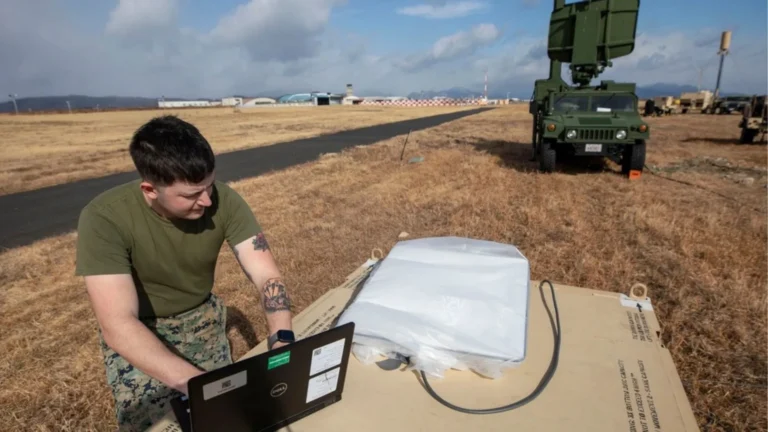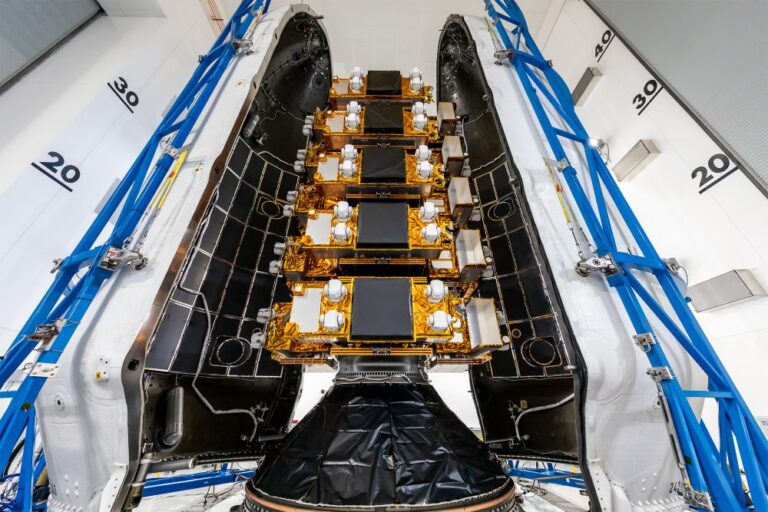
The U.S. Space Force’s Space Systems Command (SSC) has awarded Viasat an indefinite delivery/indefinite quantity (IDIQ) contract with a $450 million ceiling to support the design, fielding, sustainment and operations of the mission operations center (MOC) of the Space Data Network Backbone (SDN-B). SSC announced the award on November 5, 2026, in partnership with Golden Dome for America, and Viasat confirmed it on November 10, 2026. An initial $115 million task order funds development and scaling of the MOC and its associated network operations capability.
SDN-B is the backhaul data transport layer of the Space Force’s broader Space Data Network (SDN), the architecture intended to move sensor data to shooters worldwide across military and commercial satellites. Previously a joint Space Force and National Reconnaissance Office (NRO) effort known as MILNET, the program accelerated on May 26, 2026, when SSC awarded SpaceX a $2.29 billion Other Transaction Authority (OTA) agreement for a proliferated low Earth orbit (pLEO) constellation, with a fully operational prototype due by the end of 2027. The Viasat contract shifts the program from buying satellites to running them as one network.
Inside the SDN Backbone Mission Operations Center Contract
Under the contract, Viasat serves as network and mission system integration partner for the MOC, working under government direction. The company lists four lines of effort:
- Systems engineering and integration for the space-to-ground interface, supporting multi-orbit connectivity services.
- Enterprise network operations infrastructure to manage data transport in line with government-directed mission priorities.
- A common operational picture (COP) of network health, status and performance.
- Life-cycle engineering and sustainment, with future task orders addressing availability, resilience and cybersecurity requirements.
Functionally, the MOC is the orchestration layer of SDN-B. It integrates and manages participating connectivity services, routes and reroutes traffic across constellations operated by different vendors, and gives operators a shared view of network state. Lt. Col. Alexa Eggert, SDN-B materiel leader, has described the center as the step that matures the network into a fully operational, multi-vendor capability.
Guardians will operate the MOC, according to an SSC spokesperson. The service has not disclosed the facility’s location or manning, and says technical standards, interfaces, performance measures and future task order details are not releasable. The ceiling leaves $335 million beyond the initial task order for follow-on work.
Multi-Vendor Architecture: SpaceX, Space Exchange Points and the Transport Layer
The MOC exists because SDN-B is designed from the outset as a multi-vendor network. The SpaceX backbone, based on the company’s Starshield militarized derivative of Starlink, forms an optically interconnected mesh delivering worldwide tactical and broadband communications. Space Force budget documents indicate plans to buy 13 SDN satellites in fiscal 2026 and 21 in fiscal 2027.
On August 13, 2026, SSC brought five more companies into the architecture: Amazon LEO for Government, Lockheed Martin, Northrop Grumman, Rocket Lab and York Space Systems. Each received a $12 million package in two parts. A $10 million fixed-price contract with a six-to-nine-month period of performance covers prototyping and demonstrating ground-to-space and space-to-space data transport between vendor systems and the backbone. A $2 million OTA with a six-month period of performance seeds Space Exchange Point (SEP) satellites, spacecraft that act as orbital routers so that commercial networks and government satellites can connect directly to SDN-B.
The SEP effort draws on the Enterprise Space Terminal (EST) program, which developed optical terminals around a government-owned communications standard for links spanning low Earth orbit to geostationary orbit. SDN also incorporates the Space Development Agency’s (SDA) Transport Layer, for which SDA ordered 126 satellites in Tranche 1 alone. Eggert has described the MOC as the mission operations layer that integrates these separate transport and exchange efforts.
Golden Dome Requirements and Viasat’s Network Operations Track Record
Golden Dome, the Pentagon’s layered homeland defense initiative, integrates sensors, command and control, and defensive systems to detect, track and defeat advanced missile and aerial threats. Its kill chains depend on moving track data from space sensors to shooters, and the MOC is to provide real-time routing of that traffic according to mission priorities.
Viasat brings experience running large commercial networks, including its geostationary fleet and the Inmarsat fleet acquired in May 2023. Its government space work is also expanding: on May 22, 2026, SSC awarded the company a Protected Tactical SATCOM-Global (PTS-G) prime contract for one of the program’s first small, maneuverable geostationary satellites, carrying a dual-band X- and Ka-band payload, and in August Viasat selected Rocket Lab to build the spacecraft bus.
“The Space Data Network Backbone represents a critical leap forward toward a unified, highly resilient and interconnected military space architecture,” said Craig Miller, president of Viasat Government. “We are proud to support SSC as the network and mission system integration partner for the MOC effort.”
Analysis: The award shows the Space Force treating network operations, not satellite count, as the pacing item for Golden Dome connectivity. Assigning integration to a company other than SpaceX gives the government a structural check on single-vendor lock-in, easing concerns raised after SpaceX’s May award that one company would dominate the program, while keeping routing and prioritization under a government-operated center. It also concentrates risk: a single MOC managing traffic across every SDN-B constellation becomes a priority target for cyber and physical attack. Viasat knows that threat firsthand: the February 2022 cyberattack on its KA-SAT network, attributed by the United States, United Kingdom and European Union to Russia, exploited a misconfigured VPN appliance to issue management commands that left tens of thousands of terminals across Europe inoperable. How SSC hardens and distributes the MOC will matter as much as the constellations it controls.
SpaceX must field its operational prototype backbone by the end of 2027, and the five interconnectivity demonstrations awarded in August should conclude in the first half of 2027. The Space Force’s fiscal 2027 request seeks roughly $1.5 billion in SDN-B research and development, including $685 million to accelerate constellation growth and $800 million to onboard additional vendors, to be provided through a reconciliation package that remains subject to congressional action. Still unknown: where the MOC will sit, when it reaches initial operational capability, and how quickly further task orders draw down the remaining IDIQ ceiling.