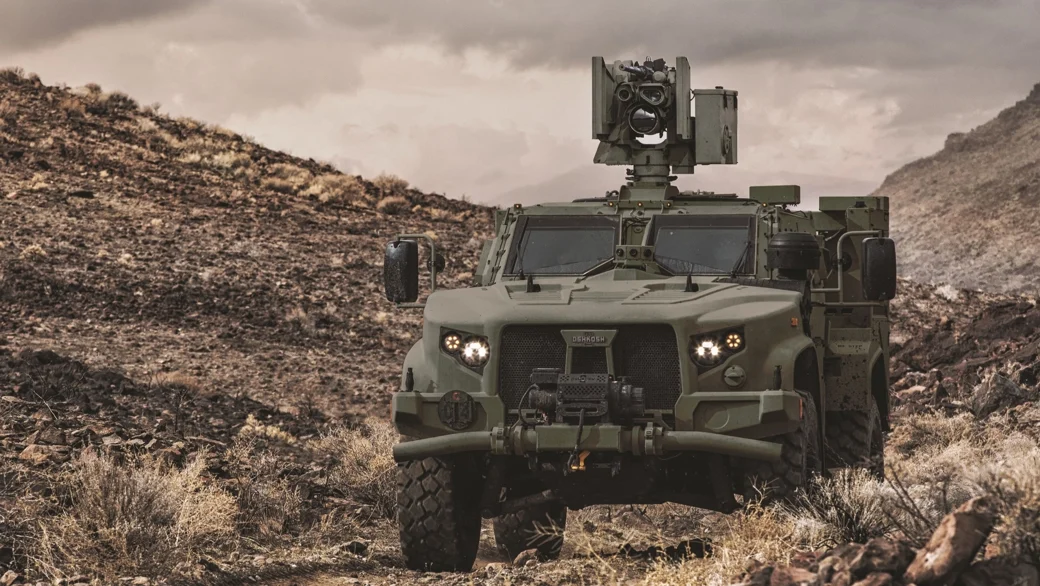
Kongsberg Gruppen ASA signed an agreement with Oshkosh Defense Europe B.V., announced September 29, 2026, to deliver PROTECTOR RS4 remote weapon stations (RWS) with counter-unmanned aerial system (CUAS) capability for the Royal Netherlands Armed Forces. The stations will be integrated on Oshkosh Joint Light Tactical Vehicles (JLTVs). Kongsberg did not disclose the contract value, quantity, or delivery schedule.
The order adds a vehicle-mounted tier to a Dutch counter-drone architecture that is expanding quickly. The Ministry of Defence contracted Kongsberg for National Advanced Surface-to-Air Missile System (NASAMS) air defense on November 21, 2024, and Rheinmetall Air Defence for Skyranger 30 on December 11, 2025, with deliveries in both programs beginning in 2028. A letter of intent with Electro Optic Systems (EOS) on the Apollo high-energy laser, reported September 28, 2026, has no disclosed quantity or timeline.
Kongsberg PROTECTOR RS4 Counter-UAS Package: Sensors, Effectors, and Open Items
Kongsberg describes the PROTECTOR RS4 as combat-proven and in service with 31 nations and allied forces. Publicly available specifications indicate it accepts 5.56 mm, 7.62 mm, and 12.7 mm machine guns and 40 mm grenade launchers, with an optional coaxial machine gun or anti-tank guided missile, and weighs 135 to 190 kilograms (298 to 419 pounds) depending on configuration, excluding weapon and ammunition. Its 2+2-axis Detached Line of Sight stabilization keeps the sight on target independently of weapon movement, which supports accurate fire from a moving vehicle.
PROTECTOR CUAS adds detection and cueing. Kongsberg says it combines sensors, targeting data, and effectors to detect, track, identify, and neutralize drones, and that it lets operators engage single drones and more complex threat scenarios. The release does not name the radar, the effectors, or the engagement ranges for the Dutch package. In September, Echodyne announced that Kongsberg had integrated its metamaterials electronically scanned array (MESA) radar with the RS4 and the up-gunned RS6. The radar supplies range, range-rate, and bearing data that cue the optical sensors and, with programmable airburst munitions, help time detonation along a drone’s flight path. Neither company has said whether the Dutch stations use that radar.
Oshkosh JLTV Payload Margin and the Unconfirmed Kaaiman DXPV Link
Publicly available specifications for the baseline JLTV indicate a 6.6-liter turbodiesel V8, a six-speed automatic transmission, independent suspension, a road speed of 70 mph (110 km/h), a range of about 300 miles (480 km), and payload of up to 2,300 kilograms (5,100 pounds) in the two-door configuration or 1,600 kilograms (3,500 pounds) in the four-door version. The RS4’s mass, before weapon and ammunition, is a small share of that payload. Pat Williams, chief programs officer at Oshkosh Defense, said the JLTV’s open architecture was intended to let the vehicle take on new technologies, such as PROTECTOR CUAS, quickly.
The host vehicle is not identified. The Netherlands signed an agreement on June 25, 2025 for 150 JLTV-derived Dutch Expeditionary Patrol Vehicles (DXPVs), known as Kaaiman, for the Royal Netherlands Marine Corps. Oshkosh announced a follow-on order valued at $25 million to $30 million in January 2026. Neither Kongsberg nor Oshkosh said the counter-drone stations will ride on those vehicles, and the release names the Royal Netherlands Armed Forces rather than a specific service.
Analysis: The order suggests the Dutch are pushing counter-drone protection down to the vehicle level rather than relying only on dedicated air defense systems. A weapon station on a general-purpose vehicle raises defensive density with a comparatively light installation, but it offers a narrower engagement envelope than Skyranger 30, which fires 30 mm AHEAD airburst rounds, and its effect depends on radar cueing and ammunition that Kongsberg has not specified. Kongsberg’s Dutch footprint now spans NASAMS, a separate contract to link Skyranger 30 into its command and control network, and a vehicle-mounted effector. Poland’s SAN program, signed January 30, 2026 and worth about NOK 16 billion to Kongsberg for 18 counter-UAS batteries, shows the PROTECTOR family anchoring a national counter-drone network elsewhere in NATO.
The next markers are disclosure of the contract value and quantity, confirmation of the radar and effector fit, and a delivery schedule, none of which Kongsberg or Oshkosh has published. The Ministry of Defence must also decide whether Apollo advances beyond a letter of intent. Skyranger 30 and NASAMS deliveries begin in 2028, so the fielding date of the JLTV-mounted stations will show whether they serve as an interim layer or a permanent one.