The U.S. Army has introduced a .50 caliber reduced range ammunition (RRA) family designed to destabilize in flight and land at less than half the distance of standard ball, the Combat Capabilities Development Command (DEVCOM) Armaments Center announced at Picatinny Arsenal, New Jersey, on November 18, 2026. Developed with the Portfolio Acquisition Executive for Agile Sustainment and Ammunition, the family comprises the M1181 ball and M1199 tracer cartridges, which share a matched trajectory at standard training distances.
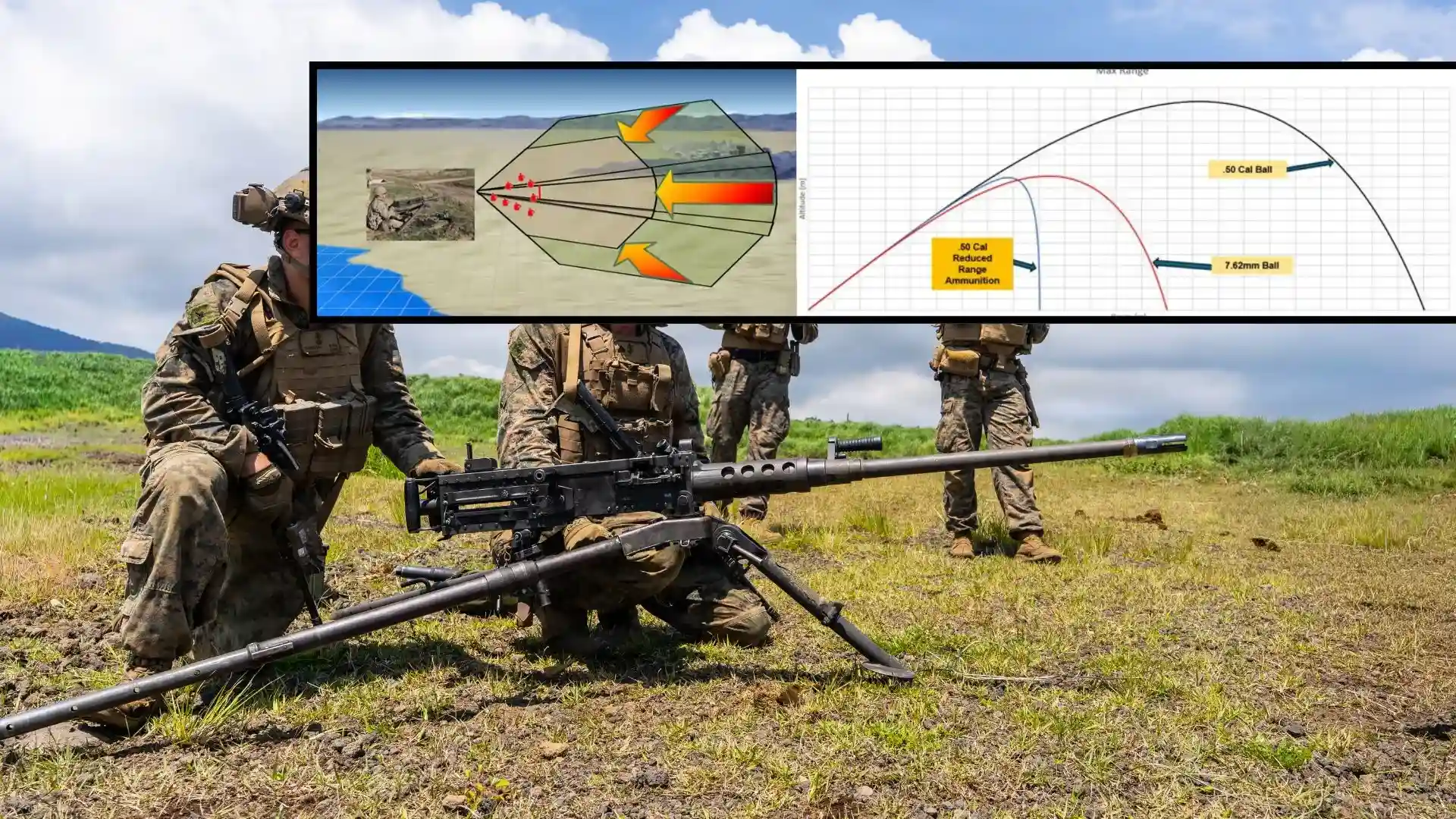
The round targets a core constraint on heavy machine gun training: the surface danger zone (SDZ), the fan-shaped area downrange where a projectile or ricochet can endanger people. Standard 12.7×99 mm ammunition fired from the M2A1 requires an SDZ that not every range can provide, which can force units to travel to distant ranges at the cost of transportation, planning effort, and schedule disruption. According to Kip Hess, the Armaments Center’s small caliber munitions competency manager, the requirement originated during the Global War on Terror, when the priority was simulating convoy live fire for soldiers certifying for deployment.
How .50 Caliber Reduced Range Ammunition Destabilizes in Flight
The M1181 and M1199 rely mainly on projectile geometry to cut their range. The bullet is shaped to become aerodynamically unstable as it slows toward Mach 1, roughly 741 mph (1,190 km/h). At that point drag rises sharply, the projectile loses spin stability and energy, and it falls to the ground well short of a standard round’s impact area.
The Army solicited industry for design candidates and selected a submission from General Dynamics Ordnance and Tactical Systems (GD-OTS). The Armaments Center then ran ballistic testing, reliability trials, user evaluations, and tracer performance assessments before the design was judged to meet Army requirements. The service has not published a maximum range for the M1181. GD-OTS product literature for its .50 caliber RRA lists a maximum range of 3,500 meters and a trajectory match within 1 mil of M33 ball out to 800 meters. For comparison, a 2012 Naval Surface Warfare Center Crane briefing put the M33’s maximum range at 6,500 meters.
The Army also drew a line between RRA and the older M858 and M860 (A602) short range training ammunition. Kevin O’Connor of the Warfighter Ammunition Information Program noted that those rounds have a dramatically shorter range and are not ballistically matched to the M33 ball and M17 tracer combat cartridges.
Smaller Danger Zones Open 7.62 mm Ranges to M2A1 Gunnery
The practical payoff is range access. A reduced SDZ lets units fire the M2A1 on ranges sized for 7.62 mm ammunition, which are more common. Adjacent ranges that were previously restricted because a .50 caliber SDZ overlapped them can now be used simultaneously, and crews can rehearse firing from moving platforms in training areas once too small for heavy machine gun live fire. The M2A1 adds a quick-change barrel with fixed headspace and timing to the earlier M2 design, according to the Army, and fires at a cyclic rate of 450 to 600 rounds per minute, according to GD-OTS specifications.
Unit feedback cited by the Army describes a gentle learning curve, easier weapon configuration, and a near drop-in replacement for current training rounds. The Navy and Marine Corps moved first: by 2012 both services had qualified GD-OTS .50 caliber reduced range ball and tracer cartridges as the MK 322 Mod 0 and MK 321 Mod 0, fired from unmodified M2HB guns, according to the NSWC Crane briefing.
The same aeroballistic approach now spans 6.8 mm and 7.62 mm, with ball and tracer variants in both calibers that can be linked for belt-fed weapons such as the 7.62 mm M240 and the new 6.8 mm M250 automatic rifle. Alpha Tang, the Armaments Center project officer for 7.62 mm and .50 caliber RRA, said building awareness among units, planners, and installation staff is the next milestone, since many remain unfamiliar with the round.
Analysis: The M1181 and M1199 address a throughput problem more than a technology gap. Every training cycle lost to range scheduling or transport erodes mounted gunnery proficiency. By shifting .50 caliber live fire onto common 7.62 mm infrastructure, the Army effectively expands its usable range inventory without new construction. A complete RRA family across 6.8 mm, 7.62 mm, and .50 caliber also keeps training ammunition aligned with the Next Generation Squad Weapon transition. The counter-drone angle deserves caution: Hess said the potential to engage small drones at close range without long-range spillover is still being tested, even as the Army seeks $994 million for counter-small unmanned aircraft system procurement in its fiscal 2027 request.
Key unknowns remain. The Army has not disclosed procurement quantities, unit cost, contract value, or a fielding schedule for the M1181 and M1199, nor whether installation range regulations will be updated with RRA-specific SDZ templates. Those decisions, along with results from counter-drone testing, will determine how quickly units can exploit the new cartridge. Hess framed the goal as a “transparent, drop-in replacement” that gives soldiers more time in realistic training scenarios.