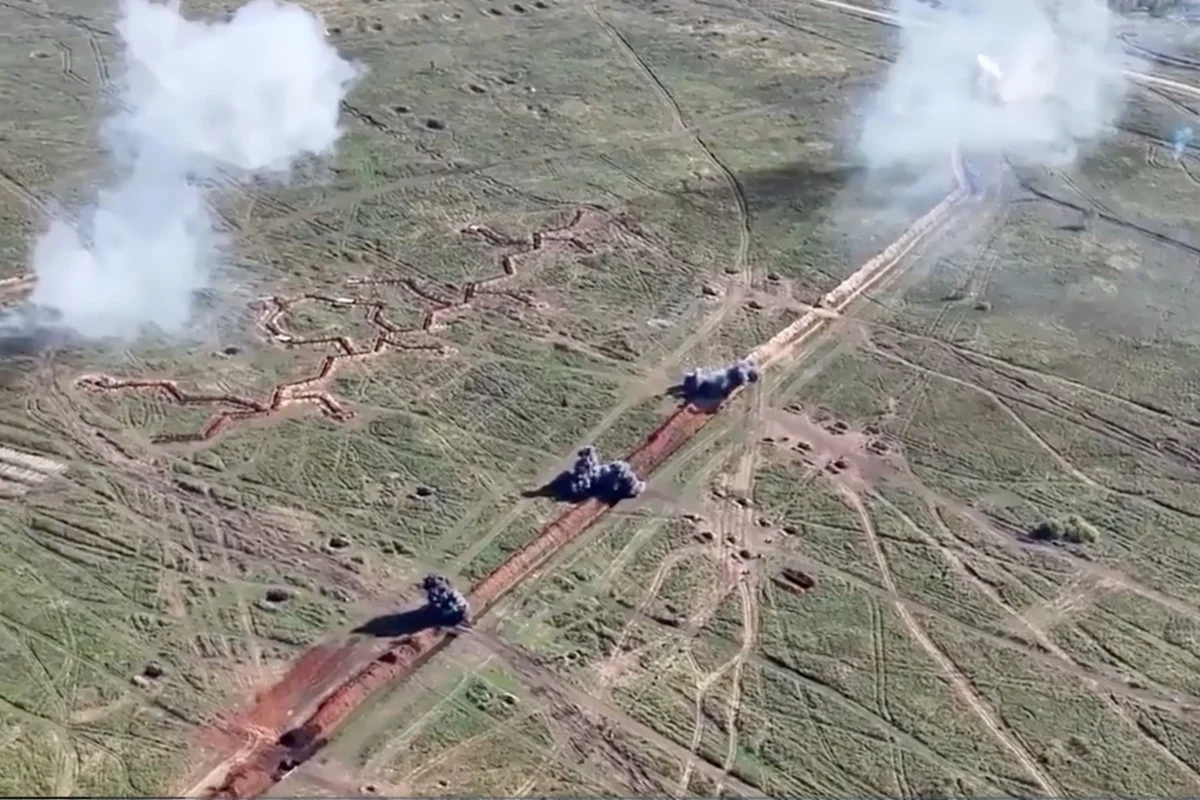
Units of China’s People’s Liberation Army (PLA) fought on the flank of a Russian-led coalition during Tsentr-2026, Russia’s strategic command-and-staff exercise, which ended on October 3, 2026. During the main stage on October 2 at the Chebarkul training ground in the Chelyabinsk region, PLA tanks and combat vehicles with artillery support finished off a retreating enemy force while covering the advance of Russian motorized rifle and tank assault groups, according to the Russian Defense Ministry.
Tsentr-2026 ran from September 28 alongside Interaction-2026, a command post exercise of the Collective Security Treaty Organization (CSTO). The Kremlin put participation at more than 47,000 personnel, with seven foreign states contributing contingents and 51 countries sending observers. The PLA has joined Russia’s rotating strategic exercises since Vostok-2018, when it sent about 3,200 personnel. Tsentr-2019, which drew roughly 128,000 personnel by Russian count, was framed around counterterrorism. This year’s scenario, built on combat lessons from Ukraine, centered on repelling conventional aggression in what Moscow calls the Central Asian strategic direction.
Tsentr-2026 Exercise Scenario: Counteroffensive and a Cross-Border Security Zone
Russian figures put the Chebarkul force at more than 6,000 personnel: 4,600 Russian and 1,479 foreign troops, including 634 from the CSTO Collective Rapid Reaction Force. Deputy Defense Minister Army General Yunus-Bek Yevkurov described the battle formation to President Vladimir Putin: Tajik and Mongolian units on the right flank with the rapid reaction force, Russian troops and a Belarusian unit in the center, and the PLA alongside Pakistani and Kyrgyz forces on the left. Kazakhstan and the Republic of the Congo sent operational groups. India, which fielded troops at Tsentr-2019, was absent from the contingents Moscow named.
The Chinese contingent came from the PLA Central Theater Command and reached Chebarkul by road, rail and air. The PLA’s official newspaper said Chinese personnel worked at every level, from scenario design and operational command to field training. Training focused on reconnaissance, command and control, fire strikes and comprehensive support. Neither Beijing nor Moscow has disclosed the contingent’s size.
The scenario went well beyond static defense. Yevkurov reported that after absorbing an opening assault, coalition forces launched a large-scale counteroffensive and, from October 2, rehearsed retaking seized territory and establishing a “security zone” on the adjacent territory of the opposing state. Four Russian long-range bombers simulated strikes on enemy critical infrastructure, according to Russian defense briefings. The buffer-zone logic mirrors language Moscow has applied to Ukrainian border regions. Field drills spanned ten training grounds plus the Caspian Sea, Yevkurov said. Putin observed the final stage at Chebarkul on October 2 and met foreign military attachés.
Type 99A Tanks, Arena-M and Ground Robots: Drone-Era Lessons at Chebarkul
Imagery released by PLA official media showed Type 99A main battle tanks with the Chinese contingent. Publicly available specifications indicate the Type 99A, also designated ZTZ-99A, mounts a 125 mm smoothbore gun with an autoloader and a 1,500 hp diesel engine in a vehicle of roughly 55 tonnes. The PLA brought its established frontline tank, not the networked ZTZ-99B unveiled at the September 3, 2025, Beijing parade, whose data-sharing links are designed to work with the Type 100 family, according to open-source assessments. PLA media said unmanned equipment featured prominently but did not identify specific systems.
Yevkurov listed the hallmarks of the Chebarkul phase: massed drones operating with ground robotic systems, breaching lanes driven through underground utility tunnels to penetrate deep into enemy defenses, mobile fire teams and counter-drone modules, and uncrewed tanks used for fire missions. Russian state media said several new ground robotic systems were tested. Each element reflects adaptations Russian units have made under persistent drone surveillance in Ukraine.
In a staged attack on a tank column, a T-90M used its Arena-M active protection system to destroy first-person-view (FPV) and fixed-wing drones. Russia says Arena-M gained a dedicated counter-drone mode in 2025, but its known configuration carries only 12 interceptor munitions, a ceiling saturation attacks can exhaust. Russia also showed a Pantsir-S1M air defense system on a Belarusian MZKT-7930-312 chassis, the first official confirmation of that pairing. Publicly available specifications indicate the Pantsir family pairs two 30 mm autocannons with 12 surface-to-air missiles, a short-range layer aimed at drones, cruise missiles and low-flying aircraft. China has displayed its own GL-6 active protection system, though fielding across the Type 99A fleet remains unconfirmed.
Analysis: For Beijing, the return lies less in hardware than in access. Tsentr-2026 placed PLA officers inside the planning and command of a coalition offensive scripted around Russia’s Ukraine experience: drone-saturated airspace, robotic breaching and hard-kill defense on tanks. The PLA has not fought a major war since 1979; this is the closest it can come to absorbing those lessons without combat. The shift from counterterrorism in 2019 to a cross-border counteroffensive in 2026 signals rising ambition in Sino-Russian training, even if the PLA’s role stayed supporting and Moscow’s declared force shrank to about a third of 2019 levels.
Chinese troops began withdrawing from Chebarkul by air and rail after the drills. The contingent’s size, parent brigade and unmanned systems remain undisclosed. Indicators to watch include PLA after-action reporting, further PLA-Pakistani integration in Russian drills, and whether Beijing hosts a reciprocal strategic exercise, as it did with Zapad/Interaction-2021 in Ningxia.