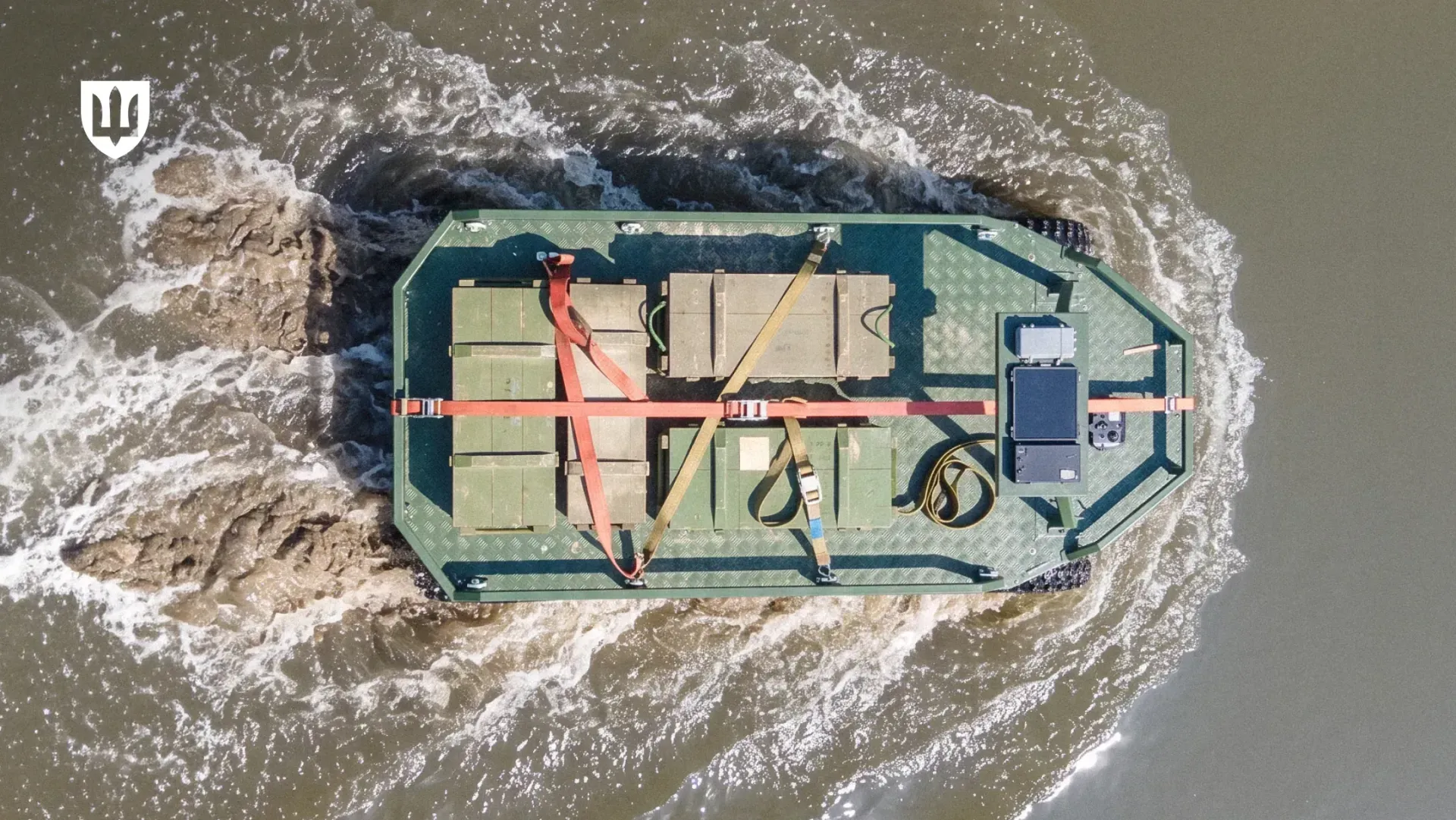
Ukrainian troops have completed a front-line logistics mission with a domestically developed amphibious unmanned ground vehicle (UGV), moving ammunition and provisions more than 40 km across land and water to forward positions, Ukraine’s Ministry of Defence announced on September 29, 2026. The ministry described the operation as the first logistics mission conducted with an amphibious UGV by the Armed Forces of Ukraine.
The ministry attributed the mission to one of the army’s separate mechanized brigades without naming it. Brave1, the government-backed defense innovation cluster that financed the system’s development, identified the operators as the Alter Ego ground robotics unit of the 93rd Separate Mechanized Brigade “Kholodnyi Yar.” The mission lands as UGVs shift from niche capability to routine sustainment tool: Ukrainian units logged about 112,000 UGV logistics and evacuation missions between January and early September 2026, according to DELTA combat system data released by the ministry.
Amphibious UGV Mission Profile: 40 km Across Land and Water
Water obstacles remain one of the hardest problems in front-line sustainment. Rivers, canals, and marshland can slow or block conventional wheeled and tracked UGVs, pushing resupply onto a limited number of bridges, fords, and dams that adversary reconnaissance drones can watch continuously. Aerial delivery, the ministry noted, is not always the optimal alternative either.
According to the ministry, the amphibious UGV retains the cross-country mobility of a conventional ground robot on land and can transition into water within seconds, then continue moving. A single platform can therefore complete a mixed route that would otherwise require a vehicle change, a cargo transfer at the bank, or a long detour. Developers refined the system over several months in close cooperation with the military, adapting it to real mission profiles, combat feedback, and the terrain of the brigade’s sector.
Key specifications remain undisclosed. The ministry has not named the developer or released payload capacity, water speed, propulsion method afloat, endurance, or the control architecture used to hold the datalink across open water. It also did not specify how much of the 40 km route was waterborne. For reference, the ministry has previously stated that Ukrainian logistics UGVs typically carry 200 to 300 kg under fire.
Ukraine has codified an amphibious ground robot before. In April 2025, the ministry adopted the UNEX UGV, a remote-controlled armored platform on a specialized wide-tire chassis whose ground pressure is lower than that of an infantryman’s foot, reducing the risk of triggering anti-vehicle mines. The UNEX features an electronic warfare-resistant radio control system, a programmable autopilot, and configurations for logistics, evacuation, demining, a weapon station, or an electronic warfare payload. The ministry has not indicated whether the vehicle used in September is a UNEX derivative or a separate design.
Brave1 Grants and DELTA Data Show Ukraine Scaling Ground Robot Logistics
The amphibious effort sits inside a broader industrial push. Brave1 grant funding carried the system from prototype to operational use, and in June 2026 the cluster introduced a dedicated “Amphibious UGVs” track in its updated grant program. Since 2023, Brave1 has disbursed UAH 6.2 billion across more than 1,000 grants, with 199 awarded to UGV developers, second only to unmanned aerial systems at 215, according to the ministry. By April 2025, the ministry had already codified nearly 80 domestically produced ground robotic complexes for assault, reconnaissance, mine-laying, demining, logistics, and evacuation roles.
Operational demand is rising in parallel. DELTA data show monthly UGV logistics and evacuation missions climbing from 7,511 in January to 25,143 in August 2026, a 3.3-fold increase. Every month recorded growth, and the sharpest jump came between July and August, when missions rose by more than 5,000. At that pace, Ukrainian ground robots are completing roughly 800 logistics and evacuation missions per day across the front.
The numbers reflect a doctrinal shift in which UGVs absorb the most lethal segment of the supply chain: the final kilometers into positions covered by first-person-view (FPV) drones, artillery, and mines, where every crewed run puts soldiers at risk. Units can also order ground robots directly through the ePoints program on the Brave1 Market marketplace, and troops had ordered almost UAH 1.9 billion worth of UGVs through that channel by mid-2026, per ministry figures. The Defence Procurement Agency DOT has meanwhile opened its first UGV tender built on ministry-defined tactical and technical specifications, a step toward more standardized purchasing.
Analysis: The operational value of an amphibious UGV lies less in crossing water than in route choice. Where rivers and wetlands funnel logistics through predictable crossing points, those chokepoints become priority targets for Russian reconnaissance and FPV strike teams. A robot that can enter the water at almost any point along a bank multiplies viable routes and complicates the adversary’s surveillance problem. The trade-off is exposure: a vehicle afloat is typically slower, loses terrain masking, and stands out visually and thermally against the water surface. Whether amphibious UGVs scale beyond a single brigade will depend on survivability data the ministry has not yet published and on whether unit costs stay close to those of conventional logistics robots.
The next milestones are confirmation of the platform’s codification status, identification of its manufacturer, and adoption by brigades beyond the 93rd. Open questions include whether the 40 km run reflects a repeatable operating radius or a single route, and how the vehicle performs as autumn flooding and winter ice reshape water obstacles along the front.