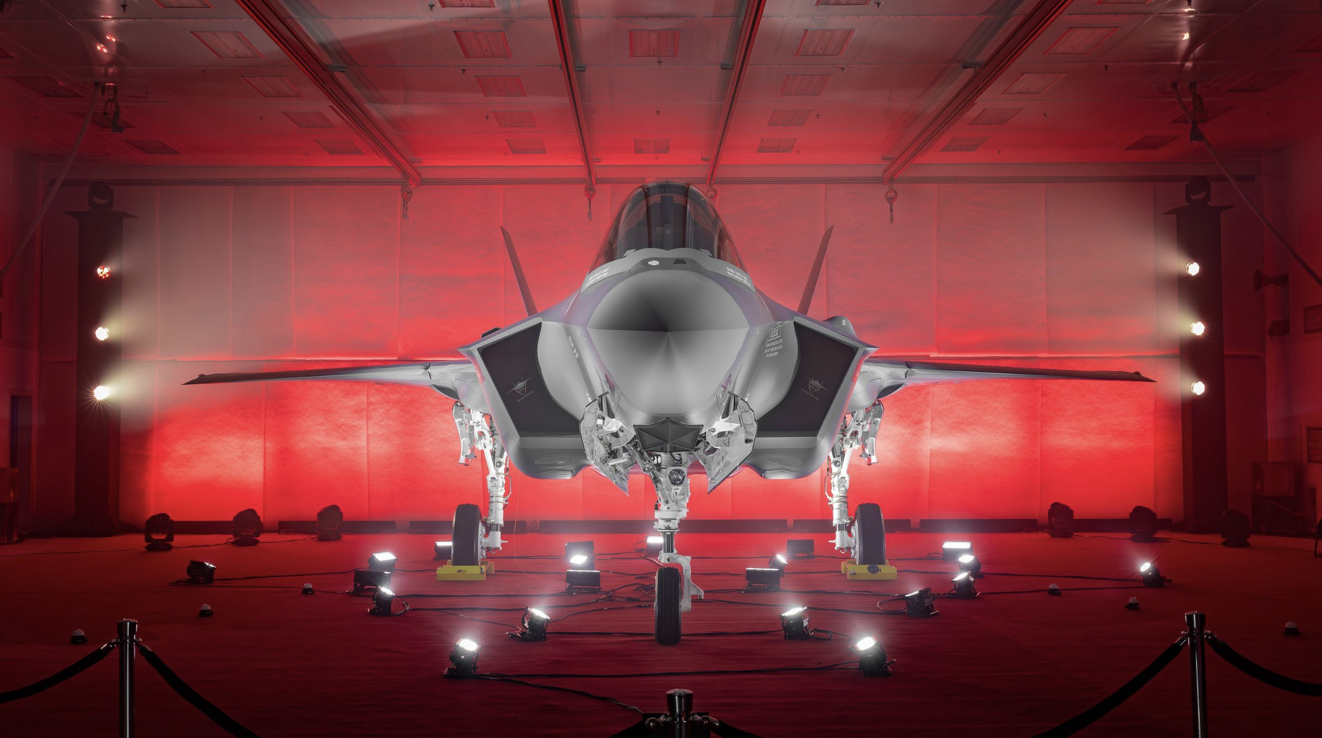
Poland’s ninth F-35A Lightning II, the first Polish stealth fighter assembled outside the United States, landed at the 32nd Tactical Air Base in Łask-Buczek on October 1, 2026. Deputy Prime Minister and Minister of National Defence Władysław Kosiniak-Kamysz announced the arrival of the jet, manufacturer number AZ-17 and registration 3517, built at the Final Assembly and Check-Out (FACO) facility in Cameri, Italy, operated by Leonardo.
Kosiniak-Kamysz called deliveries of the “Husarz” aircraft “a key element in building the capabilities of our Air Force,” adding that fifth-generation jets enhance reconnaissance, strike and cooperation with NATO allies and that “deliveries are proceeding according to plan.”
Warsaw signed a $4.6 billion Letter of Offer and Acceptance for 32 F-35As on January 31, 2020, to replace its Soviet-era MiG-29 and Su-22 fleets. Production is split evenly between Lockheed Martin’s Fort Worth, Texas, plant and Cameri. The first three Fort Worth jets, AZ-09 to AZ-11, reached Łask on May 22, 2026, after the base was certified for F-35 operations on March 10, and formally entered service on June 12. Five more, AZ-12 to AZ-16, followed on August 28. AZ-17 brings Poland’s deliveries to 17 aircraft; AZ-01 to AZ-08 remain at Ebbing Air National Guard Base in Fort Smith, Arkansas, as training aircraft until the third quarter of 2027.
How Cameri Builds the Second Half of the Poland F-35 Order
Cameri, in the Piedmont region’s Novara province, is owned by the Italian Ministry of Defence and operated by Leonardo with Lockheed Martin. It is the only F-35 final assembly line in Europe and one of two outside the United States, alongside Mitsubishi Heavy Industries’ line in Nagoya, Japan. The site has delivered F-35s to Italy and the Netherlands, produces F-35A wing assemblies and serves as Europe’s designated hub for F-35 airframe maintenance, repair, overhaul and upgrade work.
Poland’s General Staff released images of AZ-17’s forward fuselage when final assembly began on June 13, 2025, and the aircraft made its first flight from the airfield adjoining the FACO on July 22, 2026. The second Italian-built jet, AZ-18, registration 3518, flew on September 15, 2026.
Aircraft AZ-17 through AZ-32 are earmarked for a second F-35 squadron at the 21st Tactical Air Base in Świdwin, in northwestern Poland, where the General Command has reported ten infrastructure projects under way, with completion planned for early 2027. Building that squadron’s jets in Italy also puts them a short ferry flight from Europe’s F-35 airframe depot, rather than a transatlantic crossing with a refueling stop in the Azores, the route the Fort Worth aircraft flew.
F-35A Husarz Sensors, Propulsion and TR-3 Configuration
Publicly available specifications indicate the F-35A is powered by a single Pratt & Whitney F135-PW-100 turbofan rated at about 43,000 pounds of thrust in afterburner, giving a top speed of Mach 1.6 and a combat radius exceeding 590 nautical miles (1,093 km) on 18,250 pounds (8,278 kg) of internal fuel. In low-observable configuration, the internal bays carry four weapons, typically two AIM-120 Advanced Medium-Range Air-to-Air Missiles and two 2,000-pound-class munitions, while a 25 mm GAU-22/A four-barrel cannon carries 180 rounds.
Combat value rests on sensor fusion. The Northrop Grumman AN/APG-81 active electronically scanned array radar, the AN/AAQ-40 Electro-Optical Targeting System, six AN/AAQ-37 Distributed Aperture System infrared sensors with spherical coverage and the BAE Systems AN/ASQ-239 electronic warfare suite feed a single tactical picture. Shared between F-35s over the Multifunction Advanced Data Link and with legacy fighters over Link 16, that picture lets the Husarz act as a forward sensor node for Poland’s 48 F-16C/D Block 52+ fighters, the reconnaissance and cooperation role Kosiniak-Kamysz highlighted.
Polish jets are delivered in the Technology Refresh 3 (TR-3) configuration, which adds a new integrated core processor, a panoramic cockpit display and expanded memory, and forms the hardware basis for Block 4 sensor, electronic warfare and weapons upgrades. TR-3 ran years behind schedule across the global fleet, and the Ministry of National Defence has not disclosed which software increment the Polish aircraft currently fly or when they will be cleared for full combat employment.
From 14 Jets in 2026 to Świdwin Readiness in 2032
By December 31, 2026, 14 F-35As are expected to be stationed in Poland, six of them from Cameri. Twelve more, including the eight training jets now in Arkansas, are scheduled to arrive in 2027, with deliveries due for completion in 2029. On July 10, 2026, the Ministry of National Defence reported that Polish pilots had become the first foreign users to complete the full F-35A training cycle at Ebbing, and the General Command planned to start in-country training in September 2026.
The General Command’s published timeline sets initial operational capability (IOC) for the Łask squadron in 2027 and full operational capability (FOC) in 2030. The Świdwin squadron is to reach initial readiness in 2030 and FOC in 2032.
The Armed Forces Development Program for 2025-2039 includes an option for 32 more aircraft, which would raise the fleet to 64 jets in four squadrons. A $4 billion US Foreign Military Financing loan granted on September 9, 2026, could fund part of that buy; no contract has been signed.
Analysis: AZ-17 matters less as a ninth tail number than as evidence that the F-35 enterprise’s European line can feed an eastern-flank customer on the timeline Warsaw set. With 17 of 32 airframes delivered, Poland’s constraint is shifting from production to absorption: combat-cleared TR-3 software, weapons stocks, pilot and maintainer throughput, and Świdwin’s infrastructure. Those factors, not delivery counts, will decide when NATO planners can treat the Husarz fleet as a combat-ready fifth-generation force on the alliance’s eastern flank.
Five more Cameri-built aircraft are due in Poland before the end of 2026. The next decision points are completion of Świdwin’s infrastructure in early 2027, the return of AZ-01 to AZ-08 from Arkansas, the Łask IOC declaration later that year and any contract for a second 32-aircraft batch. The software standard the fleet will carry at IOC remains undisclosed.