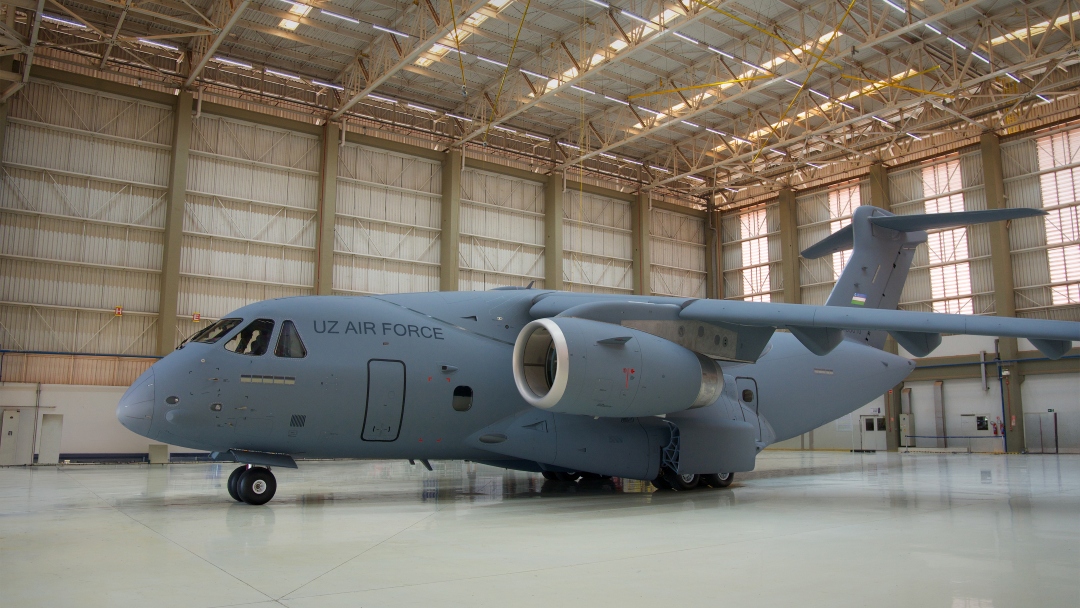
Embraer delivered the first C-390 Millennium multi-mission transport aircraft to the Uzbekistan Air Force on September 25, 2026, at the company’s Gavião Peixoto facility in Brazil. The handover, attended by Air Force Commander Major General Akhmad Jamolovich Burkhonov, makes Uzbekistan the first C-390 operator in Central Asia, according to the manufacturer. The aircraft, registered UK 39010, is the first of two ordered under a contract that also covers training, support, and spare parts.
The deal dates to December 27, 2024, when Embraer announced a two-aircraft order from an undisclosed customer. The company named Uzbekistan as the buyer only at the Singapore Airshow on February 3, 2026, and presented the first aircraft in Uzbek markings on September 10. For Tashkent, the order is small but targets a transport fleet still dominated by Soviet-era types.
Uzbekistan C-390 Specifications and the Airlift Gap It Fills
The C-390 is a high-wing, T-tailed twin-jet airlifter with fly-by-wire flight controls, powered by two International Aero Engines V2500-E5 turbofans rated at 31,330 lbf of takeoff thrust each. The engine belongs to the V2500 family flown on thousands of Airbus A320-series airliners, which gives a small operator access to a global commercial overhaul network rather than a bespoke military supply chain.
Embraer rates the aircraft at 26 metric tons of concentrated payload, or 23 tons distributed, with a maximum cruise speed of 470 KTAS (Mach 0.80) and a 36,000 ft ceiling. Published range figures are 1,080 nm with 26 tons, 1,470 nm with 23 tons, and 3,370 nm in ferry configuration, rising to 4,570 nm with internal tanks. The hold measures 18.50 m including the ramp, 3.45 m wide and 2.95 m high, for 169 cubic meters, and seats up to 80 troops or 66 paratroopers, or carries 74 litters.
Those figures matter against the fleet Uzbekistan already flies. Open-source inventory data list roughly three Ilyushin Il-76MD heavy transports, two Antonov An-12s, four An-26s, and four Airbus C295W turboprops. Publicly available specifications put the C295W near 9 tons of payload and the An-12 near 20 tons, both at turboprop cruise speeds well below the C-390’s. The Brazilian jet therefore slots between the C295W and the roughly 47-ton Il-76MD, and a Tashkent-to-Nukus leg of about 800 km sits well inside its range at maximum payload.
Embraer said in February that the Uzbek Air Force intends to use the aircraft primarily for transport and humanitarian missions. A quick-install kit lets the airframe operate as a tanker or receiver in KC-390 configuration, but neither party has disclosed whether the Uzbek contract includes refueling equipment, a defensive aids suite, or ballistic protection.
How Brazil’s Order Cut Freed a C-390 Millennium for Uzbekistan
Production records tracked by aviation observers show the delivered airframe, manufacturer serial number 39000019, was originally allocated to the Brazilian Air Force as FAB 2861 before being completed for Uzbekistan. It first flew on August 6, 2026, under the test registration PT-CYQ. Embraer’s delivery announcement does not mention the airframe’s history.
The reassignment traces back to Brazil’s program restructuring. Brasília ordered 28 KC-390s in 2014, cut the commitment to 22 aircraft in 2022, and reduced it again to 19 in November 2023, with deliveries stretched through 2034. Those cuts opened positions in the Gavião Peixoto production sequence just as export demand began to build. The United Arab Emirates signed in May 2026 for 10 aircraft with options on 10 more, the largest C-390 order to date, and Colombia announced its KC-390 acquisition in August.
The schedule reflects it. Twenty-one months separated contract signature from first delivery, a window that also had to absorb crew conversion, maintenance certification, and a spares pipeline before the aircraft can generate sorties at home. Embraer bundled all three into the contract package, which matters for an air force with no prior Embraer military transport experience.
Uzbekistan now joins Brazil, Portugal, Hungary, the Republic of Korea, the Netherlands, Austria, the Czech Republic, Sweden, the UAE, Slovakia, Colombia, and Lithuania on Embraer’s list of nations that have selected the aircraft. Only a subset of those customers have taken deliveries so far, and each new operator enlarges the shared spares and training pool on which small fleets depend.
Analysis: The purchase fits a pattern Tashkent has followed since suspending its Collective Security Treaty Organization membership in 2012: keep Soviet-era fleets flying while layering in non-Russian platforms, from C295W transports to Airbus H215M helicopters. Airlift makes the shift sharper. Tashkent’s aviation plant built Il-76s for decades, yet sustaining An-12 and An-26 fleets now depends on parts and overhaul networks in Russia and Ukraine, both disrupted by war since 2022. A Brazilian jet on a commercial engine gives Uzbekistan a supplier outside both Russian and NATO procurement frameworks. For Embraer, UK 39010 creates a reference operator in a region where Kazakhstan chose the Airbus A400M in 2021 and where other airlift recapitalization decisions remain open.
Embraer has not disclosed when the second aircraft will deliver, or when UK 39010 will ferry to Uzbekistan and reach initial operational capability; the training pipeline under the support package will set that pace. Open questions remain on the Uzbek mission configuration and on whether Tashkent expands a two-aircraft buy into a larger fleet as its Il-76MD and An-12 airframes age.